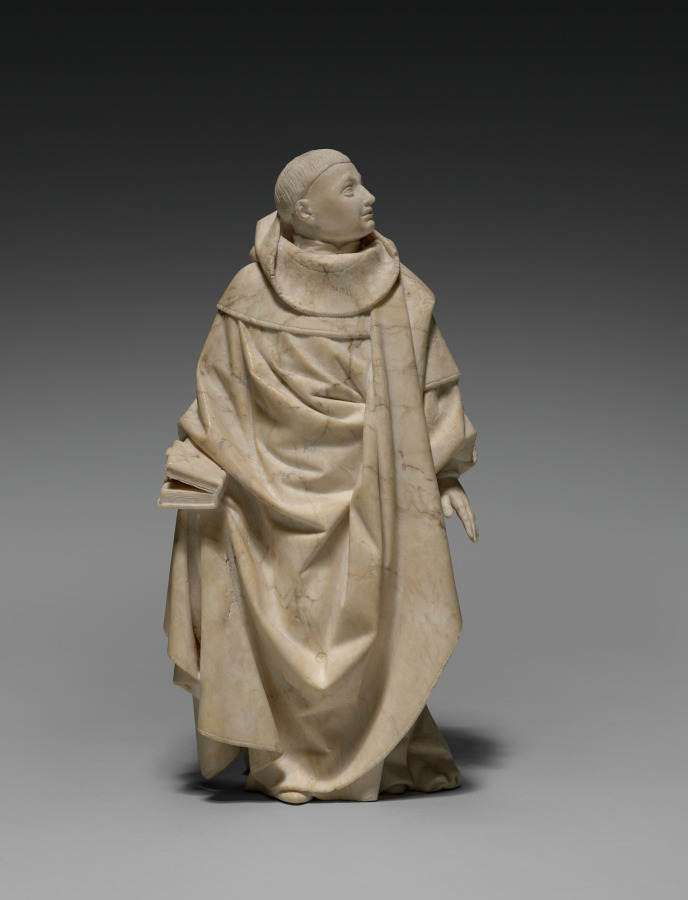
Urban Form: Mourner from the Tomb of John the Fearless and Margaret of Bavaria
Executive Summary: The Geometry of Transcendence
This analysis deconstructs the formal and chromatic DNA of the Mourner from the Tomb of John the Fearless and Margaret of Bavaria, cross-referenced with the dual sculptural paradigms of the Bodhisattva and the Amulet in the Form of a Seated Figure with Bovine Head. The objective is to extract a rigorous, urban-ready silhouette vocabulary for the 2026 NYC executive. The Mourner figure, a pleated, hooded form from early 15th-century Burgundian funerary art, embodies a state of controlled grief—a vertical compression of emotion into architectural fabric. When synthesized with the Bodhisattva’s “perfect harmony” and the Amulet’s “composite majesty,” we derive a three-part formal thesis: containment, transcendence, and protective power. The resulting wardrobe is not about expression, but about presence through absence—a minimalist system of volumetric restraint and chromatic severity.
I. Form: The Architecture of Mourning and Manifestation
A. The Mourner’s Silhouette: Vertical Compression
The Mourner figure is a study in negative space. The body is entirely subsumed by a heavy, hooded mantle that falls in deep, parallel pleats from the crown to the ground. The face is partially obscured, the hands hidden. This is not a silhouette of action, but of reception. The form is a vertical cylinder, its only articulation being the rhythmic, gravity-driven folds. For the 2026 executive, this translates to the power of the unbroken line. The key technical takeaway is the elimination of horizontal interruption. No lapels, no belts, no pockets that break the vertical flow. The garment becomes a monolithic column of fabric, suggesting immovability and depth of focus. The hem must fall precisely to the floor or the ankle bone, creating a continuous visual axis from crown to ground. This is the “mourning suit”—a single-piece outer shell in a dense, matte wool or bonded jersey, designed to absorb light and attention.
B. The Bodhisattva’s Form: Harmonious Asymmetry
In contrast to the Mourner’s rigid verticality, the Bodhisattva introduces fluid, calculated asymmetry. The drapery is not static; it flows in sinuous, rhythmic curves that suggest inner stillness through outer movement. The “perfect harmony” is achieved through a golden-ratio distribution of volume: one shoulder bare, the other draped; one hand raised in a gesture of teaching, the other resting. For the executive wardrobe, this informs the asymmetric top or one-shoulder shell. The cut must be precise, with a single, clean diagonal line from the collarbone to the opposite hip. This creates a dynamic, non-symmetrical balance that signals controlled confidence. The fabric must be weighty enough to hold the fold—a double-faced cashmere or a structured crepe. This is not a casual drape; it is a calculated architectural cantilever.
C. The Amulet’s Form: Composite Tension
The Amulet’s “composite majesty” introduces the concept of protective geometry. The bovine head atop a seated human form is a fusion of the primal and the civilized. Its power lies in the tension between the two elements. For the urban silhouette, this translates to structural inserts or architectural collars that break the expected line. Think of a severe, minimalist sheath dress with a sculptural, high-neck collar that rises like a shield, or a jacket with exaggerated, angular shoulder panels that recall bovine horns. These are not decorative; they are functional talismans of authority. The form must feel armored—a second skin that projects invulnerability. The key is singularity of gesture: one powerful, unexpected element that redefines the entire silhouette.
II. Color: The Chromatic Spectrum of Severity
A. Onyx as Primary: The Color of Absorption
The chosen color is Onyx—a black that is not flat, but deep and absorptive. This is the color of the Mourner’s mantle, of the void from which form emerges. In the 2026 executive context, Onyx is not a default; it is a strategic choice. It erases distraction, forcing the eye to read only the silhouette and the texture. It is the color of absolute focus. The fabric must be matte, with a slight nap or texture to catch micro-shadows—a worsted wool, a dense cotton velvet, or a bonded micro-fiber. Onyx is the ground against which all other elements are read.
B. Secondary Accents: Silver and Sand
To prevent the Onyx from becoming monolithic, we introduce two secondary colors derived from the sculptures’ materiality. Silver is the color of the Bodhisattva’s metallic finish—a cold, reflective accent used sparingly. It appears as a single, sharp line of piping along a seam, a metallic zipper on a back closure, or a thin chain at the neckline. It is not warmth; it is precision. Sand is the color of the stone from which the Mourner is carved—a pale, dusty neutral that introduces a tactile, organic counterpoint. It appears in a single accessory: a structured leather tote or a pair of sculptural heeled boots. Sand grounds the Onyx, preventing it from becoming purely abstract. The palette is thus: 85% Onyx, 10% Sand, 5% Silver. This is a restricted, high-impact system.
III. Synthesis: The 2026 Executive Wardrobe System
A. The Core Piece: The Mourner’s Coat
This is a full-length, single-seam coat in Onyx wool. It has no buttons, no belt, no collar. The hood is integrated, falling in deep, parallel pleats that mimic the Burgundian original. The cut is zero-waste, with the fabric folded and stitched to create the pleats, not cut and sewn. The hem is raw, left to fray slightly, suggesting impermanence within structure. This coat is worn over everything, or alone. It is the urban carapace.
B. The Structural Top: The Bodhisattva Shell
An asymmetric, one-shoulder top in double-faced cashmere. The single sleeve is long and fitted; the bare shoulder is clean. The fabric is folded at the waist to create a single, deep pleat that falls to the hip. The color is Onyx. The only accent is a Silver chain that connects the shoulder seam to the waist pleat, creating a visual line of tension. This top is worn with high-waisted, straight-leg trousers in the same fabric, creating a continuous, unbroken column.
C. The Protective Element: The Amulet Collar
A detachable, sculptural collar in Sand leather. It is a single, curved piece that rises from the collarbone to the jaw, with two sharp, angular points that echo bovine horns. It is attached to the coat or the shell via hidden magnetic clasps. This is the talisman—a piece that transforms the wearer from a subject of grief to a guardian of power. It is worn only in high-stakes environments: board meetings, negotiations, public presentations.
IV. Conclusion: The Logic of Restraint
The 2026 NYC executive does not need to express emotion. The emotion is embedded in the form. The Mourner’s vertical compression, the Bodhisattva’s harmonious asymmetry, and the Amulet’s composite tension are not decorative references; they are functional algorithms for power dressing. The palette of Onyx, Sand, and Silver is a chromatic system of elimination, removing all noise. The result is a wardrobe that is cold, precise, and deeply protective—a modern armor for the urban arena. The wearer is not seen; the silhouette is seen. That is the ultimate power move.