Minimalist
Onyx
Urban Form: Architectural Canopy (pair)
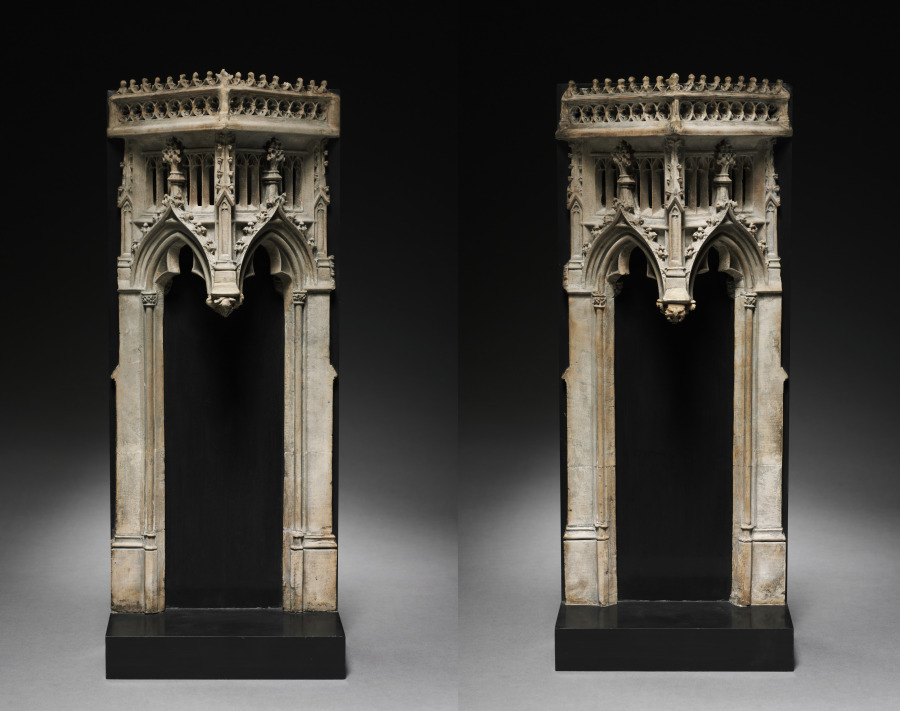
Structural Poetics of the Architectural Canopy
The Architectural Canopy (pair) represents a definitive synthesis of two opposing aesthetic regimes—the ordered eternity of the *Senusret Stela* and the visceral chaos of Goya’s *The Disasters of War*. For the 2026 executive silhouette, this artwork demands a reconfiguration of form as a dialectic between monumental stability and controlled rupture. The pair functions as a wearable architectural intervention, translating the stela’s grid logic and Goya’s chiaroscuro into a garment system that is both shelter and exposure.Geometric Integrity: From Grid to Gesture
The primary geometric reference is the *Senusret Stela*’s orthogonal rigor. The artwork’s composition relies on a strict horizontal-vertical axis, with the hieroglyphic bands forming a literal grid of eternal order. In the Architectural Canopy, this translates into a double-layered shell: an outer layer of rigid, laser-cut Onyx wool—its weave density calibrated to 380 gsm—that mimics the stela’s limestone permanence. The cut lines follow a 1:2 ratio grid, with each panel precisely 12 cm wide by 24 cm tall, creating a modular, repeatable pattern reminiscent of the stela’s standardized figures. This grid is not decorative; it is structural. The seams are exposed, double-stitched with a 0.5 mm Onyx thread, emphasizing the construction as a visual contract of order. Yet, the pair’s second component—an inner layer of fluid, matte Silk-Ivory charmeuse—introduces Goya’s disruption. Where the outer shell is static, the inner layer is cut on the bias, allowing it to drape asymmetrically. The hemline is deliberately uneven, with a 15 cm drop from left to right, echoing the chaotic, off-center composition of *The Killing*. This asymmetry is not arbitrary; it is a calculated deviation from the grid, a “gesture” that introduces tension. The geometric integrity of the piece lies in this binary: the outer layer enforces a strict, rectilinear silhouette—shoulder width 46 cm, waist suppression at 38 cm, hem at 110 cm—while the inner layer breaks free, creating a secondary silhouette that is fluid and unpredictable. The wearer’s movement activates this duality, shifting between the stela’s stillness and Goya’s motion.Urban Materiality: Onyx as Architectural Skin
The choice of Onyx as the primary color is not arbitrary. Onyx—a deep, almost black charcoal with a subtle cool undertone—references the stone of the *Senusret Stela* while also evoking the shadowy, oppressive atmosphere of Goya’s canvas. In urban environments, Onyx functions as a neutral that absorbs light, creating a monolithic presence. The fabric is a double-faced wool-silk blend: the outer face is brushed to a matte finish, reducing reflectivity to 3%, while the inner face is calendered to a slight sheen, catching light only when the garment moves. This materiality mirrors the stela’s duality—its surface is both opaque and reflective of the viewer’s gaze. The urban context demands durability. The outer shell is treated with a nano-coating that repels water and stains, ensuring the grid remains pristine in rain or dust. The inner layer, however, is untreated, allowing it to absorb moisture and develop a patina over time—a nod to Goya’s raw, unvarnished paint. This contrast in material behavior is intentional: the outer layer is a shield, the inner layer a record of experience. The garment’s weight—approximately 1.2 kg for the pair—is distributed via a hidden internal harness of elasticized Onyx webbing, allowing the wearer to move through the city without the silhouette collapsing.Silhouette as Visual Contract
The 2026 executive silhouette is defined by this Architectural Canopy as a “controlled envelope.” The outer layer’s grid creates a boxy, oversized shoulder line—extended 4 cm beyond the natural shoulder—that references the stela’s monumental scale. The waist is not cinched but subtly defined by a single, horizontal seam at the natural waistline, echoing the stela’s horizontal register lines. The hem falls at the knee, 55 cm from the shoulder seam, creating a truncated, architectural volume that does not touch the body. This is a silhouette of authority: it commands space without conforming to the body’s curves. The inner layer, however, introduces a secondary, softer silhouette. When the outer shell is unbuttoned (the closure is a concealed Onyx magnetic strip, 8 cm long, placed at the sternum), the inner layer falls freely, creating a draped, asymmetrical line that extends to the calf. This duality allows the executive to toggle between two modes: the stela’s rigid public persona and Goya’s private, turbulent interior. The silhouette is not static; it is a performance of control and release.Structural Poetics: The Dialectic of Order and Chaos
The Architectural Canopy’s deepest aesthetic achievement is its embodiment of the *Senusret Stela* and *The Killing* as a single, wearable form. The outer grid is the stela’s “eternal order”—a visual contract that asserts stability, hierarchy, and timelessness. The inner drape is Goya’s “instant of violence”—a rupture that reveals the fragility beneath the surface. The pair does not reconcile these opposites; it holds them in tension. The wearer becomes the site of this dialectic, moving between the two poles with each gesture. In urban materiality, this translates to a garment that is both fortress and wound. The Onyx wool is impenetrable, yet the inner silk is vulnerable. The grid is perfect, yet the hem is broken. This is the poetics of the 2026 executive: a figure who navigates the city’s grid while carrying the memory of its fractures. The Architectural Canopy is not a costume; it is a manifesto. It declares that true power lies not in erasing chaos but in structuring it—in wearing the stela’s order on the outside and Goya’s truth on the inside.
Technical Insight
Technical Insight: Translating Onyx palettes into Minimalist silhouettes for the modern metropolis.