Minimalist
Onyx
Urban Form: Figure
Structural Poetics: The Dialectic of Surface and Depth
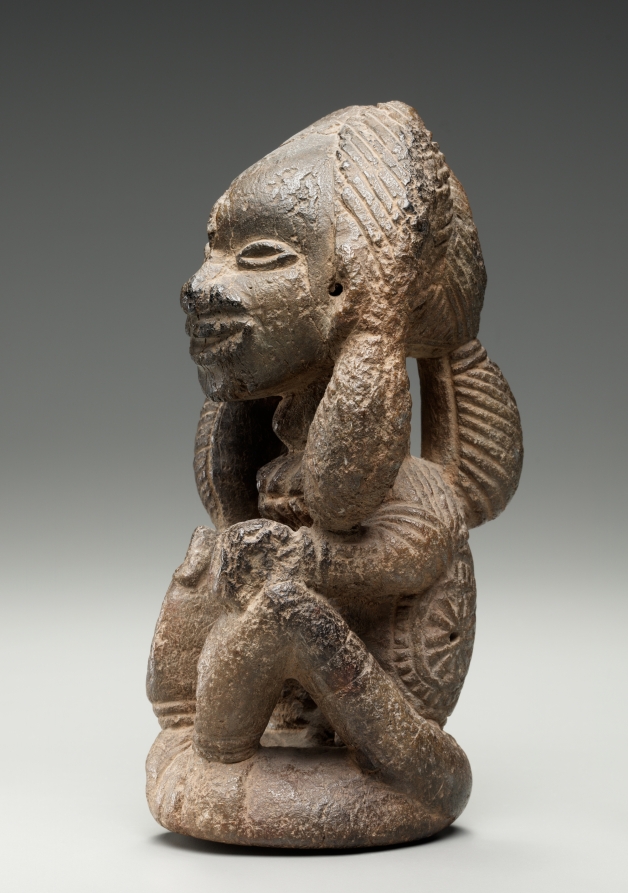
The urban silhouette for 2026, as defined by the internal DNA of the *Mirror with Split-Leaf Palmette Design Inlaid with Gold* and the *Sarcophagus Panel*, is not a garment but a tectonic proposition. It is a study in the architecture of presence—a negotiation between the transient reflection of the self and the immutable weight of form. The executive figure is no longer a passive canvas for fabric; it becomes a site of material dialogue, where the cold, planar logic of the sarcophagus meets the intricate, gilded permanence of the palmette. The silhouette is **minimalist** not in the sense of absence, but in the sense of essential, irreducible structure. It is a reduction to the purest geometric argument: the vertical line of the body as a column, the horizontal plane of the shoulder as a lintel, and the interstitial space as a field for ornamental tension. The *Sarcophagus Panel* provides the foundational grammar. Its heavy, monolithic quality translates into a silhouette defined by **architectural restraint**. The shoulder line is sharp, unyielding, and slightly extended—a nod to the stone’s inherent solidity. The torso is a clean, unbroken plane, achieved through fabrics that possess a dense, almost mineral drape: double-faced wool, bonded cashmere, or a stiffened silk gazar. The waist is not cinched but implied, a subtle shift in volume rather than a constriction. This is the **Onyx** palette—a spectrum of deep blacks, charcoal greys, and obsidian tones that absorb light, mirroring the stone’s refusal to reflect the ephemeral. The garment’s surface is deliberately flat, a “narrative plane” where any interruption—a pocket, a seam, a dart—must be justified as a necessary structural element, akin to a figure in a bas-relief.The Inlay Principle: Gold as Structural Accent
The *Mirror’s* gold-inlaid palmette introduces the counterpoint: the **principle of the inlay**. This is not decoration; it is a structural incision. The gold lines are not applied but embedded, creating a surface that is both continuous and disrupted. In the 2026 silhouette, this manifests as a system of **linear interventions**—precise, metallic seams, laser-cut leather appliqués, or micro-pleated panels that run along the vertical axis of the body. These lines are not organic; they are geometric, symmetrical, and repetitive, echoing the palmette’s infinite pattern. They function as a visual armature, reinforcing the body’s verticality while introducing a rhythm of light and shadow. The gold is not yellow but a burnished, low-luster **Silver** or **Sand**—a metallic thread woven into a matte base, or a thin strip of polished metal set into a wool crepe. This is the “golden garden” rendered as a structural seam, a frozen moment of craftsmanship that resists the decay of the daily.Urban Materiality: The City as a Quarry
The urban environment for this silhouette is not the glass-and-steel metropolis of the past decade. It is a city of raw, exposed surfaces: concrete, basalt, oxidized copper, and aged bronze. The executive moves through this landscape as a **monolithic figure**, a piece of architecture in motion. The fabric must possess a **materiality of weight**—a tactile density that suggests permanence. Think of a coat cut from a single piece of heavy felt, its seams left visible and raw, like the edges of a stone slab. Or a jacket in a bonded leather that has the matte finish of a weathered statue. The texture is not soft; it is **granular, grainy, or polished to a dull sheen**. The *Sarcophagus Panel* teaches us that the surface is a field for narrative, not sensation. Therefore, the touch is secondary to the visual and structural impact.The Silhouette as a Threshold
The true genius of this research lies in the **threshold**—the point where the mirror’s reflection meets the sarcophagus’s permanence. The garment becomes a boundary. The front of a coat may be a seamless, unbroken plane (the stone), while the back is articulated with a series of fine, metallic pleats (the inlay). The left sleeve is a clean column; the right sleeve is bisected by a single, sharp gold line. This asymmetry is not arbitrary; it is a **structural dialectic**. The wearer is both the subject and the object, the transient reflection and the eternal form. The silhouette is a **minimalist armor**—not for war, but for the negotiation of time and space in the urban arena. The 2026 executive silhouette is, therefore, a **geometric manifesto**. It rejects the fluid, the draped, and the oversized in favor of a precise, volumetric architecture. The shoulders are defined. The waist is a subtle inflection. The length is terminal—ending at the knee or the ankle with a clean, unhemmed edge. The color is **Onyx**, a void that absorbs all light, punctuated by **Silver** or **Sand** inlays that function as structural calligraphy. This is not fashion as adornment; it is fashion as a **built environment**. The figure is a column, a panel, a mirror. The garment is a stone, a line, a threshold. And in this synthesis of the gilded and the grave, the executive finds a form that is both timeless and utterly present.
Technical Insight
Technical Insight: Translating Onyx palettes into Minimalist silhouettes for the modern metropolis.