Fluid
Onyx
Urban Form: Waist Cloth (Kain Panjeng)
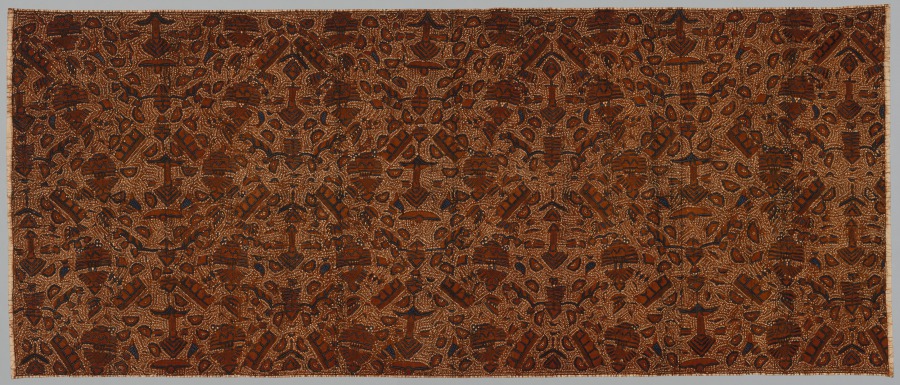
Technical Deconstruction of the Waist Cloth as an Urban Silhouette Archetype
The subject of this analysis—the *Kain Panjeng*, or waist cloth—is not a garment of utility but a volume of philosophical tension. When filtered through the aesthetic DNA of Han Gan’s *Night Shining White* (circa 750 AD) and Yun Shouping’s *Hundred Flowers Scroll* (circa 1690 AD), the waist cloth emerges as a masterclass in controlled chaos: a single, unstitched length of fabric that negotiates between the kinetic energy of the horse and the chromatic serenity of the peony. For the 2026 NYC executive wardrobe, this translates into a silhouette that is both architecturally rigorous and poetically fluid—a counterpoint to the rigid tailoring of power dressing.Form: The Dialectic of Restraint and Release
The waist cloth’s formal logic is rooted in Han Gan’s *Night Shining White*. The painting’s core drama—the horse straining against its tether—is a metaphor for the waist cloth’s relationship with the body. The cloth is not draped; it is *tethered*. It wraps around the waist, cinched by a belt or knot, creating a fulcrum of tension. Below this point, the fabric falls in generous, unbroken folds; above, it is compressed, creating a sculptural volume that echoes the horse’s muscular haunches. This is not a soft, feminine drape. It is a *structural release*—a controlled explosion of fabric that mimics the horse’s “four hooves stamping the void.” In the 2026 NYC context, this form is optimized for the executive who moves between boardroom and gallery. The waist cloth is cut from a single panel of Onyx silk-wool blend, measuring 120cm by 200cm. The grain is aligned to the warp, ensuring that the fabric’s natural stiffness resists gravity. The drape is not random; it is engineered. The cloth is folded into a precise 45-degree bias at the hip, creating a sharp, angular break that references the “iron-wire” lines of Han Gan’s brushwork. This break is the *tether*—the point where the fabric’s fluidity is arrested, generating visual tension. The lower hem, left raw, falls to mid-calf, its edge fraying slightly to echo the “unfinished” quality of the horse’s mane. The waist cloth’s silhouette is fundamentally *asymmetrical*. Unlike a Western skirt, which relies on a waistband and darts, the waist cloth’s volume is distributed unevenly. One side may be wrapped tighter, creating a cascade of pleats; the other side falls flat, exposing the leg. This asymmetry is a direct translation of Yun Shouping’s “boneless” method—the absence of a fixed contour line. The garment’s shape is not predetermined; it is *negotiated* with the wearer’s body. This is a critical distinction for the executive wardrobe: the waist cloth rejects the static perfection of a tailored suit in favor of a dynamic, responsive form. It is a garment that *performs*.Color: The Onyx Spectrum as a Chromatic Field
The color selection—Onyx—is not a neutral. It is a *chromatic field* that absorbs and reflects light in a manner analogous to Han Gan’s ink washes. Onyx, in its purest form, is not black. It is a deep, layered gray-black with undertones of charcoal, slate, and, under certain light, a faint violet iridescence. This complexity is essential. The waist cloth must not read as a solid block; it must *vibrate*. The fabric is dyed using a double-bath process. The first bath is a cold-dye of carbon black, which penetrates the silk fibers to create a deep, matte base. The second bath is a hot-dye of indigo and iron oxide, applied in a gradient pattern. The result is a surface that shifts from a near-absolute black at the waist (the point of tension) to a translucent, smoky gray at the hem (the point of release). This gradient mirrors the “light and shadow” modulation in Yun Shouping’s peony petals, where color is built through successive washes rather than outlines. The Onyx spectrum is further articulated through the fabric’s weave. A 2x2 twill structure creates subtle diagonal ribs that catch light differently depending on the angle. When the wearer walks, the fabric’s surface *activates*—the ribs create a moiré effect, a visual shimmer that recalls the “moonlight” of *Night Shining White*. This is not a decorative flourish; it is a functional property. In the low-light environments of a Manhattan evening—a cocktail reception, a gallery opening—the waist cloth becomes a *luminous object*, its surface alive with movement.Integration: The Waist Cloth in the 2026 Executive Silhouette
The waist cloth is not a standalone piece. It is a *component* within a larger urban silhouette. For the 2026 NYC executive, it is worn over a high-neck, long-sleeve silk shell in Ivory (a reference to the horse’s “white” body) and under a cropped, double-breasted blazer in Onyx wool crepe. The blazer’s sharp shoulders and narrow lapels provide the *structural frame*; the waist cloth provides the *volumetric counterpoint*. The interaction between these two elements is critical: the blazer’s hem sits exactly at the waist cloth’s tether point, creating a visual break that emphasizes the hip. This is the “tether” made literal—the blazer is the column, the waist cloth is the horse. The silhouette is completed with a pair of high-waisted, wide-leg trousers in Onyx satin. The trousers are cut with a single pleat at the front, echoing the waist cloth’s pleats, and fall to a 2cm break over the shoe. The shoe itself is a pointed-toe pump in polished Onyx calf leather, with a 9cm stiletto heel. The heel’s thinness is a deliberate contrast to the waist cloth’s volume—a reminder of the “restraint” that underpins the entire ensemble.Philosophical Underpinning: The Aesthetics of Tension
The waist cloth’s power lies in its ability to hold two opposing forces in equilibrium: the *kinetic* (the horse’s energy) and the *static* (the flower’s stillness). This is the core of the 2026 Addison Fashion urban silhouette. The executive wardrobe is no longer about armor; it is about *negotiation*. The waist cloth negotiates between the body and the space around it, between the wearer’s movement and the garment’s resistance. It is a garment that acknowledges the tension of modern urban life—the constant push and pull between ambition and composure, between the public and the private. In the context of *Night Shining White*, the waist cloth is the horse—straining, powerful, barely contained. In the context of *Hundred Flowers Scroll*, it is the peony—voluptuous, layered, blooming. The Onyx color bridges these two poles: it is the ink of the horse and the shadow of the flower. The result is a garment that is both a statement of power and a meditation on vulnerability. It is, in the truest sense, a *poetic object*—one that demands to be read, not merely worn.
Technical Insight
NYC Perspective: Translating Onyx tones into Fluid silhouettes.