Urban Form: Kneeling Carthusian Monk
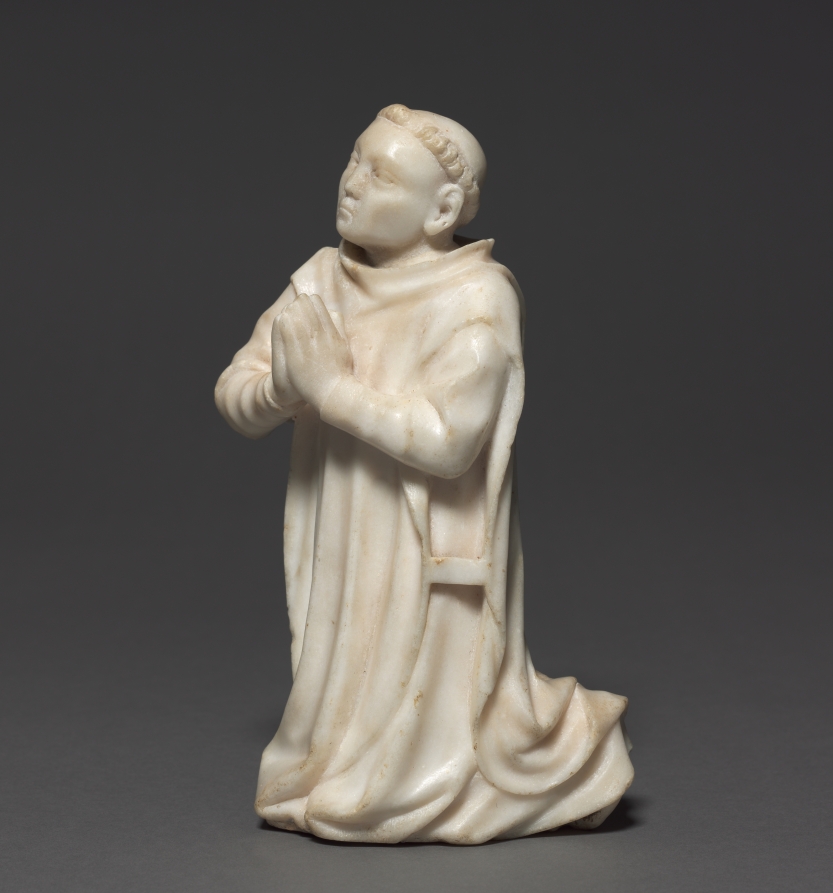
Geometric Integrity of the Kneeling Carthusian Monk
The kneeling Carthusian monk, as rendered in the dual artistic visions of The Agony in the Garden and Below, I Saw the Vaporous Contours of a Human Form, presents a study in volumetric compression and spatial negation. The figure’s posture—a quadruple flexion of hips, knees, and spine—generates a closed, self-contained geometry. The torso folds inward, the shoulders drop below the horizontal plane of the scapulae, and the head bows to a point of near-occlusion with the chest. This is not a silhouette of expansion but of containment. The body becomes a polyhedron of draped planes, where the fabric of the habit—heavy wool, likely undyed—acts as a secondary structural skin, amplifying the mass of the form while obscuring its anatomical specificity.
From the Renaissance iteration, we extract a principle of compressed monumentality. The figure’s mass is concentrated in the lower third, with the knees anchoring the composition to the ground plane. The vertical axis is broken, replaced by a diagonal thrust from the sacrum to the crown of the head. This creates a dynamic tension: the body is both static (in prayer) and poised for rupture (in agony). The geometric integrity lies in the negative space between the arms and torso, the hollow of the chest, and the void beneath the bowed head. These are not absences but active volumes, charged with the invisible weight of spiritual crisis.
From the contemporary vapor-traced iteration, we extract a principle of dissolving boundary. The “vaporous contours” suggest a silhouette that is not hard-edged but gradient, where the figure’s outline bleeds into the surrounding atmosphere. This is not a loss of form but a redefinition of form as a field of intensity. The kneeling monk becomes a locus of energy rather than a solid object. The geometry is no longer Euclidean but topological, defined by thresholds of opacity and translucency, by the density of the fabric against the lightness of the air.
Structural Poetics: The 2026 Executive Silhouette
The 2026 executive silhouette, as derived from this research, must reconcile these two polarities: the compressed monumentality of the Renaissance body and the dissolving boundary of the modern vapor-form. The result is an oversized architecture that is not merely voluminous but structurally articulated to mimic the monk’s posture of containment and release.
Shoulder Line: The shoulder must be dropped and extended, not in a power-shoulder tradition of aggressive horizontality, but in a curved, descending arc that mirrors the monk’s scapular plane. The sleeve head should be set low, creating a continuous line from the neck to the wrist, with a subtle saddle-like drape at the deltoid. This is not a shoulder that announces presence; it is a shoulder that absorbs the surrounding space, creating a protective canopy over the torso.
Upper Torso: The chest panel must be constructed with a double-layered, floating placket that allows for a slight collapse inward, echoing the hollow between the monk’s arms. This is achieved through a suspended lining attached only at the shoulder and side seams, leaving a 2-3 cm air gap between the outer shell and the inner layer. The fabric—a dense, matte wool-cashmere blend in Ivory—must have a felted surface to absorb light, eliminating any sheen that would suggest materiality. The silhouette is not fitted but shaped through weight, with the fabric falling in vertical, unbroken folds from the shoulder to the hem.
Lower Torso and Hip: The waist is suppressed minimally, only enough to suggest the monk’s pelvic tilt. The hip line is extended outward in a subtle A-line, creating a base that is wider than the shoulder. This is the inverted trapezoid of the kneeling form, where the body’s mass is concentrated below the waist. The side seams are cut with a forward pitch, pulling the fabric toward the front of the body, mimicking the forward lean of the praying figure. The back panel is left unstructured, allowing the fabric to pool slightly at the lower back, creating a vaporous tail that echoes the dissolving contours of the second artwork.
Urban Materiality: Fabric as Atmosphere
The material palette for this silhouette must operate at the intersection of weight and weightlessness. The primary fabric is a double-faced wool in Ivory, with a density of 380 gsm. The outer face is fulled and brushed to a soft, matte finish that reads as stone—the rock of the Garden of Gethsemane. The inner face is sanded and napped, creating a micro-texture that traps air and diffuses light, producing the vaporous halo of the second artwork. When the garment moves, the two faces interact: the outer layer remains still, while the inner layer shifts, creating a visual friction that suggests the boundary between solid and vapor.
Secondary Material: A silk-organza interlining is used in the sleeve heads and shoulder panels. This is not visible but structural, providing a slight crispness that prevents the wool from collapsing entirely. The organza is dyed in a silver-gray tone, which, when layered under the ivory wool, creates a cool undertone that reads as shadow—the shadow of the monk’s form against the night sky. This is the invisible geometry of the garment, the structural poetics that are felt but not seen.
Finish: All seams are felled and bound with a silk charmeuse tape in Onyx. This is a deliberate urban detail, a reference to the architectural joinery of modern skyscrapers, where steel beams are clad in glass. The black tape acts as a visual anchor, defining the edges of the garment without adding weight. The hem is left raw and slightly frayed, a nod to the dissolving contour of the vapor-form, where the boundary between garment and air is not a line but a threshold.
Conclusion: The Silhouette as Threshold
The 2026 executive silhouette, as defined by the kneeling Carthusian monk, is not a garment but a spatial intervention. It is an oversized architecture that contains the body without defining it, that absorbs light and releases shadow, that is both monumental and ephemeral. The Ivory color is not a neutral but a charged blankness, the color of stone and fog, of the Garden and the vapor. The silhouette is a threshold between the visible and the invisible, between the agony of form and the peace of dissolution. It is, in the final analysis, a garment of critical stillness—a wearable meditation on the geometry of faith, the materiality of doubt, and the poetics of the urban void.