Urban Form: Gorget (Rei Miro)
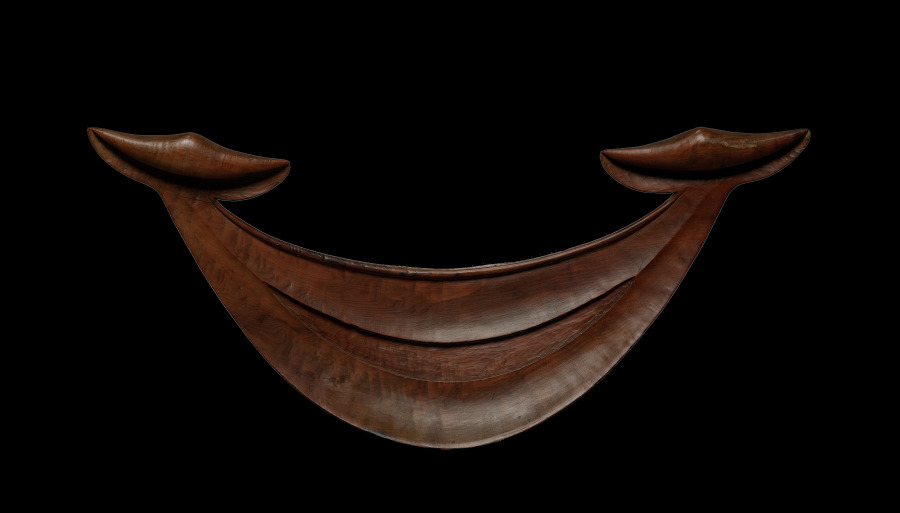
Structural Poetics of Absence: The Gorget as Urban Reliquary
The Gorget, historically a piece of armor designed to protect the throat, undergoes a radical ontological shift within the Addison Fashion Urban Silhouette Research for 2026. This is not a revival of medieval martialism, but a reclamation of its core architectural principle: the framing of a void. The subject artifact—the “Udumbara Flowers” Temple Plaque—provides the conceptual key. Its power lies not in the depiction of a flower, but in the declaration of an absent presence. The Gorget, in this context, becomes a wearable plaque. It does not guard the neck; it frames the space where breath, voice, and vulnerability converge. It is a monument to the invisible.
The 2026 executive silhouette demands a renegotiation of volume. The body is no longer a surface to be draped, but a volume to be articulated. The Gorget achieves this through a negative-space architecture. Its form is a rigid, sculpted collar—a crescent of ivory-hued, high-density felted wool, bonded to a micro-thin titanium substructure. The materiality is crucial: the wool’s matte, lunar surface absorbs light, while the titanium’s edge, left raw and unpolished, catches a single, sharp line of reflection. This is not ornament; it is a geometric boundary condition. The Gorget defines the upper terminus of the torso, creating a clean, horizontal plane that severs the line of the neck from the column of the body. The head becomes a floating object, a sovereign entity above a minimalist plinth.
Geometric Integrity: The Calculus of the Void
The plaque’s calligraphy—鎏金技法, the gold tracery on a moss-green ground—is a study in controlled decay. The characters are not solid; they are traces, like rain on night-soaked ink. The Gorget’s geometry mirrors this principle. Its primary form is a torus, but a torus that has been mathematically sheared. The front edge is a clean, unbroken arc that follows the clavicle line, terminating at the acromion. The back edge, however, rises sharply, forming a high, protective scrim that cups the nape of the neck. This asymmetry is not arbitrary. It is a structural poetics of the hunt, referencing Piero della Francesca’s *The Hunt*. In that painting, the figures are frozen in a crystalline geometry of impending action. The Gorget captures that same frozen kinetic energy. The high back suggests a defensive posture, a turning away; the open front suggests exposure, a readiness to receive. The wearer is both the hunter and the hunted, suspended in a state of pure potential.
The interior surface of the Gorget is the true locus of meaning. It is lined with a single layer of unbleached, raw silk—a material that will patina with the oils of the skin over time. This is the “Udonge” effect: a space that is not empty, but charged with the promise of a future mark. The silk is the blank plaque, waiting for the calligraphy of daily wear. The exterior, in contrast, is a study in urban materiality. The ivory felt is treated with a nano-ceramic sealant that repels water and stains, yet retains a tactile, almost suede-like softness. It is a material that belongs to the city—resilient, clean, and indifferent to the weather. It is the architectural equivalent of a concrete facade that has been sandblasted to a smooth, monolithic finish.
Urban Materiality and the Executive Silhouette
The 2026 executive is not a figure of static power, but of dynamic stasis. They move through the glass-and-steel canyons of the metropolis with a deliberate, measured pace. The Gorget facilitates this. Its weight is precisely calibrated—300 grams—to provide a constant, grounding pressure on the shoulders. It is a somatic anchor, a reminder of the body’s own geometry. The silhouette it creates is a study in contrasts. The Gorget’s rigid, horizontal line is set against the vertical fall of a single-seam, floor-length coat in a matching ivory felt. The coat is cut with zero ease, a tube of fabric that skims the body without clinging. The Gorget acts as the visual capstone, preventing the eye from sliding upward into the chaos of the face. It creates a zone of silence around the throat.
The color choice—Ivory—is not a neutral. It is a spectral color, the color of bone, of parchment, of the moon. It is the color of the absent flower. In the urban context, it reads as a deliberate withdrawal from the chromatic noise of the city. It is a statement of minimalist luxury, a refusal to participate in the spectacle of color. The Gorget, in this hue, becomes a portable fragment of a temple wall, a piece of sacred architecture carried into the secular space of the boardroom.
Conclusion: The Geometry of the Invisible
The definitive urban silhouette for 2026 is not about the body, but about the field around the body. The Gorget is the instrument that defines this field. It is a tool for creating a negative aura, a space of absence that the observer is compelled to fill. Like the temple plaque that speaks of a flower that never blooms, the Gorget speaks of a vulnerability that is never fully exposed. It is a piece of armor for the soul, a geometric prayer for stillness in a world of perpetual motion. The wearer does not simply wear the Gorget; they inhabit its void. And in that void, the Udumbara flower of the self, invisible and eternal, finally opens.