Urban Form: Jar with Design in Underglaze Iron
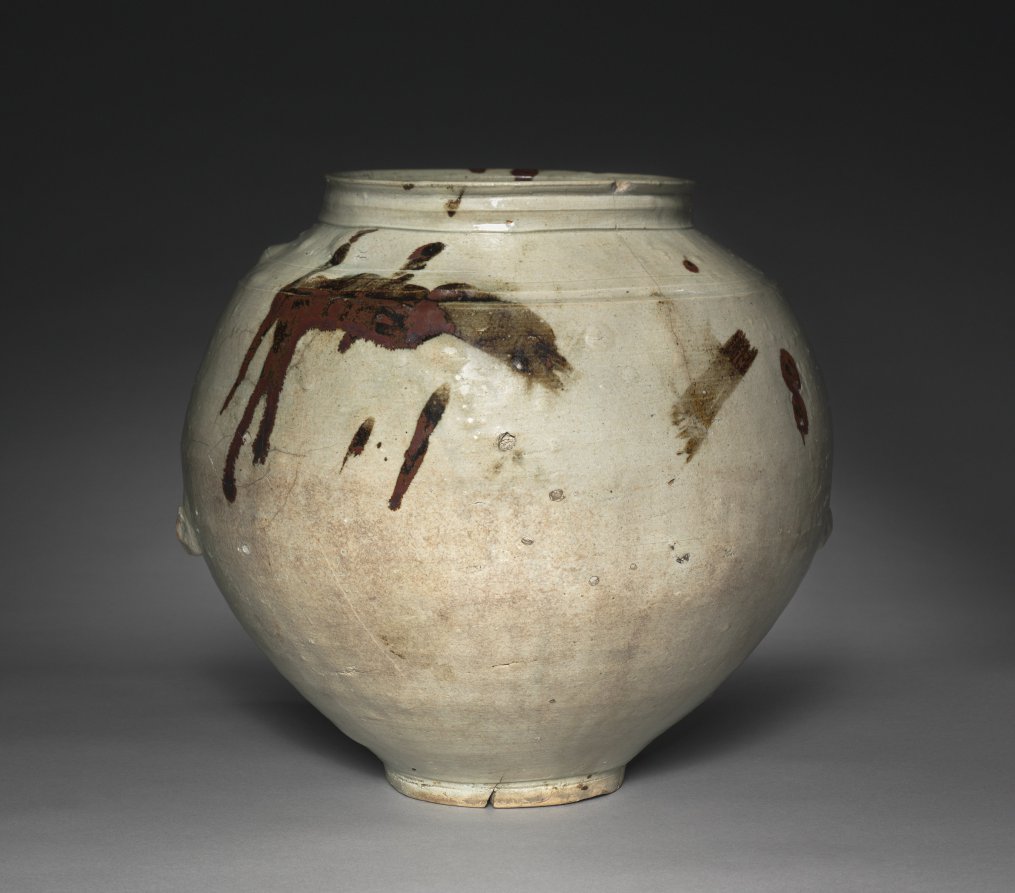
Geometric Integrity of the Jar with Design in Underglaze Iron
The Jar with Design in Underglaze Iron presents a paradox of containment: a vessel whose surface is both a boundary and a threshold. Its geometry is not one of pure Euclidean simplicity but of compressed tension. The body swells from a narrow foot to a broad, rounded shoulder, then contracts sharply at the neck. This profile—a continuous curve interrupted only by the lip and base—creates a dynamic equilibrium between expansion and restraint. The underglaze iron designs are not applied as decoration but as structural calligraphy, tracing the vessel’s volume with lines that follow its curvature. These marks do not merely adorn; they define the spatial logic of the form, mapping the jar’s interior volume onto its exterior skin.
The jar’s silhouette is fundamentally monolithic. Unlike the segmented, articulated forms of the Square Wine Container (Fangyou), which declare their structure through angular divisions, this jar asserts its presence through unbroken mass. The underglaze iron patterns—often floral or abstract—are rendered in a controlled, rhythmic repetition that echoes the vessel’s rotational symmetry. This is not the organic, flowing wood grain of the Udumbara Flowers Temple Plaque; it is a deliberate, manufactured order imposed upon clay. The iron pigment, fired into the glaze, becomes a permanent, unyielding line—a mark that cannot be erased or softened. This permanence aligns with the minimalist ethos: every line must earn its place.
Structural Poetics: The Vessel as Urban Monolith
In the context of the 2026 executive silhouette, this jar offers a blueprint for architectural dressing. The garment must mirror the jar’s contained volume—a silhouette that is full but not inflated, structured but not rigid. The shoulder of the jacket, for instance, should echo the jar’s broad, rounded upper body: a strong, unbroken line from neck to arm, with no sharp padding or aggressive angles. The fabric should fall in a single, continuous sweep from shoulder to hem, much like the jar’s glaze flows from lip to foot. This is the urban monolith—a form that commands space through its sheer, unadorned presence.
The underglaze iron designs translate into strategic seam lines and paneling. Just as the iron lines trace the jar’s curvature, the garment’s seams must follow the body’s natural architecture: a vertical seam down the center back, a horizontal seam at the shoulder blade, a subtle dart at the waist. These are not decorative; they are structural necessities that articulate the garment’s volume. The minimalist palette—here, Onyx—reinforces this logic. A single, deep black absorbs light, erasing surface detail and forcing the eye to read pure form. The underglaze iron patterns, if referenced, would appear as tonal variations in the fabric—a matte finish against a subtle sheen, a ribbed texture against a smooth surface—never as literal motifs.
Urban Materiality: From Clay to Fabric
The jar’s materiality—stoneware clay, iron oxide, feldspathic glaze—offers a direct analogue for urban textiles. The clay’s density and weight suggest a fabric like heavy wool melton or double-faced cashmere: materials that hold their shape, that drape with a deliberate, unhurried gravity. The glaze’s glassy, impermeable surface translates to a tightly woven, weather-resistant shell—a fabric that repels moisture and wind, that protects the wearer from the city’s elements. The underglaze iron, fired into the glaze, becomes a permanent, integral pattern—not printed, not embroidered, but woven into the fabric’s very structure.
This is the urban materiality of the 2026 executive: fabrics that are functional, durable, and unapologetically tactile. The Onyx color is not a flat black but a deep, absorbent void that reveals subtle shifts in texture under different light. A ribbed knit at the collar, a satin finish on the lapel, a matte suede at the pocket—these are the understated details that reward close inspection. The garment, like the jar, does not shout; it asserts through presence.
The 2026 Executive Silhouette: A Synthesis
The definitive silhouette derived from this analysis is the Minimalist Onyx Monolith. It is a single, continuous form—a coat, a jacket, a dress—that encloses the body without constricting it. The broad shoulder and tapered waist echo the jar’s swelling body and narrow neck. The unbroken line from shoulder to hem mirrors the jar’s uninterrupted glaze. The strategic seams trace the body’s architecture, just as the underglaze iron traces the vessel’s volume. The Onyx color absorbs light, erasing surface distraction and forcing the eye to read pure, unadorned form.
This is not a silhouette of nostalgia or ornament. It is a response to the urban condition: a form that is protective, authoritative, and silent. It speaks the language of structural poetics—where every line, every seam, every fabric choice is a deliberate act of containment. The wearer is not adorned; they are enclosed within a vessel of their own making. The jar’s geometric integrity—its balance of expansion and restraint, its permanent, unyielding lines—becomes the foundation of the 2026 executive wardrobe. This is minimalism as power: the power of form, of material, of silence.