Tailored
Onyx
Urban Form: Mourner from the Tomb of Philip the Bold, Duke of Burgundy (1364–1404)
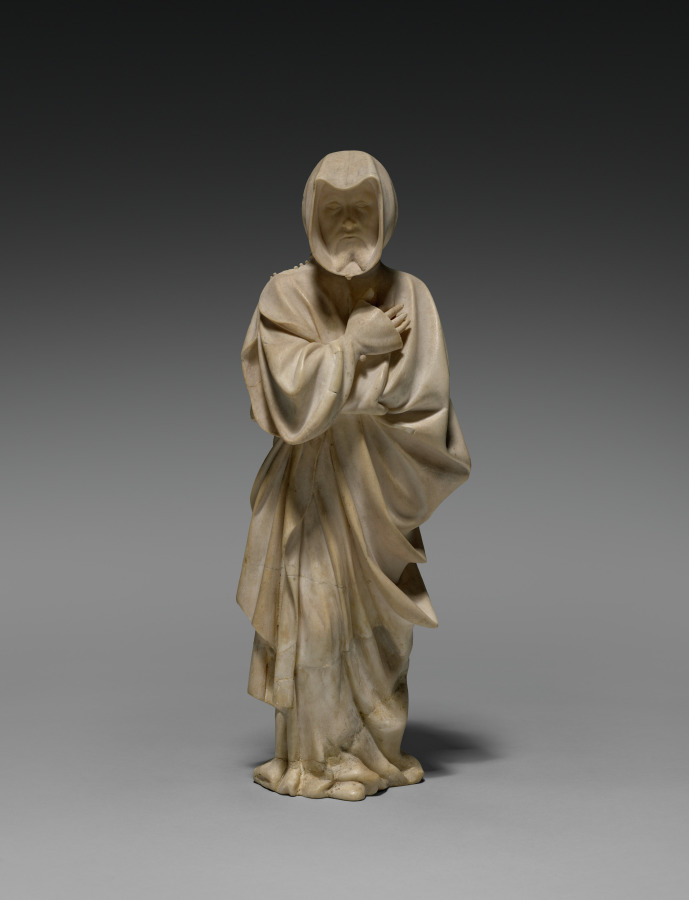
Geometric Integrity of the Mourner: A Study in Submerged Volume
The *Mourner from the Tomb of Philip the Bold* is not a figure of grief in the expressive, Baroque sense. It is a study in **submerged volume**—a body rendered as a folded, architectural mass. The heavy, deeply pleated mantle that envelops the figure creates a continuous, unbroken surface from crown to hem. This is not fabric draped over a body; it is a **geometric shell** that abstracts the human form into a series of vertical planes and sharp, cascading folds. The face is partially hidden, the hands are invisible, and the feet are lost beneath the hem. The result is a silhouette of profound **interiority**—a form that turns inward, prioritizing mass and structure over anatomical detail. For the 2026 executive silhouette, this principle of **enclosed volume** is critical. The modern urban professional requires a garment that projects authority not through exposure, but through **controlled containment**. The Mourner’s geometry is essentially a series of stacked, vertical prisms. The cowl creates a truncated cone at the head; the shoulders form a broad, rigid trapezoid; the body descends as a narrow, unbroken rectangle. This is the antithesis of the fluid, deconstructed shapes of recent seasons. It is a return to **architectural clarity**—a silhouette defined by sharp, clean lines and a deliberate suppression of the body’s natural curves.Structural Poetics: The Fold as a Load-Bearing Element
The key structural innovation of the Mourner is the **fold** itself. In classical tailoring, a fold is often a point of weakness or drape. Here, the folds are **load-bearing**. They are deep, knife-sharp channels that run vertically, creating a ribbed, columnar effect. This is not soft pleating; it is **geological stratification**. Each fold acts as a structural rib, lending rigidity to the overall form. The fabric appears petrified, frozen into a state of permanent, solemn architecture. Translating this into urban materiality demands a fabric that can hold a **crisp, permanent edge** without becoming stiff or brittle. We propose a **double-faced wool melton** in Onyx—a dense, felted wool that is shorn to a velvet-like finish. Its weight (approximately 600 GSM) provides the necessary heft to create the Mourner’s vertical drop. The inner face is a contrasting matte charcoal, visible only at the deep recesses of the fold, adding a subtle, internal chiaroscuro. The construction technique must be **fused and stitched**—the folds are not merely pressed; they are tacked at the interior seam with a blind stitch, locking the geometry into place. This creates a garment that is as much a **structural object** as it is a piece of clothing.Urban Materiality: Onyx and the Architecture of Silence
The color Onyx is not a choice of mood; it is a choice of **material philosophy**. Onyx is the color of polished stone, of deep water at midnight, of the void between city lights. It absorbs light rather than reflecting it. In the context of the Mourner’s silhouette, Onyx serves to **erase surface detail**, forcing the eye to read only the pure geometry of the form. The fabric’s matte, dense finish eliminates any distracting sheen, allowing the vertical folds to become the sole visual narrative. This aligns with the **urban poetics** of the 2026 executive. The city is a landscape of hard edges—glass, steel, concrete. The Mourner’s silhouette, rendered in Onyx, becomes a **mobile architectural element**. It does not compete with the urban environment; it harmonizes with it. The garment’s severe verticality echoes the skyscraper’s facade. Its deep, shadowed folds mimic the crevices of a granite cliff. It is a form of **silent authority**—a presence that commands space through stillness and mass, not through movement or ornament.Silhouette Application: The 2026 Executive Overcoat
The definitive garment derived from this analysis is the **Architectonic Overcoat**. Its key specifications are as follows: - **Shoulder:** A dropped, extended shoulder line, slightly squared, creating a broad trapezoidal base. The sleeve head is set with a minimal, almost non-existent cap, allowing the arm to hang as a pure cylinder. - **Body:** A straight, columnar cut from shoulder to hem. No waist suppression. The front closure is a concealed placket, maintaining the unbroken vertical plane. - **Length:** Floor-grazing, terminating at the top of the shoe. This elongates the vertical line and anchors the silhouette to the ground. - **Collar:** A high, standing collar that extends into a deep, sculptural cowl at the back. The cowl is not draped; it is **structured** with internal interfacing to hold a fixed, architectural curve. - **Folds:** Twelve deep, knife-pleated folds run vertically from the yoke to the hem, spaced at 10 cm intervals. Each fold is 4 cm deep, creating a pronounced ribbed effect.Conclusion: The Poetics of Restraint
The Mourner from the Tomb of Philip the Bold teaches us that the most powerful silhouette is not one that reveals, but one that **conceals and defines**. It is a form of **negative space**—the body is present only as an absence, a void around which the garment is built. For the 2026 executive, this translates into a wardrobe of **deliberate austerity**. The Architectonic Overcoat in Onyx is not a garment for comfort or ease. It is a garment for **presence**. It is a mobile monument, a piece of urban architecture that the wearer inhabits. In a world of constant visual noise, the Mourner’s silent, folded geometry offers a radical form of **visual silence**—a statement made not through decoration, but through the pure, unyielding logic of form.
Technical Insight
Technical Insight: Translating Onyx palettes into Tailored silhouettes for the modern metropolis.