Urban Form: Seated Buddha (sculpture)
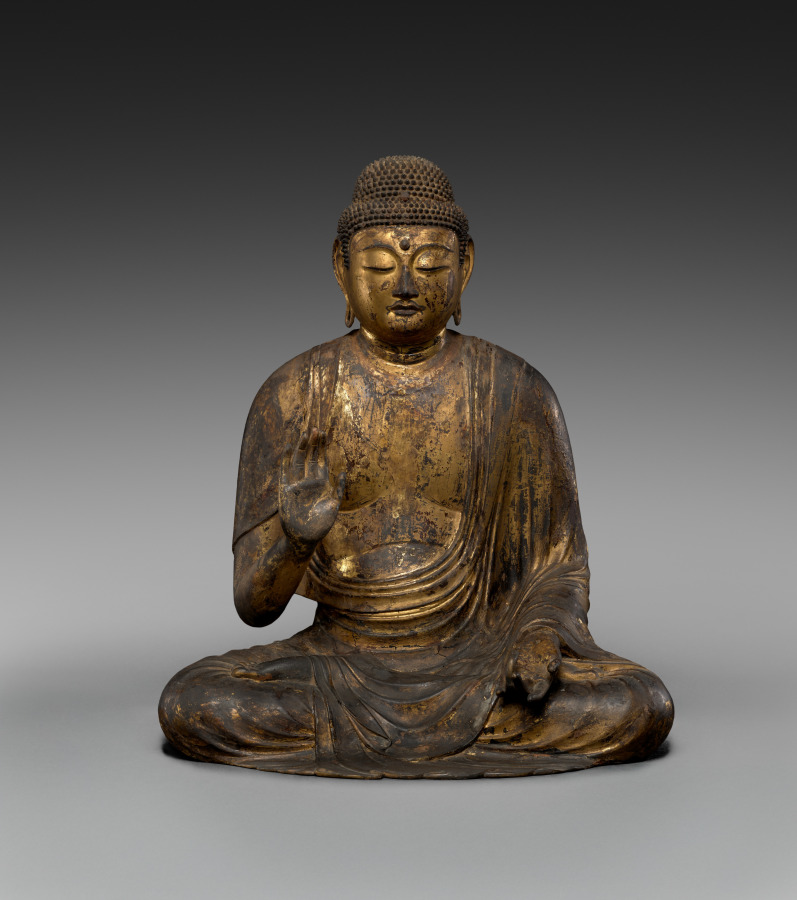
Geometric Integrity and the Seated Buddha: A Structural Poetics for the 2026 Executive Silhouette
The Seated Buddha, in its most canonical sculptural form, represents a radical departure from Western dramatic narrative. Unlike the theatrical tension of David’s Death of Socrates—a frozen climax of gesture and light—the Buddha is an architecture of stillness. Its geometry is not one of action but of compression and containment. For Addison Fashion’s 2026 Urban Silhouette Research, this object offers a definitive lexicon: the body as a monolithic volume, the garment as a structural envelope, and the urban environment as a field of silent, dignified resistance.
I. The Geometry of Stillness: From Narrative to Volume
The seated Buddha figure is defined by a series of nested, stable forms. The base—the crossed legs in padmasana—creates a broad, grounded trapezoid. The torso rises as a truncated cone or a rectilinear block, its axis perfectly vertical. The head, often capped with a cranial protuberance (ushnisha), forms a near-spherical or ovoid termination. This is not a body in motion; it is a body as monument. The limbs do not reach outward; they fold inward, creating a closed, self-referential system.
For the 2026 executive silhouette, this translates into a rejection of fluid, billowing forms. The Minimalist category is not merely about absence of decoration; it is about the absolute authority of the primary shape. The garment must function as a second skin that respects the body’s volumetric core. Shoulders are not padded to exaggerate width, but are cut to align with the natural skeletal structure, creating a clean, unbroken line from neck to hip. The jacket’s hem falls at the hip bone, not below, to preserve the torso’s integrity as a single, unsegmented block. The pant leg, from hip to ankle, is a straight, untapered cylinder, echoing the Buddha’s lower limb mass. There is no break, no dart, no pleat that disrupts the primary silhouette. The body becomes a carved object, not a draped one.
II. Materiality as Urban Armor: The Onyx Imperative
The color Onyx is not a choice; it is a structural necessity. It is the color of deep basalt, of polished obsidian, of the urban canyon at twilight. It absorbs light rather than reflecting it, creating a surface that is both dense and impenetrable. This aligns with the Buddha’s materiality in stone or bronze: a surface that does not invite touch but commands respect through its sheer, unyielding presence.
In the 2026 collection, the fabric must possess a weighted, mineral quality. We propose a double-faced wool-cashmere blend, woven at a density of 380 grams per square meter, with a slight, irregular slub that mimics the texture of carved stone. The finish is matte, not glossy. This is not a fabric that moves; it is a fabric that holds its shape. When the wearer sits, the jacket does not crumple; it folds in clean, defined planes, like the drapery of a classical statue. The pant leg, when the wearer stands, falls with a single, sharp crease—a vertical line that echoes the Buddha’s central axis.
This materiality is urban armor. It protects the executive from the visual noise of the city—the flickering screens, the chaotic signage, the relentless flow of data. The Onyx surface is a field of silence. It does not compete; it dominates through its refusal to participate in the spectacle. It is the uniform of the individual who has achieved a state of internal equilibrium, much like the seated figure itself.
III. Structural Poetics: The Dialectic of Containment and Release
The Buddha’s posture is one of profound containment. The hands rest in the lap, palms upward, in the dhyana mudra (meditation gesture). This is a closed circuit of energy. Yet, within this containment, there is a subtle release: the slight curve of the spine, the gentle tilt of the head, the soft fall of the monastic robe over the shoulder. The sculpture is not a prison; it is a vessel.
Our 2026 silhouette must replicate this dialectic. The outer shell—the jacket, the coat—is rigid, structured, and closed. It is a carapace. But the interior—the shirt, the blouse, the lining—must offer a counterpoint of softness and fluidity. We propose a high-neck, long-sleeved base layer in a liquid silk charmeuse, dyed in a slightly lighter shade of Ivory or Silver. This inner layer is never fully visible; it is glimpsed only at the collar, the cuff, or the hem. It is a secret, a private luxury. The executive, like the Buddha, presents a unified, impenetrable front to the world, while harboring an inner space of quiet, unadorned grace.
The closure system is critical. Buttons are replaced by a single, concealed magnetic clasp at the sternum. Zippers are hidden in side seams. The garment is not opened; it is accessed. This reinforces the idea of the body as a sacred, inviolable volume.
IV. Urban Materiality: The City as a Field of Dignity
The 2026 executive does not walk through the city; the city moves around the executive. The silhouette is a fixed point in a fluid environment. The Onyx surface, with its matte, light-absorbing quality, creates a visual void—a negative space that the urban landscape must navigate. This is not aggression; it is gravitas.
Consider the Buddha in a museum: it does not chase the viewer’s gaze. It sits, immutable, and the viewer must approach it, must circle it, must find the correct angle. Our garment demands the same relationship. It does not flatter the body; it houses the body. It does not move to catch the light; it creates its own shadow. The urban materiality is one of resistance—not against the city, but against the ephemeral, the transient, the disposable. The garment is an object of permanence, a counterweight to the city’s relentless pace.
In conclusion, the Seated Buddha provides the definitive model for the 2026 executive silhouette: a geometry of stillness, a materiality of urban armor, and a poetics of dignified containment. The Minimalist category, executed in Onyx, is not a style; it is a state of being. It is the garment as a monument to the self, a silent, powerful presence in the heart of the city.