Urban Form: Architecture of the Middle Ages: Rouen Cathedral, North Entrance
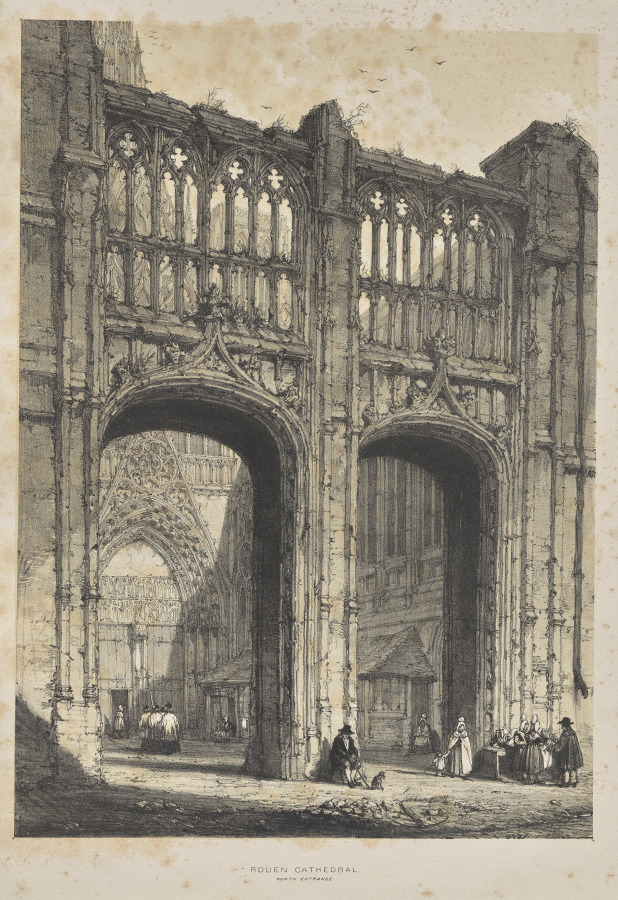
Structural Poetics of the North Entrance: A Study in Vertical Compression and Horizontal Release
The North Entrance of Rouen Cathedral is not merely a portal; it is a tectonic manifesto. Its Gothic architecture—characterized by pointed arches, ribbed vaults, and a relentless vertical thrust—presents a paradox of mass and lightness. For Addison Fashion’s 2026 Urban Silhouette Research, this edifice offers a critical vocabulary for reimagining the executive silhouette. The entrance’s geometric integrity lies in its compression of vertical energy and the subsequent release into horizontal ornamentation. The pointed arch, a signature of medieval engineering, does not simply rise; it funnels the gaze upward, creating a spine of tension that is then counterbalanced by the intricate tracery and sculpted figures that spread laterally across the tympanum. This dialectic—vertical force versus horizontal embellishment—becomes the foundational poetics for our new silhouette.
The cathedral’s stone, weathered by centuries, possesses an urban materiality that is both brutal and refined. The ivory hue of the limestone, now patinated with the grime of industrial Rouen, is not a pristine white but a complex, layered surface—a record of time, weather, and human touch. This materiality informs our color selection: Ivory. It is not a blank canvas but a sedimentary color, one that carries the memory of light and shadow. In the 2026 executive wardrobe, Ivory becomes a structural color, not a decorative one. It is the base upon which architectural lines are drawn, a neutral that absorbs and reflects the urban environment without competing with it.
Geometric Integrity: The Pointed Arch as Silhouette Generator
The pointed arch is the primary geometric unit of the North Entrance. Its geometry is not static; it is a dynamic vector that defines the silhouette’s core. For the executive silhouette, we translate this into an oversized, elongated shoulder line that tapers inward at the waist, creating a cathedral-like apex at the collarbone. This is not a soft, draped shoulder. It is a rigid, architectural cantilever—a shoulder pad that extends beyond the natural line, mimicking the stone voussoirs that transfer weight downward. The result is a silhouette that asserts presence without bulk, a compression of power into a clean, vertical trajectory.
The ribbed vaulting of the interior, visible through the entrance’s open doors, informs the vertical seam structure of the garment. We propose a double-breasted jacket with a pronounced, raised waistline, where the seams mimic the ribs of the vault. These seams are not merely functional; they are structural lines of force, guiding the eye from the shoulder apex down to the hem. The jacket’s length is critical: it must fall to the mid-thigh, creating a proportional counterweight to the oversized shoulder. This is the horizontal release—the tympanum of the garment, where the vertical energy of the shoulders is dispersed into a broad, flat plane. The fabric, a heavy wool-cashmere blend, is chosen for its drape memory—it holds the architectural shape without collapsing, much like stone holds its form under gravity.
Urban Materiality: The Surface as Narrative
The North Entrance’s surface is a palimpsest of ornament and erosion. The sculpted figures of saints and kings are not smooth; they are chiseled, faceted, and shadowed. This informs our approach to fabric texture. We reject flat, uniform surfaces. Instead, we employ jacquard weaves with a raised, almost bas-relief pattern that references the cathedral’s tracery. The pattern is not representational; it is abstracted geometry—a repetition of pointed arches and quatrefoils that creates a tactile rhythm across the garment’s surface. This is not decoration; it is structural ornament, a surface that tells the story of its own construction.
The urban materiality is further expressed through hardware. Buttons are replaced with matte-finished, gunmetal hooks and eyes, reminiscent of ironwork hinges on the cathedral’s doors. Zippers are concealed within welt seams, visible only as a thin, metallic line—a nod to the industrial infrastructure that underpins the Gothic. The lining, a raw silk in a deep Onyx, is revealed only when the garment is opened, creating a moment of interiority—a private space within the public silhouette. This duality—the austere exterior versus the rich interior—mirrors the cathedral’s own logic: a fortress-like exterior that shelters a luminous, vaulted interior.
The Power of Compression: The Torso as a Vaulted Space
The executive silhouette for 2026 is not about expansion; it is about controlled compression. The North Entrance teaches us that true power lies in the tension between containment and release. The torso is compressed by a structured, high-waisted trouser that is cut with a straight, narrow leg, tapering to a 7-inch hem. This is not a skinny fit; it is a geometric tube that anchors the body to the ground. The waistband is double-layered and reinforced, creating a corset-like rigidity that supports the upper body’s volume. The trouser’s front is flat, with no pleats, while the back features a single, vertical dart that echoes the cathedral’s central nave.
The compression extends to the neckline. A high, stand collar—almost clerical in its severity—rises from the jacket, framing the face without constricting. This collar is a micro-arch, a pointed form that repeats the cathedral’s geometry at the scale of the individual. It is not a soft roll; it is a rigid, folded plane that requires the wearer to hold their posture with intention. This is the poetics of control—a silhouette that demands a certain bearing, a certain urban discipline.
Conclusion: The Silhouette as a Monument to the Present
The North Entrance of Rouen Cathedral is a monument to a medieval worldview—a worldview that saw architecture as a dialogue between earth and heaven. For the 2026 executive, this dialogue is translated into a dialogue between the body and the city. The oversized, compressed silhouette is not a nostalgic revival; it is a critical response to the fluidity of contemporary power. In an age of remote work and digital presence, the executive silhouette must reassert physical authority. It must be a structure that commands space, not by its size, but by its geometric precision.
The Ivory color, with its layered history, becomes a neutral that is not neutral. It is a color that absorbs the city’s light—the gray of concrete, the yellow of street lamps, the blue of a winter sky. It is a chameleon of urban materiality, adapting to its environment while maintaining its structural integrity. The final garment—a single-breasted, oversized coat with a raised waist, a high collar, and a straight, narrow trouser—is not a costume. It is a uniform for the contemporary monument, a wearable architecture that encodes power in its very geometry. The wearer does not simply inhabit this silhouette; they activate it, becoming a moving point in the city’s own architectural narrative. This is the 2026 executive: a figure of compressed energy, controlled release, and unyielding structure.