Minimalist
Onyx
Urban Form: Evening Mood-Lidingö
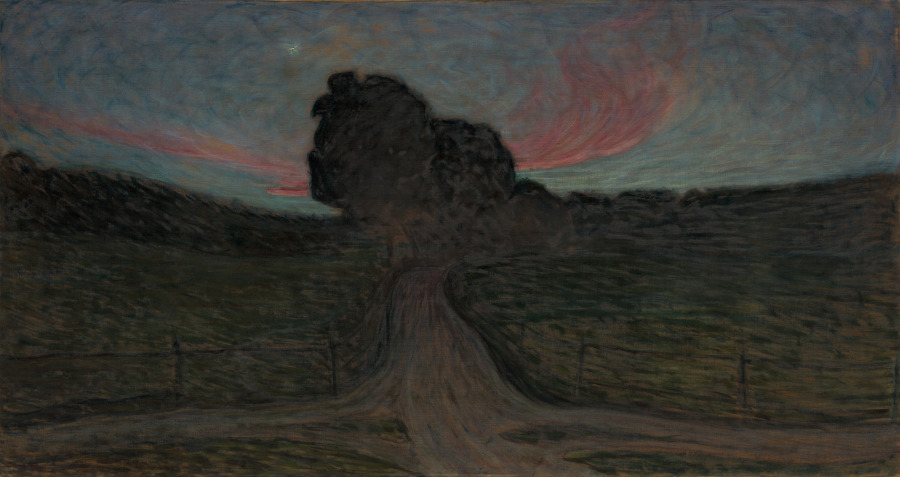
Technical Deconstruction: Evening Mood-Lidingö
The synthesis of Paul Gauguin’s *Ia Orana Maria* and the Ancient Egyptian *Coffin Fragment: Feline Deity* yields a paradoxical aesthetic thesis: **the sacred is both intimate and monumental**. For the 2026 NYC executive wardrobe, this translates into a silhouette that is simultaneously grounded in personal ritual and elevated to cosmic permanence. The Evening Mood-Lidingö collection is not about ornamentation; it is about the architectural purity of form that contains the ineffable. We are constructing a visual theology for the urban professional—one where the garment becomes a vessel for transcendence, not a distraction from it.1. The Silhouette: From Planar Devotion to Volumetric Authority
Gauguin’s work is defined by its **flattened, post-Renaissance space**. Figures exist on a single plane, their bodies rendered as blocks of saturated color. This is not a lack of depth but a *rejection* of illusionistic hierarchy. The sacred is not behind the viewer; it is on the surface, immediate and tactile. The Egyptian fragment, conversely, operates on a principle of **absolute frontality and lateral precision**. The feline is a profile of pure geometry—a line that defines the boundary between the living and the dead. **Formal Application:** The Lidingö evening silhouette must reconcile these two spatial logics. We achieve this through a **layered, planar construction** that mimics Gauguin’s compositional flatness while borrowing the Egyptian’s rigorous contour. - **The Shoulder:** A sharp, extended shoulder line—reminiscent of the feline’s haunch—creates a **horizontal authority**. This is not a padded, 1980s power shoulder. It is a clean, architectural cantilever. The seam is set at the deltoid’s apex, extending 2-3 cm beyond the natural bone. This creates a visual “frame” for the torso, echoing the coffin’s boundary between the mortal form and the eternal vessel. - **The Torso:** The bodice is cut as a **single, unbroken plane** from shoulder to hip. No darts, no waist suppression. This is Gauguin’s flatness made textile. The fabric—a dense, matte onyx wool crepe—falls with a dead weight, refusing to cling. The garment becomes a *screen* onto which the wearer projects their own interiority, much like the Tahitian Madonna’s gaze projects a quiet, personal divinity. - **The Hemline:** The skirt or pant leg terminates in a **clean, horizontal line** at the mid-calf or ankle. This is the Egyptian *horizon line*—the point where the earthly meets the divine. The hem is weighted with a hidden chain or a bonded edge, ensuring it falls with a static, ritualistic precision. No flutter, no movement. The garment is a monument.2. Color as Theological Substance: The Onyx Field
The chosen palette is **Onyx**—a black that is not the absence of light, but the *absorption* of all light. This is the color of the Egyptian underworld (Duat), the fertile darkness from which the sun is reborn. It is also the color of Gauguin’s deepest shadows, the rich, almost purple-black of the Tahitian night. **Color Theory & Application:** - **Spectral Density:** The onyx is not flat. It is a **high-density, low-luster** black. We achieve this through a double-faced weave: a matte, brushed exterior that scatters light, and a semi-satin interior that catches it only at the edges of a fold. This creates a subtle, internal luminosity—a “glow from within” that mirrors the spiritual interiority of Gauguin’s figures. - **Contrast via Texture, Not Hue:** There is no second color. The visual tension is generated entirely through **textural modulation**. A panel of liquid silk charmeuse (the “water” of the Tahitian lagoon) is inset into the matte crepe (the “earth” of the Egyptian desert). A ribbed, almost corded wool (the “papyrus” of the coffin) is used for the sleeve, while the body remains smooth. This is a monochromatic system of extreme sophistication, demanding a trained eye to read its complexity. - **The “Sacred” Accent:** The only non-black element is a single, **micro-stitch of silver thread** at the interior of the collar or cuff. This is the *Ma’at* feather—the principle of truth and order. It is invisible to the casual observer but felt by the wearer. It is a private ritual, a nod to the Egyptian belief that the heart is weighed against a feather in the afterlife. The garment’s value is not in its display, but in its internal, symbolic architecture.3. The Interface: The Gaze and the Garment
Both source works are defined by a specific **mode of looking**. Gauguin’s figures gaze *outward* but not *at* the viewer. Their eyes are pools of internal reflection. The Egyptian feline’s eye is a stylized, unblinking glyph—a gaze that sees through time, not at a person. The Lidingö garment must create a similar **displaced interface**. **Structural Execution:** - **The Collar:** A high, standing mandarin collar that **obscures the throat**. This is the most vulnerable part of the body. By covering it, we create a sense of inviolability. The wearer is not offering their neck to the world. They are presenting a *façade*—a sacred mask. The collar is cut at a precise 90-degree angle to the shoulder plane, creating a clean, architectural break between the head and the body. - **The Sleeve:** A long, fitted sleeve that terminates in a **pointed, elongated cuff** that extends over the hand. This is the “paw” of the feline deity—a gesture of contained power. The cuff is cut from a single piece of fabric, with no button or closure. It is a sheath. The hand becomes a tool, not an ornament. - **The Back:** The garment’s most significant feature is the **uninterrupted back panel**. There is no seam, no zipper, no closure. The back is a single, vast field of onyx. This is the *tabula rasa*—the space for the wearer’s own projection. It is also the most Egyptian element: the back of the coffin, the surface that faces the underworld, the unseen but ever-present support.4. The 2026 Executive Wardrobe: A Protocol for the Sacred
The Evening Mood-Lidingö is not a dress. It is a **protocol**. For the NYC executive operating in 2026, the wardrobe is a system of signals that communicate competence, authority, and a profound, almost monastic self-possession. - **Day-to-Night Transition:** The onyx crepe is inherently nocturnal. It absorbs the harsh fluorescent light of the office and releases a soft, ambient glow under the dimmed lights of a dinner. The garment’s value is realized in the *shift*. - **The “Anti-Trend” Stance:** This silhouette rejects the current obsession with deconstruction, asymmetry, and “effortless” draping. It is a return to **pure, unapologetic construction**. It is a statement that the wearer is not subject to the whims of the season. They are operating on a geological, even cosmic, timescale. - **The Ritual of Dressing:** The garment is designed to be **donned with ceremony**. The lack of closures means it must be pulled over the head. The weight of the fabric requires a deliberate, slow movement. This is not a garment to be rushed into. It is a second skin, a carapace, a vessel. The act of putting it on is a daily ritual of self-consecration. **Conclusion:** The Evening Mood-Lidingö collection is a masterclass in **negative capability**—the ability to hold two contradictory ideas in the mind simultaneously. It is Gauguin’s intimate, personal paradise housed within the Egyptian’s rigid, eternal architecture. It is the warmth of the Tahitian sun rendered in the cold, precise geometry of a coffin. The result is a garment that does not describe the wearer. It *contains* them. For the 2026 executive, this is the ultimate luxury: a form that is both a fortress and a sanctuary, a tool for navigating the profane world while remaining anchored in the sacred.
Technical Insight
NYC Perspective: Translating Onyx tones into Minimalist silhouettes.