Minimalist
Sand
Urban Form: Temple of Ramesses II, Abu Simbel
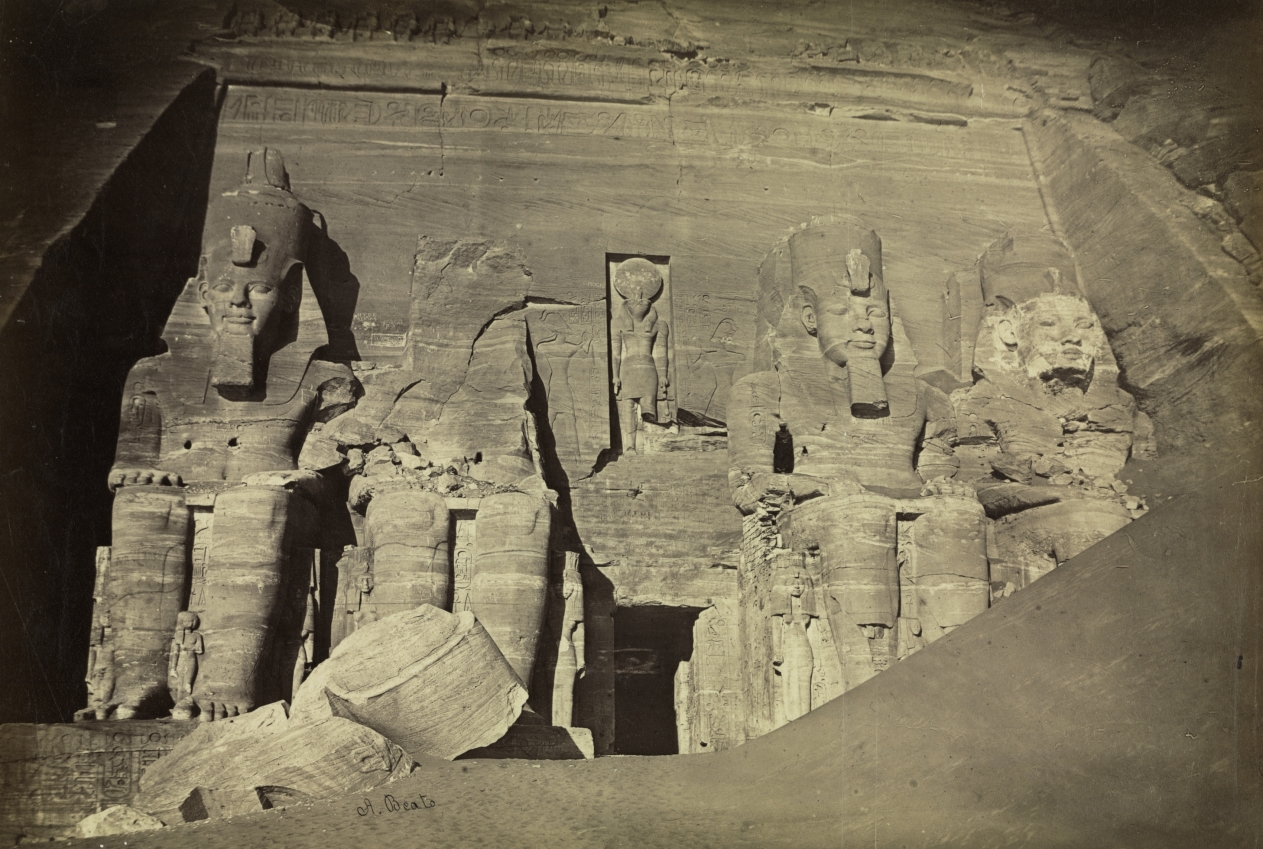
Geometric Integrity of the Temple of Ramesses II
The Temple of Ramesses II at Abu Simbel is not merely an architectural monument; it is a tectonic manifesto of power, permanence, and divine order. Its geometric integrity is defined by a rigorous, almost brutalist adherence to the orthogonal and the pyramidal. The colossal facade, carved directly into the living sandstone cliff, presents a series of four seated colossi, each over 20 meters in height. These figures are not naturalistic representations but rather hyper-simplified, block-like volumes. The torsos are monolithic cylinders, the limbs are rigid, and the faces are symmetrical to the point of abstraction. The entire composition is anchored by a central axis that bisects the entrance, creating a bilateral symmetry of absolute authority. The internal hypostyle hall, with its eight Osiride pillars, reinforces this language of structural compression and release. The pillars are not slender; they are massive, weight-bearing forms that visually press down upon the space. The ceiling, painted with celestial motifs, is a flat plane that contrasts with the vertical thrust of the pillars. This interplay of horizontal and vertical forces—the compression of the lintel against the verticality of the pillar—creates a dynamic tension that is both architectural and psychological. The geometry is one of containment: the temple is a series of nested chambers, each reducing in scale and increasing in darkness, culminating in the sanctuary where the four seated gods receive the first rays of dawn. This progression from the colossal exterior to the intimate interior is a spatial narrative of descent into the sacred, a journey from the public to the private, from the monumental to the personal.Structural Poetics: The 2026 Executive Silhouette
For the 2026 executive silhouette, the Temple of Ramesses II offers a radical departure from fluidity and ornamentation. The structural poetics here are those of the monolithic block and the compressed column. The executive silhouette must embody the same sense of grounded permanence and hierarchical order. This is not a silhouette of movement; it is a silhouette of stasis and authority. The primary structural element is the shoulder line. Borrowing from the horizontal lintel of the temple’s entrance, the shoulder should be broad, squared, and unyielding. A tailored, architectural jacket with a pronounced, almost exaggerated shoulder pad—not soft or rounded, but sharp and rectilinear—creates the visual equivalent of the temple’s facade. The lapel should be minimal, a simple notch or a sharp peak, echoing the clean lines of the Osiride pillars. The torso of the jacket should be cut with a slight suppression at the waist, but the overall volume remains generous, suggesting the mass of the colossi. This is a silhouette that does not drape; it stands. The trouser is equally architectural. It should be a straight, wide-leg cut, falling from the hip with a clean, unbroken line to the floor. The fabric should be heavy, with a dense, matte finish—think wool flannel or a bonded cotton twill. The hem should just brush the top of the shoe, creating a continuous vertical line that anchors the figure to the ground, much like the seated colossi are anchored to their stone plinths. The waistband should be high and structured, with a simple button closure and no belt loops, preserving the purity of the form. The inner layer—a blouse or a shell—must be treated as a secondary structural element. It should be high-necked, perhaps a mandarin collar or a mock turtleneck, to create a continuous column from the neck to the waist. The fabric should be a crisp, non-stretch material, such as a silk faille or a cotton poplin, to maintain the architectural integrity. No ruffles, no draping, no softness. The silhouette is a series of interlocking geometric planes: the horizontal shoulder, the vertical torso, the straight leg.Urban Materiality: Sand and Stone
The materiality of the Temple of Ramesses II is defined by its context: the Nubian sandstone, the desert sun, and the artificial lake created by the Aswan Dam. The color palette is a study in earth tones, specifically the Sand colorway. This is not a warm, golden sand; it is a dry, bleached, almost lunar sand—the color of sun-baked stone, of ancient dust, of a surface that has been eroded by millennia of wind and light. For the 2026 executive wardrobe, this materiality translates into a rigorous selection of fabrics and finishes. The primary fabric for the jacket and trouser should be a heavyweight wool crepe or a worsted wool with a tight, flat weave. The finish must be matte, with no sheen, to mimic the absorptive quality of sandstone. A slight slub or a subtle, irregular texture can be introduced to echo the granular surface of the temple’s stone, but the overall effect must remain smooth and uniform. The inner layer should be a silk charmeuse in a slightly lighter shade of Sand, but with a matte finish achieved through a sand-washing process. This creates a subtle contrast in texture—the smooth, cool silk against the dense, warm wool—without introducing a color shift. The buttons should be made of matte horn or corozo nut, in a tone that matches the fabric exactly, rendering them almost invisible. The stitching should be minimal, with flat-felled seams that lie flush against the fabric, reinforcing the idea of a monolithic surface. Accessories must be equally architectural. A belt should be a simple, wide strip of matte leather, the same Sand color, with a rectangular, brushed brass buckle. A bag should be a structured tote or a briefcase, made of a rigid, full-grain leather, with a clean, boxy silhouette and no external branding. The hardware should be minimal—a single, flat clasp. The overall effect is one of urban austerity: a wardrobe that is as unyielding and timeless as the temple itself, designed for the executive who commands space through presence, not through ornament.Conclusion: The Bodhisattva and the Bovine Amulet
The internal DNA of the Bodhisattva and the Amulet in the Form of a Seated Figure with Bovine Head provides a crucial counterpoint. The Bodhisattva represents an inward, compassionate geometry—a softening of the self into the world. The Bovine Amulet represents an outward, protective geometry—a hardening of the self against the world. The Temple of Ramesses II, in its monumental scale and rigid symmetry, aligns more closely with the latter. It is a fortress of the self, a declaration of permanence in the face of chaos. For the 2026 executive silhouette, this means a rejection of the fluid, the draped, and the empathetic. The silhouette is a protective shell, a monument to individual authority. It is not about comfort; it is about presence. It is not about movement; it is about stillness. The Sand colorway, the Minimalist category, and the structural poetics of the temple combine to create a wardrobe that is both a shield and a statement—a material manifestation of the executive’s unassailable position in the urban landscape. This is the definitive silhouette for the executive who understands that power is not expressed through volume or color, but through the absolute integrity of form.
Technical Insight
Technical Insight: Translating Sand palettes into Minimalist silhouettes for the modern metropolis.