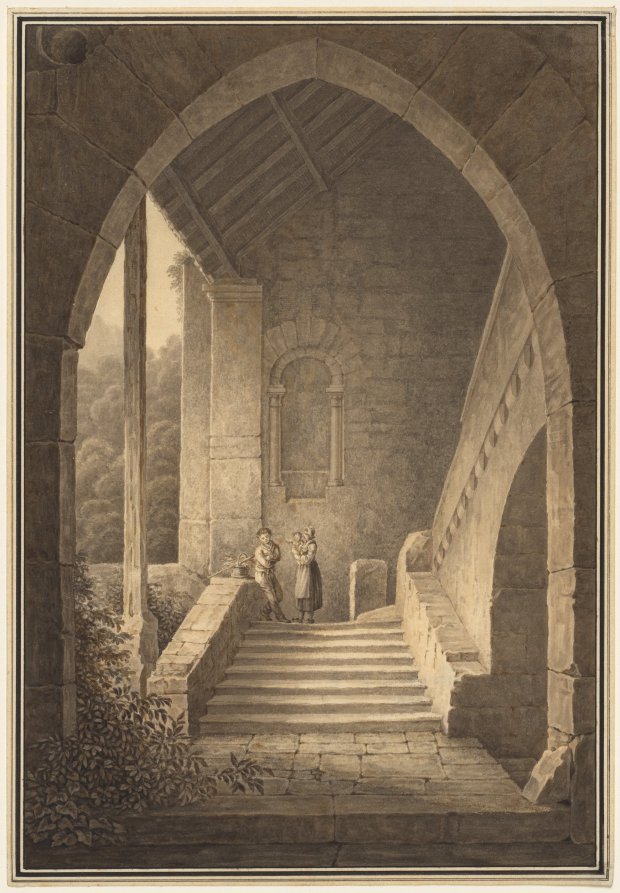
Urban Form: Outer Staircase of a Gothic Ruin
Structural Analysis: The Gothic Ruin as Architectural Framework
The outer staircase of a Gothic ruin presents a masterclass in collapsed geometry and structural memory. Its defining characteristic is the tension between vertical aspiration—the original intent of the Gothic arch and spire—and lateral disintegration, where time and entropy have introduced fractures, asymmetrical displacements, and exposed cross-sections. This is not chaos, but a recalibrated order. The spiral or fragmented stair treads create a series of irregular, repeating platforms and negative spaces, forming a non-linear but rhythmic progression. The silhouette extracted is one of imposed angularity upon a broken curve, where the sharp, fractured edges of stone define a jagged, yet profoundly intentional, outline against the sky. This is the foundational geometry for 2026: an architecture that remembers its form even in its deconstruction.
Silhouette Definition: The 2026 Executive Armature
For the 2026 executive silhouette, this analysis dictates a move beyond soft deconstruction toward rigorous, tailored fragmentation. The body becomes the central tower, and the garments are the applied, load-bearing buttresses and fractured staircases. Key geometric implementations include:
Asymmetric Seaming as Structural Fault Lines: Darts and seams will not follow traditional symmetrical patterns. Instead, they will emulate the cracks and shifts in the ruin’s stonework, slicing across the torso and sleeves to create unexpected facets and planes. A single, severe seam may run from the collarbone to the opposite hip, acting as a visual load-bearing axis.
The Cantilevered Shoulder: Inspired by crumbling corbels and overhanging stone, the shoulder line will be engineered to extend sharply, yet precisely, beyond the natural shoulder point. This is not padding for volume, but architectural projection, creating a silhouette of formidable, protective geometry. It suggests a fortress, albeit an open one.
Tiered Hemlines as Stair Treads: Jackets and coats will feature stepped, layered hemlines—shorter in the front, elongated and fractured at the sides or back. This creates a sense of ascending or descending form even in stasis, a direct translation of the staircase’s function into static, poetic shape.
Materiality: The Poetics of Urban Stone and Void
The material language must echo the ruin’s textural dichotomy: eroded surface and stark void. Slate, as the designated color, is not a flat grey but the chromatic essence of weathered lead, damp stone, and shadow. Its application is critical.
Primary Fabric: Technical Wool-Ceramic Blend. A fabric engineered to have the drape of heavy wool but the matte, cool rigidity of stone. It will hold the garment’s fractured seams with knife-edge precision, yet develop a subtle, personal patina—a modern erosion. This is the exposed outer wall of the silhouette.
Contrast Element: Micro-perforated Neoprene or Fused Technical Jersey. To articulate the concept of “void” and “negative space” seen in the ruin’s missing stones and window apertures, strategic panels will be implemented. These matte, slightly elastic black panels, placed within slash pockets or as insets beneath fractured seams, represent the absorbent darkness within the structure. They provide textural depth and a sense of layered history.
Hardware: Oxidized Silver Alloy. Fastenings and detail elements will be crafted from an alloy that mimics aged lead cames or rusted structural iron. Their function is overtly structural-poetic—visible hooks, asymmetric closures, and bar-like embellishments that appear to bind the garment’s fragments together, much like the metal supports in a preserved ruin.
Internal DNA Synthesis: The Dialogue of Absence and Ornament
The provided internal DNA—contrasting the transcendent emptiness of the Udumbara flower plaque with the worldly abundance of the Animal-Grape Mirror—informs the silhouette’s philosophical tension. The Tailored category is the vessel for this dialogue.
The Udumbara principle manifests in the silhouette’s extreme reduction and intentional emptiness. A single, severe line of seaming; a vast, unadorned slate plane across the back; a collar that stands away from the neck to create a architectural void—these elements are the “three-thousand-year bloom.” They are non-ornamental, demanding intellectual engagement to perceive their significance. They are the garment’s spiritual armature.
The Animal-Grape Mirror principle manifests in the coded, structural ornamentation. The micro-perforations in the technical panels are not random; they form subtle, geometric patterns reminiscent of abstracted grapevines or architectural tracery. The asymmetric seam lines themselves, in their complex intersections, create an implicit, almost heraldic pattern—a modern “瑞兽” (auspicious beast) woven into the garment’s very bones. This ornamentation is not applied; it is integral to the structure, a celebration of life and complexity embedded within the minimalist form.
Conclusion: The 2026 Executive Silhouette
The definitive 2026 executive silhouette for Addison Fashion is therefore a Tailored Armature of Fractured Ascension. It is a study in Slate and shadow, where geometric integrity is defined by the poetry of collapse and resilience. It translates the Gothic ruin’s vertical aspiration compromised by lateral reality into a wearable architecture for the urban executive. This silhouette does not merely clothe the body; it constructs a persona that is simultaneously fortified and open, reduced and complex, echoing the eternal dialogue between the transcendent void and the richly patterned now. It is a uniform for those who navigate the ruins of old systems while building new ones, their form a testament to both memory and fracture.