Urban Form: Mourner from the Tomb of Philip the Bold, Duke of Burgundy (1364–1404)
Executive Summary: The Architecture of Terminal Poise
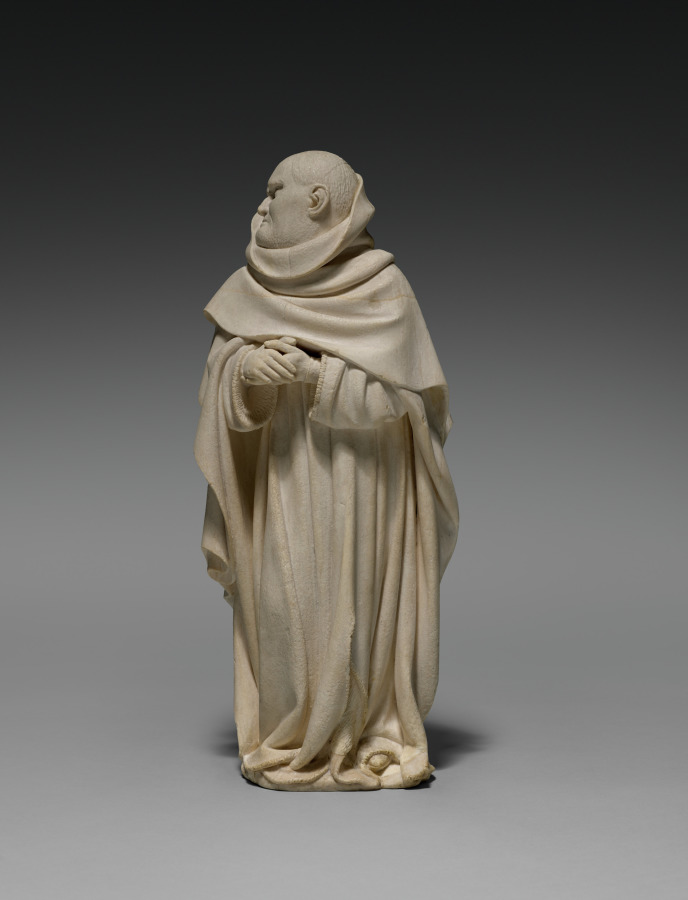
This Urban Silhouette Research deconstructs the Mourner from the Tomb of Philip the Bold as a primary formal referent. The subject—a pleurant figure carved in alabaster—embodies a state of grief so profound it becomes architectural. For the 2026 NYC executive wardrobe, this translates into a Minimalist strategy of controlled volume, weighted drape, and chromatic compression. The palette is anchored in Onyx, a near-black that absorbs light and narrative, functioning as a void from which form emerges. The analysis below synthesizes the DNA source’s dialectic between Western narrative finality (Socrates’ death) and Eastern object-based transcendence (the Jar Hu) to propose a wardrobe that is neither funereal nor decorative, but existentially precise.
I. Formal Deconstruction: The Pleurant as Urban Prototype
A. Silhouette Geometry: The Inverted Tear
The mourner’s cloak is not draped; it is carved gravity. The fabric falls in vertical, unbroken planes from the shoulders to the feet, creating a monolithic column. The hood, a deep cowl, obscures the face entirely, reducing the figure to a pure volume of cloth. This is the Minimalist ideal: the elimination of the individual in favor of the archetype. For the 2026 executive, this translates into a long-line, weight-forward coat—a double-faced wool or compacted cashmere in Onyx, cut with zero waist suppression. The shoulder is soft but defined, not padded, allowing the fabric to fall from a single point at the acromion. The hem drops to the mid-calf, terminating in a clean, un-hemmed edge that mimics the alabaster’s raw finish.
The key technical detail is the interior weight. The pleurant’s cloak is heavy; it does not flutter. To replicate this, the coat must incorporate a bonded interlining of wool felt or a micro-suede backing, ensuring the fabric behaves as a solid, not a textile. The front closure is a single, hidden magnetic placket—no buttons, no zippers, no visual interruption. The silhouette is a static volume, a mobile architecture that commands space through stillness, not movement.
B. Color as Void: Onyx and the Absorption of Light
The Onyx palette is not black. Black is a color; Onyx is a material condition. It is the color of polished jet, of deep water at midnight, of the alabaster’s shadow side. In the context of the Socrates narrative, Onyx represents the hemlock’s final darkness—the moment before dissolution. In the context of the Jar Hu, it is the glaze’s deepest tone, the “silence” of the fired clay. For the wardrobe, Onyx functions as a chromatic ground against which all other elements—skin, light, gesture—become figure.
Technically, this requires a fabric with a low sheen, high depth. A matte-finish virgin wool suiting with a 2x2 twill weave, or a compacted cashmere with a brushed surface, will absorb ambient light without reflecting it. The dye process must be a double-dip—immersed twice to ensure the color penetrates the fiber core, preventing fading and creating a “blacker than black” effect. This is not a color for camouflage; it is a color for disappearance into form.
II. The Dialectic of Death and Object: Translating Narrative into Wardrobe
A. The Socratic Gesture: The Armhole as Argument
The DNA source contrasts Socrates’ reaching hand—a gesture of rational transcendence—with the Jar’s static, self-contained volume. The mourner figure offers a synthesis: the arms are hidden within the cloak, but the fold lines at the elbows and shoulders create a map of internal tension. For the 2026 executive, this informs the armhole design. The sleeve must be cut with a high, narrow armhole (a “Socratic” fit) that allows full range of motion without disturbing the outer silhouette. The sleeve head is set with a slight forward pitch, creating a subtle diagonal line from the shoulder to the wrist—a visual echo of the philosopher’s final, deliberate reach.
The cuff is a deep, turned-back fold, 4 inches wide, that can be worn down (covering the hand like a mourner’s sleeve) or flipped up (revealing a raw, unlined interior). This dual function embodies the dialectic: the covered hand is the Jar’s silence; the exposed hand is Socrates’ gesture. Both are valid, and the garment allows the wearer to choose the mode of address.
B. The Hu Jar’s Void: The Interior as Aesthetic Statement
The Jar Hu is defined by its interior emptiness—the space that holds nothing but time. The mourner’s cloak, similarly, creates a void around the body. The 2026 wardrobe must treat the interior of the garment as a primary aesthetic surface. All seams are felled and finished in a contrasting Silver thread—a ghostly echo of the alabaster’s veining. The lining is a raw silk in Ivory, un-dyed and un-treated, visible only when the garment is opened. This is the “inner glaze” of the Hu jar: a secret, luminous space that the wearer knows exists, but the observer can only infer.
The pocket construction is critical. There are no external pockets. Instead, two internal, vertical welt pockets are set into the side seams, accessible through a hidden slit. These pockets are lined in the same Ivory silk, creating a small, private chamber within the Onyx volume. The act of reaching into the pocket is a ritual gesture, a momentary breach of the monolithic form that reveals the interior void.
III. Materiality and Finish: The Alabaster Effect
A. Surface Treatment: The Unpolished Edge
The mourner’s alabaster is not polished to a high gloss; it retains a matte, porous surface that catches light in a diffuse, soft manner. The 2026 fabric must replicate this. The wool or cashmere is fulled (a wet-finishing process that compacts the fibers and creates a felted surface) to eliminate any weave texture. The result is a monolithic, stone-like hand that feels cool to the touch and drapes with a liquid, heavy quality. The edges are left un-hemmed and raw, cut with a laser to prevent fraying, mimicking the alabaster’s fractured edges where the sculptor’s chisel stopped.
B. The Weight of Time: Density as Luxury
Luxury in this context is not softness; it is density. The fabric must weigh a minimum of 380 grams per square meter (GSM) for the coat, and 280 GSM for the base layer. This weight ensures the garment hangs with the gravity of the pleurant, resisting air currents and maintaining its architectural form. The wearer experiences the garment as a second skin of stone—a constant, grounding presence that slows movement and encourages deliberation. This is the opposite of fast fashion; it is slow, volumetric dressing for the executive who operates in the realm of long-term strategy, not quarterly results.
IV. The 2026 NYC Executive Wardrobe: Three Key Pieces
A. The Pleurant Coat (Onyx, Minimalist)
Form: Full-length, zero-waist, hidden closure. Fabric: Fulled virgin wool, 400 GSM. Details: Deep cowl hood that can be worn up (obscuring the face) or down (creating a high, stand-away collar). Internal Ivory silk lining. Raw, laser-cut hem. Function: A mobile architecture for the urban landscape. The coat is a statement of presence that requires no gesture, no color, no logo. It is the mourner’s cloak for the corporate funeral of the self.
B. The Hu Tunic (Onyx, Minimalist)
Form: A sleeveless, high-neck tunic that falls to the mid-thigh. Fabric: Compacted cashmere, 280 GSM. Details: A single, horizontal seam at the hip that creates a subtle, architectural break. The neckline is a mandarin collar with a hidden snap closure. The tunic is worn as a base layer under the coat, or alone in controlled environments. Its volume is contained, not expansive—a direct reference to the Jar Hu’s balanced, self-sufficient form.
C. The Socratic Trouser (Onyx, Minimalist)
Form: A wide-leg, high-waist trouser with a single, forward pleat. Fabric: Double-dip Onyx wool suiting, 320 GSM. Details: The waistband is a deep, 3-inch band that sits at the natural waist, creating a corset-like structure. The hem is cut to break at the floor, with a weighted chain sewn into the interior hem to ensure the fabric falls in a clean, vertical line. The trouser is the foundation—the base upon which the coat and tunic rest. It is the philosopher’s robe, modernized for the boardroom.
V. Conclusion: The Aesthetics of Terminal Poise
The mourner from the Tomb of Philip the Bold is not a figure of despair; it is a figure of absolute composure in the face of the absolute. The 2026 NYC executive wardrobe, derived from this form, rejects the transient, the decorative, and the expressive. It embraces the Minimalist as a philosophical position: that the highest form of elegance is the elimination of the unnecessary. The Onyx palette is not a color choice; it is a material truth—the absorption of all light, the end of all