Tailored
Onyx
Urban Form: Mourner from the Tomb of Philip the Bold, Duke of Burgundy (1364–1404)
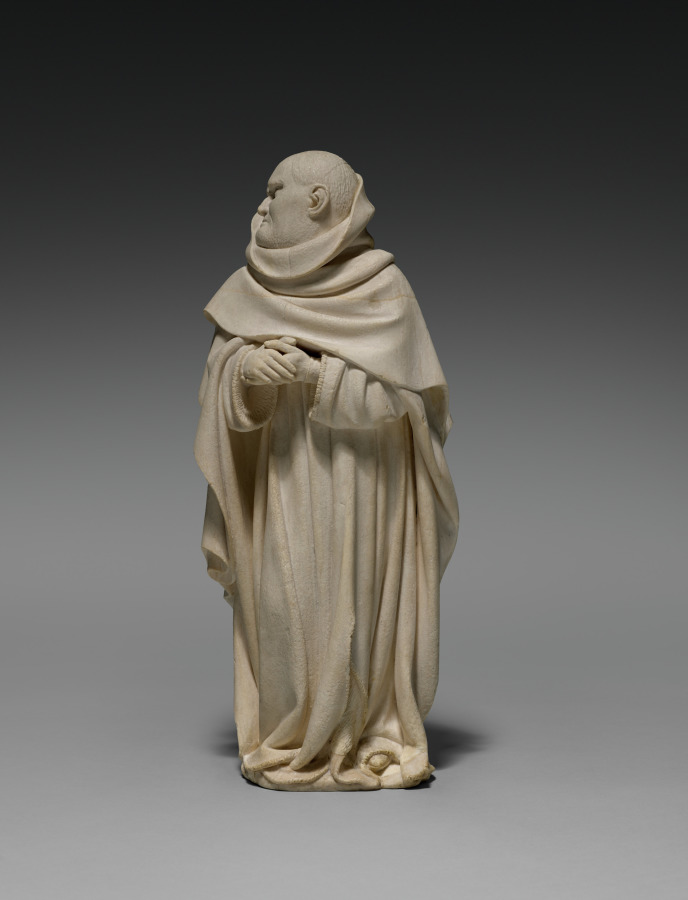
Deconstructing the Mourner: A Technical Analysis of Form and Color for the 2026 NYC Executive Silhouette
The subject of this Urban Silhouette Research is the *Mourner from the Tomb of Philip the Bold, Duke of Burgundy* (1364–1404). This figure, a pleurant carved in alabaster, is not merely a representation of grief; it is a masterclass in the architectural containment of emotion. For the 2026 NYC executive wardrobe, this artifact offers a profound lexicon of form, color, and psychological presence. The DNA source—the juxtaposition of Greek vase painting and Indian bas-relief, specifically *The Death of Socrates* and the *Stele with Sakyamuni and Bodhisattvas*—provides the dialectical framework. The Mourner sits at the intersection of these two poles: the heroic, rational stillness of Socrates and the transcendent, mineralized serenity of the Buddha. From this synthesis emerges a silhouette that is both a shield and a statement.I. The Architecture of Grief: Form as a Container for Power
The Mourner’s form is defined by its geometric compression. The figure is enveloped in a heavy, voluminous cloak that falls in deep, vertical folds. This is not the fluid, organic drapery of Hellenistic sculpture; it is a structured, almost architectural casing. The shoulders are hunched, the head is bowed, and the hands are hidden within the fabric. The silhouette is a near-perfect rectangle, a block of material that absorbs and contains the energy of mourning. This is the antithesis of the Socratic gesture—the upward-pointing finger, the open, declarative posture. The Mourner’s form is inward-facing, a closed system. For the 2026 executive, this translates directly into a tailored, high-shoulder, elongated jacket. The line must be clean, uninterrupted, and severe. The shoulder pad is not for breadth but for structural definition, creating a clear, architectural line from the neck to the sleeve head. The fabric—a dense, matte wool or a bonded crepe—must have zero drape. It must hold its shape, resisting the body’s movement to create a static, powerful presence. The key technical detail is the concealment of the hand. The Mourner’s hands are lost in the folds, suggesting a state of deep, unexpressed interiority. In the 2026 wardrobe, this is achieved through a deep-set armhole and a slightly extended sleeve length, allowing the hand to disappear into the cuff. This is not a gesture of vulnerability but of controlled power. The executive’s hands are not on display; they are weapons held in reserve. The silhouette becomes a fortress, a mobile architecture of authority.II. The Color of Stone: Onyx as a Material Statement
The color palette is drawn directly from the alabaster of the Mourner and the mineral pigments of the *Stele*. We select Onyx—a deep, non-reflective black that absorbs light rather than reflecting it. This is not the glossy black of evening wear; it is the matte, sedimentary black of stone, of the earth from which the figure is carved. It is the color of the void, of the space between the Socratic finger and the Buddha’s stillness. Onyx, in this context, operates on multiple levels. First, it is a color of negation. It denies the vibrancy of the mineral pigments in the *Stele* and the bright, idealized white of Greek marble. It is the color of the tomb, of the end of narrative. Second, it is a color of absorption. Like the Mourner’s cloak, Onyx absorbs all external stimuli, creating a field of psychological gravity around the wearer. The executive in Onyx is not a participant in the environment; they are the environment. This color choice is a direct response to the dialectic of the DNA source. The Socratic death is a drama of light and shadow, of rational clarity. The Buddha’s death is a drama of color and flow, of transcendent warmth. The Mourner’s Onyx is the synthesis: a color that contains both the coldness of stone and the depth of mineral pigment. It is the color of permanent mourning, of a grief that has been formalized into a system. For the 2026 executive, this translates into a wardrobe that is monochromatic and tonal. The entire look—jacket, trousers, top, shoe—must be in Onyx, with variations in texture (matte wool, polished leather, matte silk) providing the only visual interest.III. The Silhouette of the Void: Applying the Socratic-Buddhist Dialectic
The Mourner’s form is a static, vertical block. This is the core of the 2026 silhouette. The jacket is long, reaching the mid-thigh or even the knee, with a straight, boxy cut. There is no waist suppression. The line is a pure, uninterrupted vertical. This is the anti-body silhouette, a rejection of the feminine or masculine curves in favor of a neutral, architectural form. The trousers are equally straight, falling from the hip without taper, creating a continuous column of Onyx. This silhouette is a direct reference to the geometric containment of the Socratic death. The figure of Socrates is a study in controlled, rational form. His body is a vessel for his intellect. The Mourner takes this one step further: the body is a vessel for absence. The 2026 executive, in this silhouette, is not displaying their physical form but their mental and strategic presence. The body becomes a tool, a piece of architecture designed for function and authority. The Buddhist influence appears in the treatment of the surface. The *Stele* uses mineral pigments to create a surface that is both solid and ethereal, a paradox of material and spirit. In the 2026 wardrobe, this is achieved through textural layering. The Onyx jacket is in a dense, felted wool. The trousers are in a slightly lighter, matte crepe. The top is a silk georgette, also in Onyx, with a subtle, almost imperceptible sheen. The effect is a monochromatic depth, a surface that is not flat but has a mineral, sedimentary quality. The wearer appears carved from a single block of stone, yet the subtle shifts in texture create a sense of internal life, a quiet, contained energy.IV. The 2026 Executive: A Living Pleurant
The final silhouette is a tailored, architectural column in Onyx. The jacket is long and boxy, with a high, structured shoulder and a deep-set armhole. The trousers are straight and floor-length. The only accessory is a single, flat, matte black shoe—a loafer or a boot—that disappears into the hem. The hair is pulled back, the face is bare of makeup, and the expression is neutral. This is the Mourner as executive. The figure is not sad; they are present. They are a container for the weight of the organization, the gravity of the decision. The silhouette is a formalization of grief—not personal grief, but the grief of the market, the grief of the quarterly loss, the grief of the strategic pivot. The executive in Onyx does not express emotion; they embody it. They are the stone that absorbs the shock. The 2026 NYC executive wardrobe, derived from the Mourner, is a system of containment. It is a rejection of the fluid, the expressive, the organic. It is a return to the primacy of form, to the idea that power is not performed but held. The Socratic finger points upward; the Buddha’s hand rests in stillness. The Mourner’s hands are hidden. The 2026 executive, in their Onyx column, does not point and does not rest. They simply are. And in that being, they command.
Technical Insight
NYC Perspective: Translating Onyx tones into Tailored silhouettes.