Urban Form: Dragon
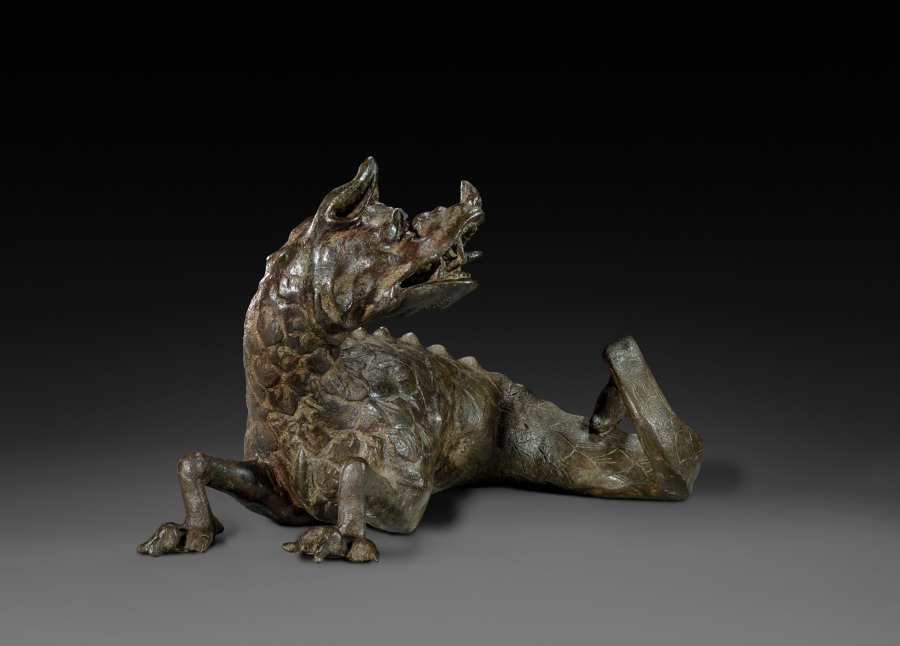
Structural Poetics: The Dragon as Architectural Silhouette
The dragon, as rendered in the comparative analysis of the Damascus Room and the He Xiangu base, emerges not as a figurative ornament but as a structural principle. For the 2026 executive silhouette, this principle dictates a form that is simultaneously layered and voided. The dragon’s body is not a single line but a series of overlapping planes—scales, spines, and sinuous curves—that create a dense, protective carapace. This is the Oversized category’s mandate: volume that does not overwhelm but rather encloses the wearer in a controlled, architectural envelope. The silhouette is defined by a broad, sculpted shoulder line that mimics the dragon’s powerful thoracic arch, tapering to a narrow, articulated waist that suggests the creature’s coiled energy. The hem falls in a clean, uninterrupted column, referencing the verticality of the Damascus Room’s wall panels, while the interior structure—a hidden system of boning and canvas—echoes the layered substructure of the He Xiangu base, providing a hidden foundation for the outward form.
The geometric integrity of this silhouette is rooted in the dialectic between accumulation and subtraction. The Damascus Room’s “layered abundance” is translated into a jacket or coat with multiple, overlapping panels—each cut with a precise, asymmetrical geometry that references Islamic geometric patterns. These panels are not merely decorative; they create a visual rhythm of light and shadow, a urban materiality that plays with the opacity and sheen of Onyx-dyed wool and bonded leather. The “void” at the center of the room—the space for human activity—becomes the negative space of the garment: a deep, open neckline or a strategically placed cutout that reveals a contrasting inner layer of Ivory-colored silk. This is not a gap but a deliberate absence, a moment of breath within the dense structure, mirroring the He Xiangu base’s function as a “transition” between the earthly and the transcendent. The dragon’s spine is suggested by a central seam that runs the length of the back, a vertical axis that anchors the entire composition, much like the calligraphic bands in the Damascus Room organize the visual chaos of its surfaces.
Urban Materiality: Onyx and the Architecture of Light
The choice of Onyx as the primary color is not arbitrary. It is the color of deep space, of polished stone, of the void that the Damascus Room’s decoration seeks to contain. In the 2026 executive silhouette, Onyx functions as a neutral ground against which the structural details emerge. The fabric itself must possess a mineral quality—a dense, matte finish that absorbs light rather than reflects it, creating a surface that is both monolithic and tactile. This is achieved through a double-faced wool crepe, bonded with a micro-fiber backing to ensure a crisp, unyielding drape. The dragon’s scales are not printed but constructed: small, overlapping panels of leather or patent material are stitched onto the wool in a repeating, tessellated pattern, their edges catching the ambient light of the urban environment. This is a material translation of the He Xiangu base’s layered cloud and lotus motifs—each scale a micro-architecture that contributes to the whole.
The urban materiality is further emphasized by the use of hardware. Instead of traditional buttons, the closure is a series of interlocking, gunmetal-toned clasps that resemble the dragon’s claws. These are not merely functional but sculptural elements, placed at asymmetrical intervals to disrupt the garment’s vertical flow and create a sense of dynamic tension. The interior is lined with a Silver-colored silk jacquard, a hidden luxury that references the reflective surfaces of the Damascus Room’s tiles and the luminous quality of the He Xiangu painting’s base. This contrast between the matte exterior and the reflective interior is a poetic gesture: the garment, like the room, encloses a space of inner radiance. The pockets are cut on the bias, their openings framed by a thin strip of Slate-colored suede, adding a layer of texture that invites touch and reinforces the tactile hierarchy of the design.
The Executive Silhouette: A Synthesis of Power and Transcendence
The 2026 executive silhouette, as defined by this dragon research, is not about aggression but about contained power. The Oversized form is a sartorial fortress, a mobile architecture that projects authority without overt display. The structural poetics of the dragon—its layered scales, its coiled strength, its vertical ascent—are distilled into a garment that is both a shield and a statement. The wearer is not merely dressed but inhabited by the silhouette, much as the Damascus Room’s inhabitants were enveloped by its decorative universe. The void at the center of the design—the open neckline or the cutout—is the point of human connection, the space where the garment yields to the body, allowing for movement and breath. This is the transcendence of the He Xiangu base: the garment lifts the wearer from the mundane to the symbolic, transforming them into a figure of urban mythos.
The geometric integrity is maintained through a rigorous pattern-cutting process. Each panel is drafted with a mathematical precision that echoes the Islamic geometric patterns of the Damascus Room. The shoulder seam is set forward, creating a dragon’s wing effect—a slight extension that broadens the upper body without adding bulk. The sleeve is cut in a single, continuous piece from shoulder to cuff, a kimono-inspired construction that allows for fluid movement while maintaining the garment’s architectural line. The hem is weighted with a hidden chain, ensuring that the silhouette falls with a deliberate gravity, anchoring the wearer to the ground. This is a garment for the executive who commands space—not through volume alone, but through the intentionality of every line, every seam, every material choice.
In conclusion, the dragon is not a motif but a methodology. The 2026 executive silhouette, rendered in Onyx and constructed with the layered abundance of the Damascus Room and the transcendent structure of the He Xiangu base, becomes a wearable architecture. It is a study in urban materiality, where the cold, polished surfaces of the city are translated into fabric and form, and where the void is as important as the mass. This is the definitive silhouette for the executive who understands that true power lies not in display but in the controlled articulation of space—a dragon that does not roar, but simply exists, in perfect, geometric stillness.