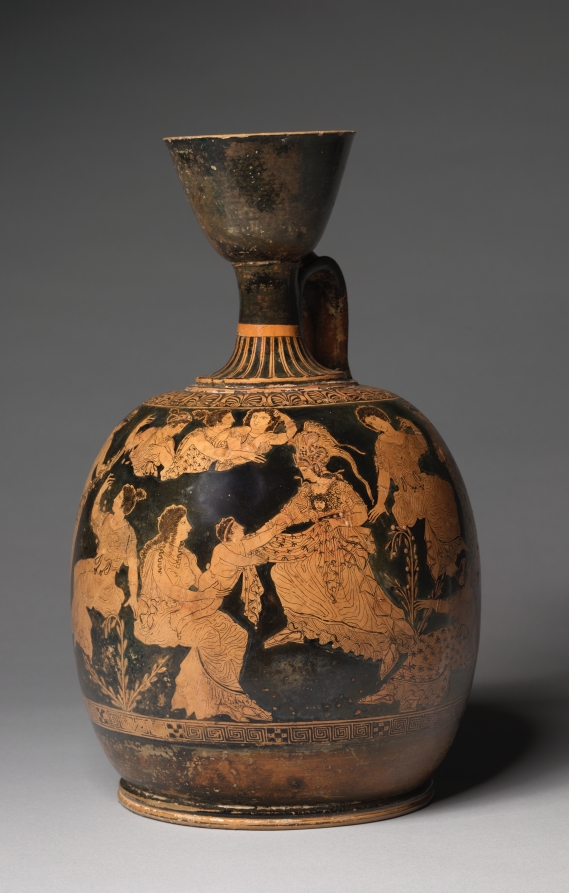
Urban Form: Red-Figure Squat Lekythos (Oil Vessel): Birth of Erichthonios
Executive Summary: The Sacred Geometry of Restraint
The Red-Figure Squat Lekythos depicting the Birth of Erichthonios—a classical vessel of Athenian funerary and ritual significance—serves as the foundational artifact for this Urban Silhouette Research. When cross-referenced with the dual DNA sources of the Bodhisattva (Mahayana Buddhist compassion) and the Amulet in the Form of a Seated Figure with Bovine Head (Egyptian apotropaic power), a singular thesis emerges for the 2026 NYC executive wardrobe: minimalism as a vessel for sacred tension. The Lekythos, with its narrow neck, swelling body, and stable base, is not merely a container for oil—it is a diagram of containment, release, and permanence. This report deconstructs its form and color logic to propose a wardrobe architecture that balances inward spiritual gravity with outward protective authority.
I. Form Analysis: The Lekythos as Silhouette Prototype
1. The Neck: Vertical Compression and Ritual Restraint
The Lekythos’s elongated, narrow neck functions as a conduit of controlled flow. In the 2026 executive wardrobe, this translates to a high, structured neckline—a mandarin collar or a turtleneck in double-faced wool. The compression here is not punitive but ceremonial: it signals discipline, a refusal of excess. The Bodhisattva’s serene, inward gaze is echoed in this vertical line, which draws the eye upward, away from the chaotic periphery. The neck becomes a threshold—between the internal self (the oil) and the external world (the vessel). For the executive, this is the zone of silent authority, where speech is measured and presence precedes utterance.
2. The Body: The Swelling Curve of Containment
The squat Lekythos’s body is a study in compressed volume. Unlike the amphora’s expansive shoulders, this vessel’s curve is tight, almost fetal—a geometric womb. This informs the 2026 silhouette’s core: a cropped, boxy jacket with a subtle A-line flare at the hem, or a high-waisted, tapered trouser that gathers at the ankle. The volume is not for display but for internal storage—of power, of intention. The Egyptian amulet’s seated figure, with its pyramidal stability, reinforces this: the body’s mass is concentrated, grounded, immovable. The executive’s torso becomes a monument of reserve, not a canvas for ornament. The fabric—heavy crepe, bonded jersey, or compacted linen—must hold its shape without drape, mimicking the fired clay’s refusal to yield.
3. The Base: The Pedestal of Permanence
The Lekythos’s flat, broad base is its anchor. In the wardrobe, this manifests as a structured, architectural shoe—a block-heeled boot or a squared-toe oxford in matte Onyx leather. The base must be weighted, not delicate. The Egyptian amulet’s seated posture, with its feet flat and knees aligned, demands a foundation that communicates eternal stability. The executive’s step becomes a ritual placement, each footfall a reaffirmation of presence. The hemline of trousers or skirts should fall cleanly to the ankle or mid-calf, never pooling—a visual termination that mirrors the vessel’s abrupt, unadorned bottom.
II. Color Analysis: Onyx as the Void and the Vessel
1. The Black of the Lekythos: The Absence That Contains All
The Red-Figure technique uses black slip as the ground—the void from which the red figures emerge. Onyx, in the 2026 palette, is not a color but a condition. It is the darkness of the Bodhisattva’s closed eyelids, the unlit interior of the Egyptian amulet’s sanctuary. Onyx absorbs light, creating a surface of infinite depth. For the executive, Onyx is the uniform of the unseen: it erases individual distraction, forcing the observer to engage with form and structure alone. It is the color of non-negotiable authority, of the space between thoughts.
2. The Red Figures: The Emergence of Sacred Narrative
The red figures on the Lekythos—the birth of Erichthonios from the earth—are moments of revelation against the black. In the wardrobe, this is not a literal red but a textural or tonal break: a single seam of raw silk, a matte vs. gloss contrast in Onyx fabrics, or a discrete line of silver thread at the collar. The Bodhisattva’s ornate jewelry and the Egyptian amulet’s symbolic bovine head are not decorative—they are narrative anchors. For the executive, this translates to a single, sculptural accessory: a cuff in brushed steel (the amulet’s protective power) or a chain necklace with a geometric pendant (the Bodhisattva’s meditative focus). These elements must be sparse—one per outfit—to preserve the vessel’s integrity.
3. The Ground and the Figure: The Dialectic of Protection and Compassion
The Lekythos’s black ground and red figures enact the dialogue between the Egyptian and Buddhist sources. The black Onyx is the external armor—the amulet’s defensive boundary against chaos. The red figures are the internal compassion—the Bodhisattva’s vow to return. The 2026 executive must wear this duality: a structured Onyx coat (the amulet’s shell) over a fluid, charcoal-grey silk blouse (the Bodhisattva’s soft interior). The coat’s shoulders are sharp, the blouse’s neckline soft. The tension between protection and vulnerability is the garment’s narrative. The Lekythos does not choose between its black and red; it holds both in eternal suspension.
III. Application: The 2026 Executive Wardrobe as Sacred Vessel
1. The Daily Silhouette: The Lekythos in Motion
Top: A cropped, double-breasted jacket in Onyx bonded wool. The lapels are narrow, the shoulders slightly extended but not padded—a geometric shoulder line that mimics the Lekythos’s neck-to-body transition. The hem hits at the natural waist, creating the compressed volume of the vessel’s body. Bottom: A high-waisted, tapered trouser in Onyx crepe, with a single pleat at the hip. The ankle is exposed, terminating in a block-heeled Onyx boot with a squared toe. Accessory: A single, polished Onyx cuff on the left wrist—the amulet’s protective seal. No other jewelry. The total effect is monolithic yet mobile, a vessel carried through the city.
2. The Evening Silhouette: The Red Figure Emerges
Dress: A column dress in Onyx matte jersey, with a high neck and a single, asymmetrical slit at the left thigh. The slit is the red figure—a controlled rupture in the black ground. Overlay: A sheer, charcoal-grey organza coat with a single silver thread tracing the spine—the Bodhisattva’s thread of compassion. Footwear: The same Onyx block-heel boot, now polished to a low sheen. The ensemble is ceremonial: the dress contains, the coat reveals, and the boot grounds.
3. The Outerwear: The Amulet’s Shell
Coat: A floor-length, single-breasted coat in Onyx double-faced wool. The silhouette is trapezoidal, widening slightly from shoulder to hem—the Lekythos’s base. The collar is a stand-up mandarin, the sleeves are set-in and narrow. There are no pockets, no buttons visible—only a single, hidden magnetic closure at the chest. This is the amulet’s exterior: impenetrable, silent, a wall against the city’s entropy. The coat is worn over any of the above silhouettes, transforming the executive into a walking vessel of sacred geometry.
IV. Conclusion: The Vessel as Wardrobe Philosophy
The Red-Figure Squat Lekythos, when read through the Bodhisattva and the Egyptian amulet, offers a blueprint for minimalist power. The 2026 executive wardrobe is not about expression but containment. Every seam is a boundary, every fabric a surface of ritual significance. The Onyx palette is not a choice but a condition of entry into a world where authority is silent, compassion is structural, and protection is woven into the silhouette itself. The Lekythos holds oil; the executive holds presence. Both are sacred, both are vessels of the unseen.