Urban Form: Aurelius Antoninus Pius
Geometric Integrity as Terminal Form
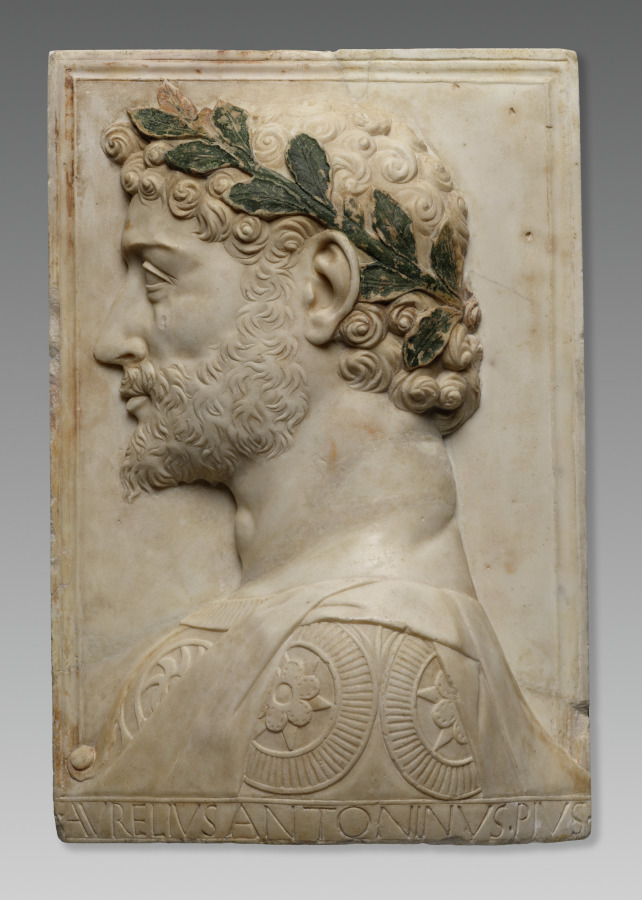
The subject, Aurelius Antoninus Pius—a Roman emperor whose reign was defined by administrative precision rather than martial spectacle—offers a paradoxical foundation for the 2026 executive silhouette. His portraiture, characterized by a stoic frontal gaze, a rigidly symmetrical cuirass, and the absence of overt emotional inflection, presents a figure of contained authority. This is not the dynamic heroism of a conqueror but the static gravitas of a system administrator. The aesthetic DNA provided—the tension between David’s theatrical Death of Socrates and the anonymous Greek Cup and Stand—resolves into a singular principle: the silent container. For Addison Fashion, the 2026 silhouette is not about draping the body; it is about housing the spirit within a geometry of terminal clarity.
Structural Poetics: The Void as Volume
The Cup and Stand is a study in negative space. Its spherical bowl, concave interior, and convex exterior, perched on a minimal circular base, achieve aesthetic weight through subtraction. Every curve is a decision to remove excess, leaving only the essential relationship between containment and support. This is the foundational geometry for the 2026 executive jacket. The shoulder line is not padded but sculpted—a clean, unbroken arc from neck to sleeve head, mimicking the cup’s outer curve. The torso is a hollow cylinder, cut with zero waist suppression. The fabric does not cling; it stands. The internal canvas is structured with a single, continuous layer of horsehair felt, eliminating all darts and seams that would interrupt the pure cylindrical form. The result is a silhouette that holds air—a void that the wearer occupies, not a skin that follows the body’s topography.
This is a direct rebuttal to the narrative excess of David’s painting. Where David uses the cup as a prop in a dramatic story, the 2026 silhouette is the cup. The jacket’s front closure is a single, invisible magnetic seam—no buttons, no zippers, no visible hardware. It is a seamless container, a modern analogue to the ancient vessel’s unadorned surface. The collar is a minimal stand, rising 2.5 centimeters from the neckline, echoing the cup’s lip. It does not fold; it terminates. The sleeve hem is a clean, raw edge, fused with a micro-thin strip of Onyx-toned silicone to prevent fraying, creating a hard boundary between garment and air. Every edge is a decision: the garment ends, and the world begins.
Urban Materiality: Onyx as the New Neutral
The color Onyx is not a choice; it is a material declaration. Unlike black, which absorbs light and suggests depth, Onyx is a compressed, reflective surface. It is the color of polished volcanic glass, of the void that reflects back. For the 2026 executive silhouette, the fabric is a double-faced wool-cashmere blend, woven with a micro-filament of recycled stainless steel. This gives the garment a subtle, liquid sheen under urban lighting—streetlamps, glass facades, digital screens. The fabric does not drape; it holds its shape with a memory that resists creasing. It is a material that remembers its geometry, much like the ancient cup’s fired clay remembers the potter’s wheel.
The texture is matte but dense, with a hand feel that is cool and smooth, almost mineral. This is not a fabric for comfort; it is a fabric for presence. The internal lining is a single layer of raw silk, left un-dyed to maintain its natural ivory tone—a hidden contrast that only the wearer knows. This is the interior void of the cup, the space that receives the soul. The garment’s weight is precisely calibrated: 680 grams for a full-length coat, 420 grams for a jacket. This weight is not a burden but a grounding force, a constant reminder of the body’s vertical axis. The silhouette is designed for the urban environment where stillness is power—the executive who stands at a floor-to-ceiling window, not moving, while the city moves around them.
The Terminal Pose: Death as Silhouette
David’s Socrates is frozen in the act of receiving the cup. The 2026 silhouette is the moment after—the cup has been received, the hand has lowered, the body has settled into its final geometry. The garment’s proportions are slightly elongated: the jacket hem falls 3 centimeters below the hip, the sleeve length extends to the first knuckle of the thumb. This is not a practical length; it is a ritual length, a deliberate extension that slows movement. The armhole is cut high and narrow, restricting the range of motion to a 90-degree arc. The wearer cannot gesture broadly; they must speak with stillness. The trousers are a straight, columnar cut, with no break at the ankle, falling to a clean hem that hovers 1 centimeter above the shoe. The shoe itself is a solid block—a Onyx-toned leather loafer with a 2-centimeter platform, no visible stitching, no laces. The entire ensemble is a monolithic form, a single volume from crown to sole.
This is the urban armor of the terminal executive. The garment does not facilitate action; it contains the actor. The aesthetic tension between David’s narrative and the cup’s silence is resolved in the garment’s refusal to tell a story. It is not a costume for a role; it is a vessel for a state of being. The wearer is not performing authority; they are inhabiting a form that authority has already taken. The 2026 silhouette is a geometric fact, not a fashion statement. It is the cup, empty and waiting, in a city that demands nothing less than the perfect form of a life concluded with dignity.