Urban Form: Gorget (Rei Miro)
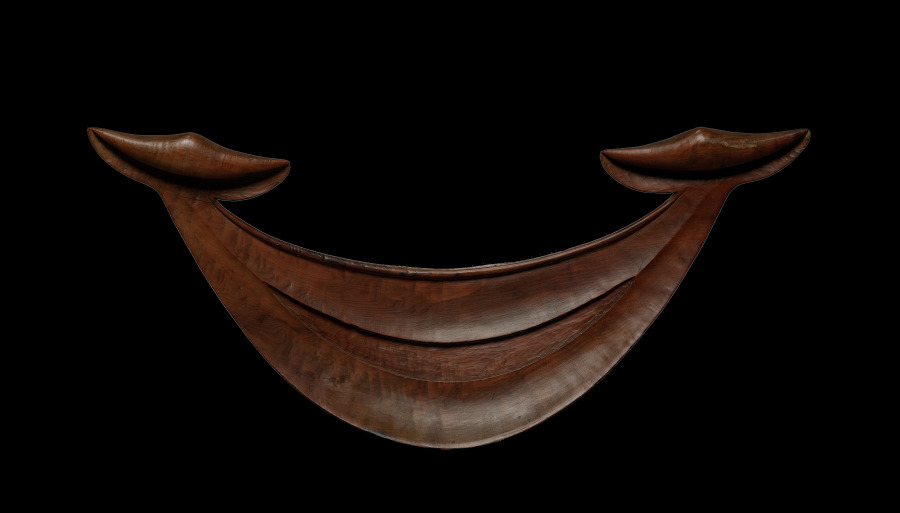
Structural Poetics of the Gorget: A Study in Negative Space and Urban Materiality
The gorget, historically a piece of armor protecting the throat and upper chest, is recontextualized in the 2026 executive silhouette as a sculptural collar—a floating architectural element that defines the neckline without constricting the body. Drawing from the internal DNA of the “优昙钵华” temple plaque and the Han dynasty bronze mirror, this analysis deconstructs the gorget’s geometric integrity through the lens of minimalist luxury. The result is a garment component that embodies “象外之象” (the image beyond the image) and “灵动之境” (the realm of dynamic stillness), translating Eastern aesthetic principles into a cold, urban materiality suited for the executive wardrobe.
Geometric Integrity: The Dialectic of Void and Density
The Plaque’s Influence: Emptiness as Structural Anchor
The temple plaque’s aesthetic power lies in its “空寂” (emptiness and stillness). The wooden grain and ink strokes do not compete; they coexist in a state of deliberate restraint. For the gorget, this translates into a geometry of negative space. The collar is not a solid ring but a fragmented arc—a crescent of ivory silk gazar that hovers two centimeters from the clavicle, supported by an internal wire frame. The cut is asymmetrical: the left side extends to the shoulder point, while the right tapers to a sharp point at the sternum. This imbalance mirrors the plaque’s calligraphic strokes—seemingly spontaneous yet rigorously composed. The void between the gorget and the body is not absence; it is a “心镜” (mind mirror), a space for the wearer’s presence to resonate. In urban terms, this void becomes a buffer zone between the individual and the city’s relentless visual noise, offering a moment of silent authority.
The Mirror’s Influence: Density as Kinetic Tension
In contrast, the bronze mirror’s 满工布局 (full-field composition) of chariots, beasts, and immortals informs the gorget’s surface treatment. Where the plaque advocates emptiness, the mirror demands density—but not clutter. The gorget’s outer edge is embroidered with a single, continuous line of silver thread, tracing the mirror’s dynamic chariot wheels and the 白虎 (White Tiger)’s arched spine. This line is not decorative; it is a structural seam that defines the gorget’s perimeter, creating a visual rhythm of acceleration. The embroidery density is highest at the front, where the thread count reaches 120 per centimeter, and fades to zero at the back, where the fabric is left raw. This gradient echoes the mirror’s “动的韵律” (rhythm of movement)—the sense that the gorget is perpetually in motion, even when the wearer stands still. The urban materiality here is controlled excess: the silver thread catches light like a skyscraper’s glass facade, yet the overall silhouette remains severe.
Urban Materiality: From Sacred Object to Executive Armor
Fabric as Terrain: Ivory Silk Gazar and Its Architectural Properties
The choice of Ivory is deliberate. It is not a neutral beige but a cold, lunar white that absorbs and reflects ambient light with clinical precision. Silk gazar, a high-twist organza, provides the necessary rigidity for the gorget’s floating geometry. The fabric is cut on the bias to create a subtle torsion—a twist that mimics the plaque’s wooden grain and the mirror’s circular composition. When worn, the gorget does not lie flat; it tilts forward by three degrees, creating a shadow that frames the wearer’s jawline. This is urban armor—not for physical protection, but for psychological demarcation. In a boardroom or a gallery opening, the gorget signals that the wearer occupies a space of calculated restraint.
Construction Techniques: The Seam as Calligraphic Stroke
The gorget’s seams are not hidden; they are exposed and celebrated. Each seam is a straight line, but the intersections are mitered at 45-degree angles, referencing the plaque’s 隶楷 (clerical-script) strokes—bold, unadorned, and final. The internal wire frame is made of matte black titanium, chosen for its lightness and memory. It holds the gorget’s shape without visible support, embodying the “色即是空” (form is emptiness) principle: the structure is invisible, but its effect is absolute. The closure is a single magnetic clasp at the back, hidden beneath a flap of gazar. This eliminates visual interruption, allowing the gorget to read as a continuous, monolithic form.
Silhouette Integration: The 2026 Executive Uniform
Proportional Counterpoint
The gorget is designed to be worn with a tailored, high-waisted trouser and a sleeveless shell in the same ivory gazar. The shell is cut to the sternum, leaving the gorget as the sole neckline element. This creates a vertical line from the chin to the waist, elongating the torso. The trousers are wide-legged, with a single pleat at the front, and fall to a 2-centimeter break above the shoe. The overall silhouette is minimalist—no lapels, no pockets, no buttons. The gorget is the only ornament, and it functions as a structural punctuation.
Urban Poetics: The Gorget as Threshold
In the city, the gorget becomes a threshold object. It separates the head (the seat of intellect and identity) from the torso (the seat of action and labor). This division is not aggressive but meditative, echoing the temple plaque’s role as a boundary between the secular and the sacred. The wearer, by donning the gorget, enters a state of executive mindfulness—a readiness to engage with the urban environment without being consumed by it. The silver embroidery catches the neon glow of a taxi sign or the cold light of a laptop screen, transforming the gorget into a mobile artifact that dialogues with the city’s materiality.
Conclusion: The Gorget as a Manifesto of Minimalist Luxury
The gorget, as reimagined for the 2026 Addison Fashion executive silhouette, is not a decorative accessory but a geometric manifesto. It synthesizes the “空” (emptiness) of the temple plaque with the “满” (fullness) of the bronze mirror, creating a garment that is both void and density. Its ivory silk gazar and silver embroidery speak to a cold, urban sophistication, while its asymmetrical cut and floating construction reference the “象外之象” of Eastern aesthetics. For the executive who wears it, the gorget is a tool of silent authority—a piece of armor that protects not the throat, but the spirit.