Minimalist
Sand
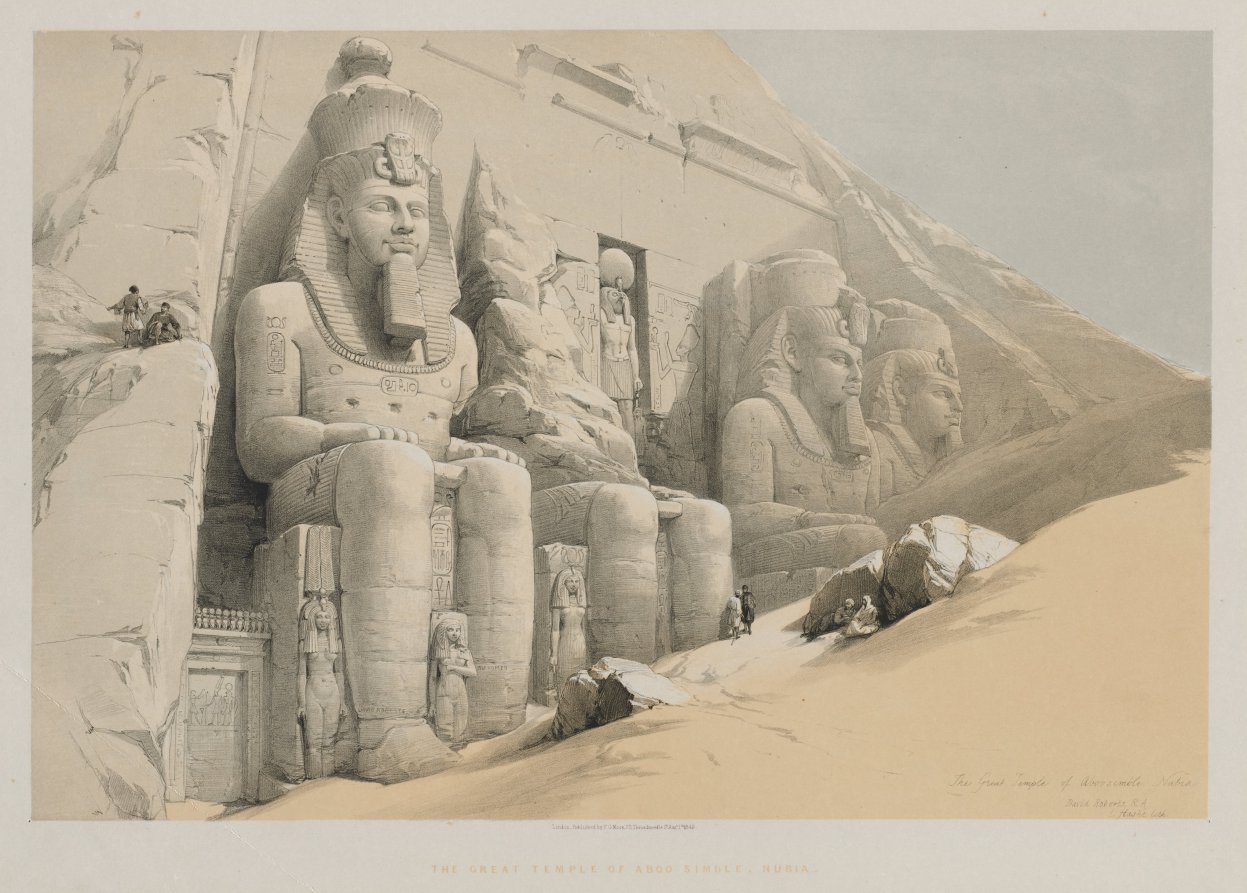
Urban Form: Egypt and Nubia, Volume I: The Great Temple of Aboo-Simble, Nubia
Structural Poetics: The Architectural Void
The Great Temple of Aboo-Simble presents a definitive study in negative space and monumental mass. The rock-hewn facade, with its four colossal seated figures, is not merely a sculpture but a tectonic statement. The geometry is one of stark, orthogonal planes—the verticality of the seated pharaohs, the horizontal lintels of the entrance, and the recessive darkness of the inner sanctuary. This is not ornamentation; it is pure structural logic. The void of the doorway, a precise rectangular incision into the sandstone, functions as the focal point of the entire composition. It is an absence that defines presence. For the 2026 executive silhouette, this principle of the *architectural void* is paramount. The Addison silhouette will not rely on superfluous draping or decorative seams. Instead, it will be defined by precise, negative-space cutouts—strategic apertures at the shoulder, a sharp keyhole at the nape, or a clean, geometric slit at the hem. These are not decorative; they are structural. They create a dialogue between the garment and the body, where the body becomes the positive mass and the garment the negative frame. The shoulder line, in particular, will be a study in horizontal tension, echoing the lintel of the temple. A sharp, unbroken line from acromion to acromion, achieved through internal structuring rather than padding, creates a silhouette of quiet authority. The fabric itself, a dense, sand-washed silk twill, will hold this line without compromise, its matte finish absorbing light like the sun-baked stone.Urban Materiality: Sandstone in Silk
The materiality of Aboo-Simble is not one of polished refinement but of raw, geological time. The sandstone is granular, porous, and warm. It has been carved, not cast. This informs the urban materiality of the collection. We reject the cold, sterile sheen of synthetic luxury. Instead, we embrace a fabric that mimics the tactile memory of stone. A heavy, double-faced wool crepe, brushed to a soft, powdery finish, will be the primary textile. Its weight provides the necessary gravity for the architectural cuts, while its surface—a subtle, irregular texture—echoes the striations of the Nubian rock. The color is not a flat beige but a complex, layered Sand—a blend of raw umber, pale ochre, and a whisper of grey, as if the pigment itself had been ground from the temple’s own foundation. The construction is equally geological. Seams are not hidden but expressed as deliberate joints, like the lines between stone blocks. A single, continuous seam running from the shoulder to the hem on a long coat acts as a structural spine. The internal canvas is not a hidden support but an integral part of the garment’s logic, visible at the lapel’s edge as a precise, un-hemmed line. This is an urban uniform for the executive who understands that power is not in decoration but in the integrity of the structure. The pockets are not pouches but slit-like incisions, parallel to the ground, reinforcing the horizontal axis of the silhouette.The Dialectic of Void and Volume
The internal DNA of the artwork—the juxtaposition of Socratic transcendence and Taoist emptiness—finds its resolution in the garment’s core philosophy. The Socratic element is the *rational structure*: the precise geometry, the calculated proportions, the unyielding shoulder line. This is the architecture of the mind, a deliberate imposition of order upon the chaos of the body. The Taoist element is the *void*: the negative-space cutouts, the unadorned expanse of fabric, the silence of the silhouette. This is the acceptance of emptiness as a generative force. The garment, therefore, is not a container for the body but a frame for its presence. The void at the neckline is not a lack but a potential—a space for the wearer’s own breath, their own existence. The volume of the sleeve is not a ballooning excess but a carefully calculated negative space that defines the arm’s movement. The silhouette is minimalist not because it is simple, but because it has been reduced to its essential structural elements. Every line, every seam, every cutout is a philosophical statement: that true presence is defined by what is absent. The executive who wears this silhouette does not disappear into the garment; they are made more visible by its restraint. They are the positive mass, the living stone, framed by the architectural void.Conclusion: The 2026 Executive Silhouette
The definitive urban silhouette for 2026, as derived from the Great Temple of Aboo-Simble, is one of monumental restraint. It is a silhouette of sharp, horizontal shoulders, a clean, columnar body, and precise, geometric apertures. The color is a complex, geological Sand. The material is a heavy, tactile wool crepe that holds its shape with the permanence of stone. This is not a garment for the transient or the decorative. It is a uniform for the executive who operates at the intersection of structure and void, of rational order and generative emptiness. It is the architecture of presence, carved from the silence of stone.
Technical Insight
Technical Insight: Translating Sand palettes into Minimalist silhouettes for the modern metropolis.