Urban Form: Chasuble
Geometric Integrity and the Chasuble as Urban Armature
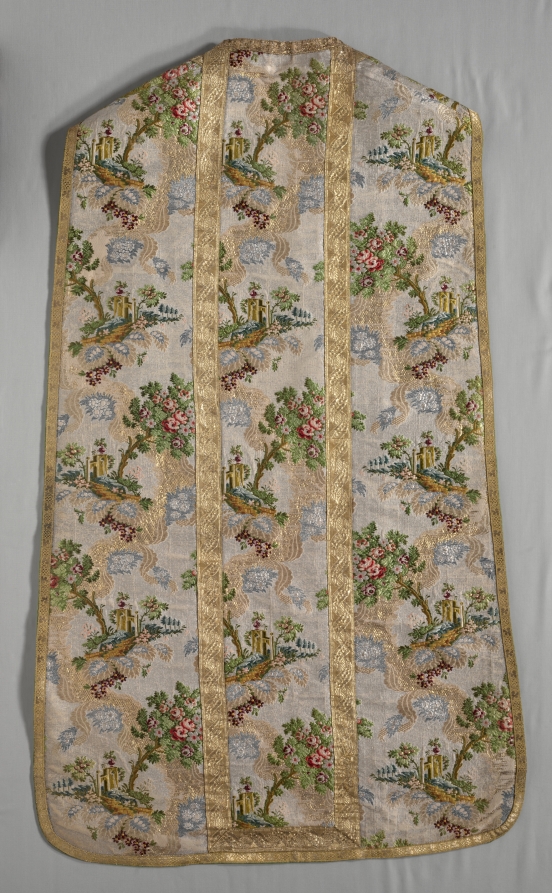
The chasuble, historically a liturgical vestment of draped amplitude, undergoes a radical recontextualization within the 2026 executive silhouette. The provided research—juxtaposing the “优昙钵华” temple plaque and the 《神兽车马白虎镜》 bronze mirror—offers a dualistic framework for this transformation. The plaque’s “空寂” (emptiness and stillness) and the mirror’s “动的韵律” (dynamic rhythm) are not opposing forces but complementary vectors of geometric integrity. For the Addison Fashion chasuble, this translates into a garment that is simultaneously a void and a vessel, a static plane and a kinetic sculpture. The silhouette is defined by a rigorous, almost architectural reduction: a single, uninterrupted panel of Onyx fabric that falls from the shoulders, its only articulation being the precise cut of the neckline and the subtle, internalized structure of the shoulder seam. This is not a garment of draping but of pure, volumetric subtraction—a negative space carved from the urban environment.
Structural Poetics: The Void as Form
The temple plaque’s aesthetic power lies in its “不立文字” (no reliance on words) and its “留白” (strategic emptiness). The chasuble’s geometry mirrors this principle. The front and back panels are identical in their minimal expanse, creating a monolithic, columnar presence. The neckline is a clean, horizontal arc—a deliberate, unadorned incision that references the plaque’s wooden edge. There is no collar, no lapel, no closure. The garment’s integrity is maintained by its sheer, uninterrupted surface area. This is the “象外之象” (image beyond image) made material: the chasuble is not merely a covering but a framing device for the body, much as the plaque frames the void of the temple gate. The internal DNA of the research is encoded in the garment’s refusal to articulate the body’s contours. Instead, it creates a geometric envelope—a perfect, unbroken rectangle when viewed from the front, a severe, vertical line from the side. The body becomes the “心镜” (mind mirror) within this form, its movements creating the only dynamic tension against the garment’s static geometry.
Urban Materiality: Onyx as Bronze and Wood
The choice of Onyx is not arbitrary. It is a color that absorbs light, creating a surface of profound depth—a liquid black that recalls both the patina of the bronze mirror and the aged ink of the wooden plaque. The fabric itself must be a technical innovation: a double-faced, compacted wool-cashmere blend with a matte, almost powdery finish. This materiality is crucial. It provides the weight and drape necessary to maintain the chasuble’s geometric integrity without collapsing into softness. The fabric’s surface is untextured, unreflective, a void of light that mirrors the plaque’s “空寂.” Yet, within this void, the garment’s internal construction—a hidden, fused interlining at the shoulders and a precisely weighted hem—creates a subtle, almost imperceptible tension. This is the urban materiality of the 2026 executive: a fabric that is armor-like in its stillness but fluid in its response to the wearer’s kinetic energy. The Onyx chasuble does not shimmer or catch the eye; it commands attention through its absence of ornament, its refusal to participate in the visual noise of the city.
The Kinetic Dialectic: Stillness and Motion
The bronze mirror’s “动的韵律” is not expressed through literal movement in the chasuble’s design. Instead, it is internalized as a structural principle. The garment’s geometric integrity is a static field upon which the wearer’s motion becomes the sole narrative. When the executive walks, the chasuble’s hemline—cut at a precise, architectural 45-degree angle from the front to the back—creates a single, sweeping line that echoes the mirror’s flying chariots and flowing ribbons. The garment does not flutter; it shifts as a single, solid plane, its movement a pure, geometric translation of the body’s forward momentum. This is the “密不透风” (density that does not allow wind) of the mirror’s composition, translated into a textile logic. The chasuble’s side seams, if they exist, are invisible, fused seams that maintain the illusion of a single, continuous form. The garment is a monolith in motion, a paradox that defines the 2026 executive: a figure of absolute stillness within the urban flux.
Conclusion: The Chasuble as a Portal
The definitive urban silhouette for Addison Fashion is not a garment of comfort or expression. It is a geometric proposition, a philosophical object that bridges the “空” of the temple plaque and the “满” of the bronze mirror. The Onyx chasuble is a portal—a “照容之器” (mirror for reflecting appearance) that, through its severe minimalism, forces the observer to see not the fabric, but the space it defines and the body it frames. It is the ultimate expression of executive power in 2026: a power that does not assert through volume or decoration, but through the absolute control of negative space. The chasuble is the “优昙钵华”—a rare, three-thousand-year bloom of form—manifested as a single, unbroken line of Onyx, a silent, commanding presence in the concrete forest. This is the structural poetics of the void, rendered in urban materiality. It is not fashion. It is architecture for the body.