Urban Form: Woman with a Veil
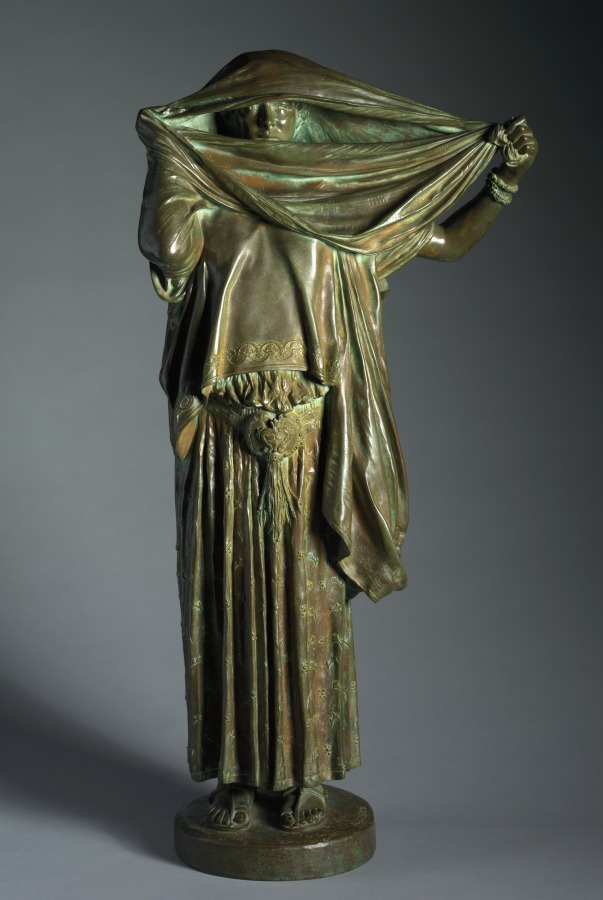
Geometric Integrity of the Veiled Subject
The woman with a veil presents a paradox of concealment and revelation, a structural tension that directly informs the 2026 executive silhouette at Addison Fashion. The veil, as rendered in the referenced artworks—specifically the dynamic energy of the Musician Mold Fragment and the static transcendence of the Arhat Paintings—is not a mere fabric but a geometric proposition. It is a plane that both obscures and defines the underlying form. In the Musician Mold Fragment, the veil’s folds are captured in mid-motion, their lines radiating outward like sound waves from an instrument. This is a geometry of kinetic expansion, where the veil becomes a diagram of rhythm, its creases and cascades mapping the invisible force of music. Conversely, the Arhat Paintings depict the veil as a still, almost architectural volume—a series of parallel, unbroken folds that descend with the gravity of a plumb line. Here, the geometry is one of static compression, where the veil functions as a spatial boundary, enclosing the subject in a state of meditative equilibrium.
For the 2026 executive silhouette, this duality is synthesized into a tailored architecture. The veil is reimagined as a structural element—a high, sculpted collar or a draped shoulder panel that mimics the Musician Mold’s dynamic flow while retaining the Arhat’s disciplined containment. The geometric integrity lies in the precision of the fold: each crease is a deliberate vector, neither random nor overly soft. It is a line that asserts control over volume, transforming fabric into a three-dimensional grid. This is not a silhouette that drapes passively; it is one that holds its shape, a testament to the wearer’s authority. The Onyx color palette deepens this effect, absorbing light to emphasize the play of shadow and highlight across the folds, creating a chiaroscuro that reads as both urban materiality and architectural poetics.
Structural Poetics: From Fragment to Form
The Dynamic Fragment
The Musician Mold Fragment is a study in incomplete motion. Its broken edges do not signify loss but rather a frozen moment of ecstasy. The veil here is not a whole garment but a fragment of a gesture, its lines suggesting a body in the act of turning, of reaching, of being swept by sound. For the executive silhouette, this translates into asymmetrical draping—a single shoulder exposed, a hemline that cuts diagonally across the body, a sleeve that ends in a sharp, unfinished edge. The poetics are those of interrupted narrative: the garment tells a story that begins before the viewer’s gaze and continues beyond it. This is achieved through strategic cutouts and layered panels that mimic the fragment’s broken geometry, creating a silhouette that is deliberately incomplete, inviting the eye to complete the form. The Tailored category ensures that these fragments are not chaotic but precisely calibrated, each edge a clean, sharp line that speaks of urban precision.
The Static Whole
In contrast, the Arhat Paintings offer a geometry of absolute stillness. The veil here is a solid mass, its folds repeating with the regularity of a colonnade. This is the architecture of silence, where every line is a boundary that contains the subject’s inner world. For the 2026 silhouette, this manifests as structured volumes—a cape that falls in rigid, vertical pleats, a skirt that flares from the waist in a single, unbroken plane. The poetics are those of contained power: the garment does not move with the body; rather, the body moves within a defined spatial envelope. The Onyx color reinforces this by creating a monolithic presence, the fabric absorbing all ambient light to become a negative space that the wearer inhabits. The Tailored approach here is about exacting construction: seams that follow the body’s architecture, darts that create volume without excess, and closures that are hidden, ensuring the silhouette remains uninterrupted.
Urban Materiality: Fabric as Urban Landscape
Texture and Light
The materiality of the veil in both artworks is translated into urban fabrics that speak of architectural surfaces. The Musician Mold Fragment suggests a matte, granular texture—like weathered stone or raw silk—that catches light in irregular patches, mimicking the fragment’s aged surface. For the 2026 collection, this is realized in heavy crepe or double-faced wool, fabrics that hold a crease with sculptural rigidity while offering a soft, tactile hand. The Arhat Paintings, with their smooth, lustrous finish, evoke polished onyx or liquid satin, fabrics that reflect light in a controlled, linear manner. These are not fabrics that shimmer; they gleam with a cold, urban sheen, like a glass facade at dusk. The Onyx palette unites these textures, allowing the play of matte and gloss to define the silhouette’s spatial depth.
Weight and Drape
The urban materiality of the 2026 executive silhouette is defined by weight. The veil, whether dynamic or static, must have gravitas. In the Musician Mold Fragment, the fabric appears light yet anchored, as if caught in a breeze that cannot lift it fully. This is achieved through weighted hems and internal structuring that give the garment a sense of purpose. The Arhat Paintings demand a heavier drape, a fabric that falls with the inevitability of a curtain, creating a vertical line that elongates the figure. For the collection, this translates into camel-hair blends and felted wools, materials that resist movement and command space. The Tailored construction ensures that this weight is distributed evenly, creating a silhouette that is balanced and authoritative.
Conclusion: The 2026 Executive Silhouette
The woman with a veil, as interpreted through the Musician Mold Fragment and the Arhat Paintings, yields a silhouette that is both fragment and whole, dynamic and static. The 2026 executive silhouette is Tailored in its precision, Onyx in its chromatic authority, and architectural in its structural poetics. It is a silhouette that conceals to reveal, using the veil as a geometric device to create volumes of power and lines of control. The urban materiality—heavy, textured, and light-absorbing—grounds the silhouette in the concrete reality of the city, while the structural poetics elevate it to the realm of art. This is not a garment for the passive observer; it is a statement of presence, a manifesto of form that defines the executive woman of 2026 as a master of space, a conductor of light, and a wearer of veils that speak of eternal truths in the language of the city.