Oversized
Onyx
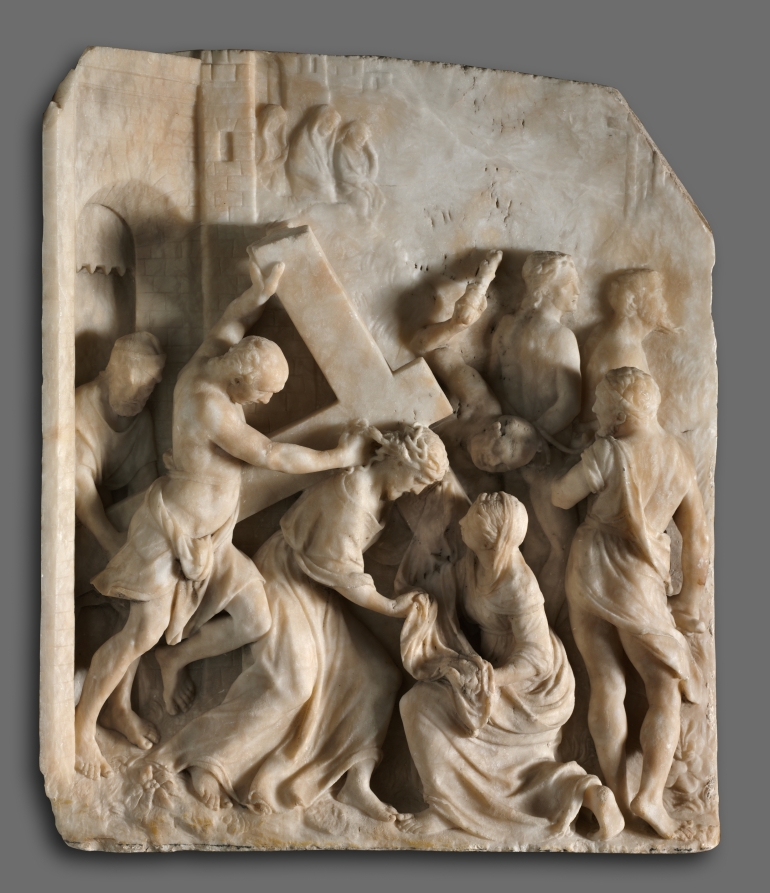
Urban Form: Christ Carrying the Cross with Saints Simon and Veronica
Structural Poetics: The Architectural Frame of the Sacred
The subject, *Christ Carrying the Cross with Saints Simon and Veronica*, presents a masterclass in geometric compression and vertical tension. The composition is not merely a narrative of burden; it is a diagram of weight distribution. Christ’s spine forms a primary vertical axis, a plumb line against which the diagonal of the crossbeam creates a dynamic, asymmetrical load. This is not a static crucifixion but a moment of kinetic arrest—a body in motion frozen by spiritual gravity. For the 2026 executive silhouette, this translates into an **oversized, structural drape** that mimics the cross’s cantilever. The shoulder line must be extended, not padded in the traditional sense, but engineered as a rigid, architectural shelf. The fabric—think a double-faced wool in Onyx—should fall from this shelf in clean, unbroken planes. The cross’s horizontal beam is reinterpreted as a sculpted yoke, a piece of negative space that frames the torso without constricting it. The urban materiality here is one of **compressed volume**: the garment does not flow; it holds. It carries the air around it as a burden, a silent testament to the weight of presence.Geometric Integrity: The Triangle of Support
The painting’s secondary geometry is the triangular support system formed by Simon of Cyrene and Veronica. Simon’s body, bent under the cross’s rear, creates a counter-lever—a stabilizing force. Veronica’s veil, held aloft, introduces a softer, curved triangle, a counterpoint to the rigid wood. This dialectic between hard and soft geometry is critical. In silhouette, this manifests as a **layered, oversized coat** with a built-in structural underlayer. The outer shell is a rigid, almost carapace-like fabric (a bonded Onyx twill), cut with a sharp, dropped shoulder. Beneath it, a secondary layer—a vest or a draped panel in a fluid, matte silk—mirrors Veronica’s veil. This inner layer is not decorative; it is a functional counterweight. It adds volume to the lower torso, creating a visual triangle that widens at the hips, balancing the broad shoulders. The coat’s hem is cut asymmetrically, longer at the back, mimicking the trailing end of the cross. The entire silhouette is a study in **controlled imbalance**: the wearer appears to be in a state of perpetual, elegant motion, burdened yet unbroken.Urban Materiality: The Texture of Stone and Dust
The palette of *Christ Carrying the Cross* is one of earth, stone, and shadow. The Onyx color choice is not arbitrary; it is the color of wet cobblestone, of compressed urban earth. It absorbs light rather than reflecting it, creating a surface that is both monolithic and porous. For the fabric, we require a **technical wool** with a slight, irregular slub—a texture that reads as “dust” from a distance but reveals a complex weave up close. This is not a pristine, corporate wool. It is a material that has walked through the city, that has been marked by time. The finish is matte, almost chalky, with a subtle, graphite sheen at the crease points. This is the materiality of the **urban palimpsest**: layers of history worn into the surface. The structural elements—the yoke, the shoulder shelf—are reinforced with a **molded, resin-stiffened canvas** that is invisible to the eye but palpable to the hand. This is the “bone” of the garment, the internal architecture that allows the oversized silhouette to maintain its integrity without collapsing into mere volume. The seams are felled and flat, like the joints of a steel frame. There are no visible buttons; the closure is a hidden, magnetic placket that runs the length of the torso, a silent, industrial seam.The Veronica Veil: A Study in Negative Space
Veronica’s veil is the painting’s most radical element: a piece of fabric that becomes a portal. It is not a covering but a revelation. In our silhouette, this is translated as a **cut-out or a sheer panel** within the coat’s structure. Imagine a long, vertical slit at the sternum, backed by a panel of black, micro-mesh. This is not a window to the skin but a window to the void. It is a piece of negative space that breathes, that allows the garment to “speak” of what it does not contain. This panel is framed by a rigid, laser-cut edge, a precise, architectural incision. It echoes the cross’s verticality but in a purely abstract, modern language. The wearer’s movement causes the mesh to shift, creating a subtle, kinetic play of light and shadow. This is the **silent hint of the body**, the suggestion of presence without explicit display. It is the urban equivalent of the sacred veil: a fabric that holds the memory of a face, a trace of a gesture.Conclusion: The Silhouette as Burden and Armor
The 2026 executive silhouette, derived from this analysis, is not a garment of comfort. It is a garment of **structural poetics**. It is oversized not for ease but for presence. It is Onyx not for darkness but for depth. It is a coat that carries the weight of the city on its shoulders, that frames the body as a monument to endurance. The wearer is not merely dressed; they are **architecturally inhabited**. The cross is no longer a symbol of suffering but a diagram of balance. The veil is no longer a relic but a piece of urban armor. This is the definitive urban silhouette: a study in how to carry the invisible with visible grace.
Technical Insight
Technical Insight: Translating Onyx palettes into Oversized silhouettes for the modern metropolis.