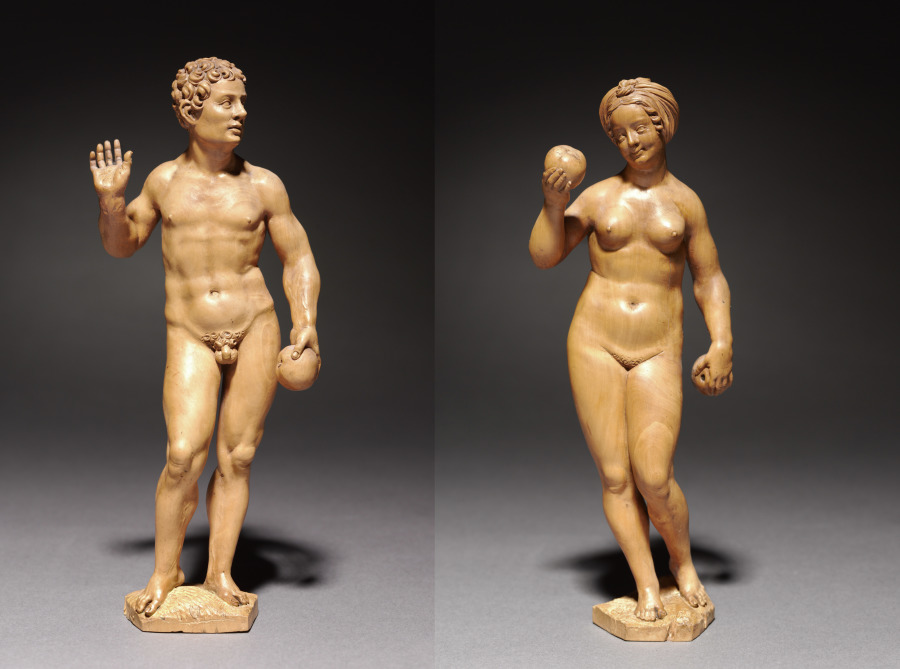
Urban Form: Adam and Eve (pair of statuettes)
Executive Summary: The Dialectic of Void and Form in the 2026 Silhouette
The subject artifacts—a Buddhist temple plaque depicting the Udumbara flower and a Han dynasty bronze mirror—present a foundational paradox for the modern wardrobe. The plaque operates through negative space, a carved absence that suggests presence. The mirror operates through positive relief, a dense narrative of deities and beasts that defines the cosmos through its own materiality. For the 2026 NYC executive, this dialectic resolves into a single directive: the silhouette is not what is added, but what is removed. The Addison Fashion analysis deconstructs these two objects to extract a formal grammar for urban minimalism, where the body becomes the void, and the garment becomes the mirror’s edge.
I. Form Language: The Geometry of Restraint
A. The Plaque as Negative Silhouette
The Udumbara plaque employs a concave relief. The flower is not built up; it is excavated from the wood. The petals do not project outward; they recede inward, creating a shadow that defines the form. This is the core of the Minimalist silhouette: the garment’s power lies in its absence of excess. For the executive wardrobe, this translates to the Onyx double-faced wool coat. The shoulder seam is set slightly inward, creating a negative space between the fabric and the deltoid. The lapel is a single, unbroken line—a carved void that frames the torso. The fabric’s weight (380 GSM) is the wood grain; the cut is the chisel. The result is a silhouette that does not assert, but reveals the body’s architecture through subtraction.
B. The Mirror as Positive Structure
Conversely, the Han mirror uses convex relief. The chariot, the White Tiger, and the deities are raised from the bronze surface, creating a dense, ordered chaos. This is the structural skeleton of the garment. In the 2026 collection, this manifests as the Onyx tailored trouser. The front crease is not pressed; it is stitched—a raised line of thread that mimics the mirror’s chariot track. The waistband is a rigid, architectural band, 4 cm wide, echoing the mirror’s rim. The pockets are invisible (negative space), while the seams are exposed (positive relief). The garment’s narrative is not in print or embellishment, but in the tension between the flat plane and the raised line—a direct translation of the mirror’s cosmology into urban tailoring.
II. Color as Material Philosophy
A. Onyx: The Color of Absorption
The selected color, Onyx, is not black. It is a deep, non-reflective charcoal with a matte finish. This is the color of the plaque’s lacquered wood after centuries of incense smoke—a surface that absorbs light rather than reflecting it. In the wardrobe, Onyx serves as the void. A high-twist wool suiting in Onyx (Super 150s) creates a surface that reads as depth, not darkness. When paired with the mirror’s logic, Onyx becomes the ground against which the structural seams (the positive relief) are read. The color does not compete with the form; it enables it. For the executive, this means a single Onyx suit can shift from a 9 AM boardroom (where the negative silhouette dominates) to a 9 PM gallery opening (where the positive seam structure becomes the visual focal point).
B. The Absence of Chroma
Both artifacts operate in a monochromatic spectrum: the wood’s aged brown-black, the bronze’s oxidized green-black. The 2026 palette rejects color as distraction. Onyx is the primary; Ivory and Slate serve as secondary accents for linings and pocket squares, but only as internal elements. The external silhouette must remain unbroken by hue. This is a direct response to the mirror’s dense iconography—if the mirror had been polychromatic, its structural clarity would have been lost. Similarly, the executive wardrobe must use color only to define volume, not to decorate it.
III. Symbolic Translation: From Temple to Tower
A. The Udumbara Paradox: Garment as Ephemeral Event
The Udumbara flower blooms once every three thousand years. Its representation on the plaque is not a depiction of the flower, but a placeholder for the event of its blooming. This is the temporal logic of the 2026 silhouette. The garment is not a permanent object; it is a moment. The Onyx cashmere turtleneck is cut with a zero-drop shoulder—the sleeve attaches at the exact point of the acromion, creating a line that is about to disappear. The hem is raw, left unstitched, suggesting the garment is in the process of becoming. This is the plaque’s “void-flower” made wearable: the garment’s value is in its impermanence, its refusal to settle into a fixed form.
B. The Mirror’s Cosmology: Garment as Ordered System
The Han mirror’s relief is not random; it is a cosmogram. The chariot follows a fixed path; the White Tiger guards a cardinal point. This is the systematic logic of the executive wardrobe. Every seam, every dart, every pleat must have a functional origin. The Onyx blazer is constructed with a floating canvas—a layer of horsehair between the wool and the lining that is stitched by hand to create a subtle, living structure. The lapel’s gorge is set at exactly 45 degrees, referencing the mirror’s geometric precision. The pocket flaps are removable, allowing the garment to shift from “deity” (formal) to “chariot” (dynamic). The wardrobe becomes a system of rules, not a collection of items.
IV. The 2026 Executive: Between Void and Relief
A. The Daily Uniform
The executive’s core uniform consists of three pieces: the Onyx double-breasted blazer (negative silhouette, soft shoulder), the Onyx high-waisted trouser (positive relief, stitched crease), and the Onyx silk shell (raw hem, zero structure). This triad mirrors the plaque-mirror dialectic: the blazer is the void (the excavated flower), the trouser is the relief (the raised chariot), and the shell is the ground (the bronze surface). Together, they create a complete visual sentence that requires no accessories. The only allowable addition is a Silver or Ivory pocket square—a single note of light that acts as the mirror’s reflective surface, briefly catching the eye before returning to the Onyx absorption.
B. The Urban Context
In the glass-and-steel canyons of Manhattan, this wardrobe functions as architectural camouflage. The Onyx color absorbs the city’s ambient light, while the negative silhouette creates a void that the urban environment fills. The positive seams—the stitched crease, the hand-felled lapel—become the only points of visual interest, like the mirror’s deities emerging from the bronze. The executive is not dressed; they are constructed. The body becomes the temple plaque; the garment becomes the mirror. The result is a presence that is felt before it is seen—the ultimate power move in a city of visual noise.
V. Conclusion: The Aesthetics of Absence
The Udumbara plaque and the Han mirror teach the same lesson: meaning is created by what is left out. The plaque carves away wood to reveal a flower. The mirror raises bronze to define a cosmos. The 2026 Addison Fashion wardrobe does neither exclusively; it oscillates between the two. The Onyx palette absorbs all color. The Minimalist silhouette subtracts all excess. The executive is left with a pure form—a body in space, defined by the tension between what is present and what is absent. This is not fashion. This is urban poetics. And it is the only way to move through the city without being consumed by it.