Urban Form: Saint Sebastian
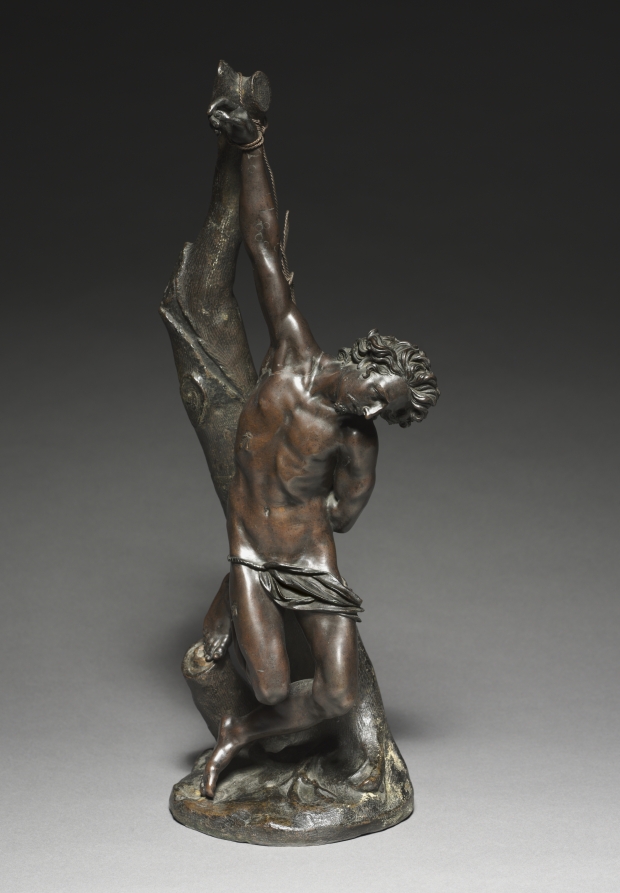
Executive Summary: The Saint Sebastian Silhouette as a Dialectical Container
This Urban Silhouette Research deconstructs the figure of Saint Sebastian through the lens of two opposing yet complementary aesthetic systems: the Western dramatic tension of Ingres’s Oedipus and the Sphinx and the Eastern meditative harmony of Ming Dynasty blue-and-white porcelain. For the 2026 NYC executive wardrobe, we extract a Fluid silhouette in Slate—a color that bridges the chiaroscuro of conflict and the atmospheric depth of landscape. The result is not a costume of martyrdom but a technical container for urban poetics: a garment that holds the paradox of being both a weapon of inquiry and a vessel of repose.
I. Form as Philosophical Armature
A. The Ingresian Tension: Triangular Stability and Disruption
Ingres’s composition is a study in controlled instability. The triangular structure—Oedipus’s torso as apex, his legs as base—creates a classical hierarchy of form. Yet the sphinx’s vertical intrusion from above fractures this stability. For the executive wardrobe, this translates into a silhouette that uses asymmetrical draping and sharp shoulder lines to evoke the moment of confrontation. The Slate hue here functions as a neutral ground, allowing the structural seams to act as the “lines of inquiry”—precise, rational, and unyielding. The garment’s weighted hem mimics the gravitational pull of the painting’s dark abyss, anchoring the wearer in a state of poised tension.
B. The Ming Porcelain Continuum: Circularity and Negative Space
In contrast, the Ming dish operates on a radial geometry. Its circular form is not a boundary but a field of flow. The negative space (留白) is as critical as the cobalt brushwork—it is the “breath” that allows the landscape to breathe. For the 2026 wardrobe, this informs a fluid silhouette that rejects rigid tailoring in favor of continuous panels and unstructured volumes. The Slate color, when applied to matte jersey or double-faced wool, absorbs light rather than reflecting it, creating a luminous void that echoes the porcelain’s white ground. The garment’s circular seams—at the shoulder blade or hip—guide the eye in a non-linear path, mimicking the cyclical time of the landscape.
II. Color as Psychological Register
A. Slate: The Chromatic Bridge
Slate is not a neutral; it is a compound color born from the fusion of cool gray and deep blue. In the Ingres context, it evokes the shadow of the cave—the darkness that Oedipus must confront. In the Ming context, it recalls the cobalt oxide under the glaze—the pigment that transforms from black to blue in the kiln’s heat. For the executive, Slate offers psychological ambiguity: it is the color of urban twilight, of concrete after rain, of steel and slate. It does not assert dominance but absorbs context, allowing the wearer to shift between the roles of interrogator (Oedipus) and observer (the porcelain’s inhabitant).
B. Chromatic Layering for the 2026 Wardrobe
We recommend a monochromatic palette built on Slate, with tonal variations from charcoal to pale ash. This mirrors the Ming dish’s gradated washes—the way cobalt bleeds into white. For contrast, introduce single accents of oxidized copper or raw silk—materials that catch light like the sphinx’s golden wings. The finish is critical: matte surfaces for the “porcelain” moments of stillness, subtle sheen for the “painting” moments of drama.
III. Silhouette Architecture: The Fluid Container
A. The Shoulder as Sphinx
The shoulder line is the site of tension. Borrowing from Ingres’s exaggerated clavicle and the sphinx’s winged silhouette, we propose a sharp, extended shoulder that is softened by draping. This is achieved through asymmetric padding—one shoulder structured, the other fluid. The effect is a visual paradox: the wearer appears both armored and vulnerable, like Oedipus before the riddle.
B. The Torso as Landscape
The torso is treated as a porcelain surface. Horizontal seams at the waist and vertical pleats at the spine create a topographical map of the body. The negative space between fabric and skin is the “breath”—the void that allows movement. For the 2026 executive, this translates into a double-layer construction: an inner sheath of stretch silk for structure, an outer shell of fluid wool for volume. The Slate color unifies these layers, making the garment read as a single, continuous form.
C. The Hem as Horizon
The hem is neither straight nor curved but asymmetric—longer at the back, shorter at the front. This mimics the horizon line in the Ming dish, where mountains recede into mist. For the urban context, it creates a dynamic silhouette that moves with the body, never static. The weight of the fabric is crucial: heavy enough to drape, light enough to float. This is the “porcelain paradox”—the illusion of solidity that is actually fluid.
IV. Materiality: The Kiln and the Canvas
A. Fabric as Glaze
We select double-faced cashmere and matte cupro for their ceramic-like hand. The surface finish is brushed to a low luster, mimicking the glaze of Ming porcelain. The weight is calibrated to fall like water—a reference to the ink washes of Chinese painting. For the Ingresian element, we introduce structured panels of wool crepe that hold a crease like a canvas stretcher.
B. Construction as Composition
Seams are exposed and finished with silk binding—a nod to the brushstroke in both traditions. The interior is as considered as the exterior: raw edges are left unhemmed, revealing the fabric’s grain. This is the “reverse side” of the porcelain—the unglazed foot that grounds the object in reality.
V. The 2026 Executive: A Dialectical Wardrobe
A. The Morning Ritual: Inquiry
The first layer is a Slate shell with the asymmetric shoulder. Worn with structured trousers in charcoal wool, it creates the Ingresian silhouette—sharp, questioning, ready for negotiation. The accessory is a single silver cuff—a “sphinx’s wing” that catches light.
B. The Afternoon Transition: Containment
Add a fluid overcoat in pale Slate with circular seams. The coat absorbs the structured shell beneath, creating a Ming-like volume. The negative space between coat and body becomes the “breath”—a moment of repose. The color shifts from charcoal to ash, mimicking the cobalt wash.
C. The Evening Resolution: Synthesis
The final silhouette is the fluid dress—a single panel of Slate cupro that wraps and drapes. The asymmetric hem creates a horizon line that moves with the body. The shoulder is unstructured, the torso unlined. This is the “porcelain moment”—the garment as container for the self, neither questioning nor answering, but holding space.
VI. Conclusion: The Eternal Question, Draped
The Saint Sebastian silhouette is not a costume of suffering but a dialectical garment—one that holds the tension between inquiry and acceptance, structure