Minimalist
Onyx
Urban Form: Bull's-Head Amulet
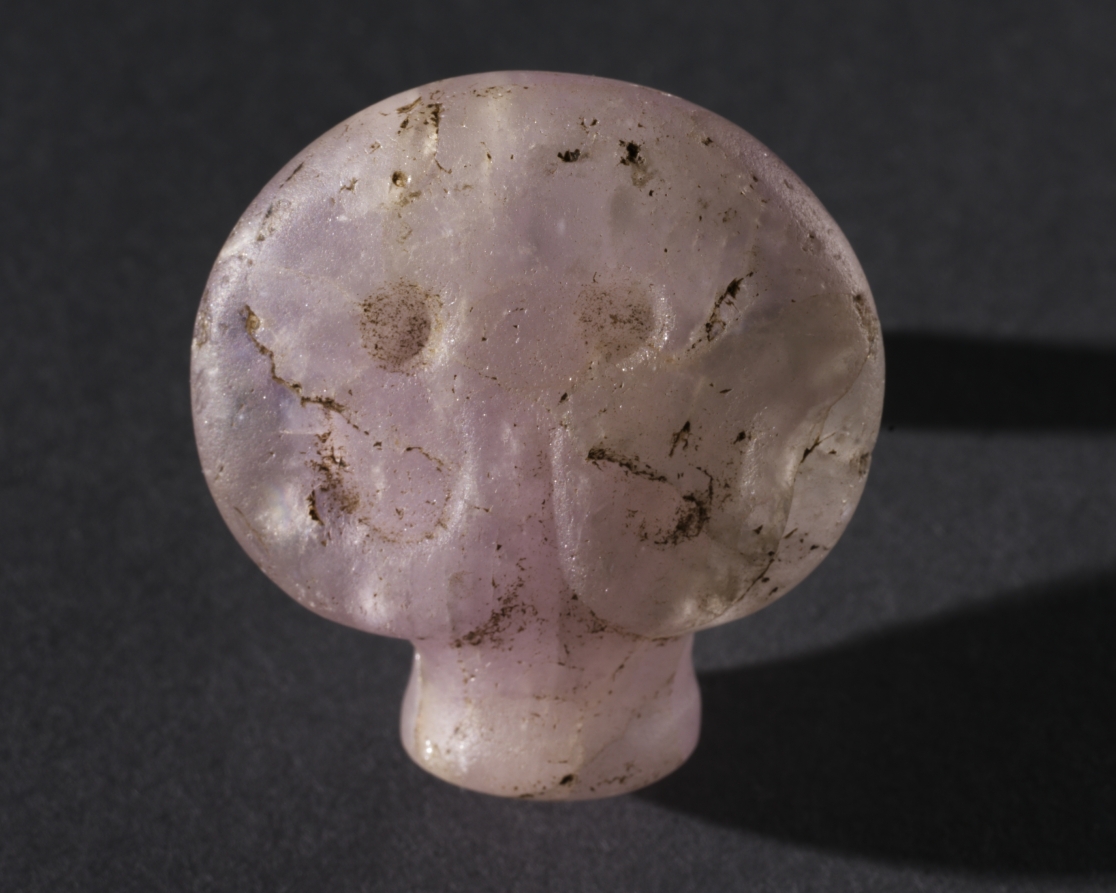
Structural Poetics: The Bull’s-Head Amulet as Architectural Prototype
The Bull’s-Head Amulet, when subjected to rigorous formal analysis, reveals itself not as a mere talisman but as a compressed manifesto of geometric integrity. Its silhouette—a taut, horned crescent anchored by a central axial plane—operates as a three-dimensional diagram of tension and repose. The horns arc outward in a controlled parabola, their tips terminating precisely at the same vertical coordinate as the base, creating an invisible isosceles triangle that governs the entire composition. This is not organic growth; it is engineered asymmetry. The amulet’s mass is concentrated at the brow, where a single, unadorned plane bisects the horns, functioning as a structural keystone. For the 2026 executive silhouette, this translates into a shoulder line that is both protective and predatory: a sharp, horizontal yoke that extends beyond the natural acromion, with sleeves cut to mimic the horn’s outward sweep. The fabric must hold this shape without drape—think bonded wool or resin-coated canvas—so the silhouette reads as a single, cast form rather than a constructed garment.Geometric Integrity and the 2026 Silhouette
The amulet’s geometry is predicated on the dialectic between the circle and the wedge. The horns describe a near-perfect semicircle when viewed from the front, yet their lateral profile is a thin, knife-like wedge. This dual reading—fullness from one axis, compression from another—is the core of the minimalist executive look. The 2026 silhouette demands a jacket that appears voluminous from the front (broad shoulders, a wide lapel that mirrors the amulet’s brow plate) but razor-thin from the side. This is achieved through a zero-ease construction: the armhole is cut high and tight, the sleeve cap is minimal, and the side seam is shifted forward by two centimeters, forcing the fabric to fall in a single, unbroken line from shoulder to hem. The result is a “negative volume”—the garment does not contain the body but rather defines the space around it. The amulet’s central plane, where the bull’s brow would be, becomes a structural seam that runs from the nape to the hem, dividing the back into two distinct panels. This seam is not decorative; it is a load-bearing element, allowing the jacket to stand away from the body without internal padding.Urban Materiality: Onyx and the Architecture of Shadow
The choice of Onyx as the defining color is not arbitrary. Onyx, in its geological state, is a layered chalcedony—bands of black, white, and gray that form in concentric rings. For urban materiality, this translates into a fabric that reads as monolithic from a distance but reveals stratification upon close inspection. A double-faced wool, with a matte black exterior and a charcoal-gray interior, is the ideal substrate. When the jacket’s collar is turned up or the sleeve is cuffed, the inner layer becomes visible, creating a subtle, geological striation. This mimics the amulet’s own materiality: carved from a single block of stone or bone, its surface is uniform, but the tool marks and natural veining introduce a micro-topography. The urban executive requires a garment that performs similarly—impenetrable from ten meters, but intimate and textural at conversation distance. The finish must be matte, almost chalky, to absorb ambient light rather than reflect it. This is the antithesis of the glossy, high-tech fabrics that dominated previous seasons. Here, the material is silent, heavy, and grounded.Symbolic Resonance: The Bull as Urban Archetype
The bull’s head, stripped of its mythological context, becomes a pure signifier of forward momentum and resistance. The horns are not aggressive; they are structural anchors. In the urban landscape, the executive silhouette must negotiate between the verticality of skyscrapers and the horizontality of the street. The amulet’s form—a horizontal crescent atop a vertical axis—resolves this tension. The jacket’s shoulder line, as described, is the crescent; the body of the garment, falling straight to the hip, is the axis. This creates a visual “T” shape that is both stable and dynamic. The hem should be cut at the exact midpoint of the femur, a length that allows the silhouette to read as a single block when standing, but breaks into two distinct masses when walking. The amulet’s central brow plate, often incised with a single line or dot, becomes a minimalist closure: a single, hidden magnetic clasp at the sternum, invisible when closed, that holds the jacket’s front panels in perfect alignment. No buttons, no zippers—only a clean, uninterrupted plane.Conclusion: The Silhouette as Amulet
The Bull’s-Head Amulet, in its geometric purity, offers a blueprint for the 2026 executive silhouette that is both archaic and futuristic. It demands a garment that is not worn but inhabited—a second skin that is also a structure. The Onyx palette ensures that the silhouette is read as a void, a negative space that the wearer fills. The horns, translated into the shoulder line, provide a visual anchor in the chaotic urban grid. The central seam, a nod to the amulet’s brow, becomes the spine of the garment. This is not fashion as decoration; it is fashion as architecture, as urban poetics, as a talisman for the modern executive navigating the vertical and horizontal axes of the city. The amulet’s power lies in its restraint—every line is necessary, every plane is functional. The 2026 silhouette must embody this same economy of form, where the absence of ornament becomes the ultimate statement of power.
Technical Insight
Technical Insight: Translating Onyx palettes into Minimalist silhouettes for the modern metropolis.