Minimalist
Ivory
Urban Form: Sculptural Element from a Reliquary Ensemble (mbulu ngulu)
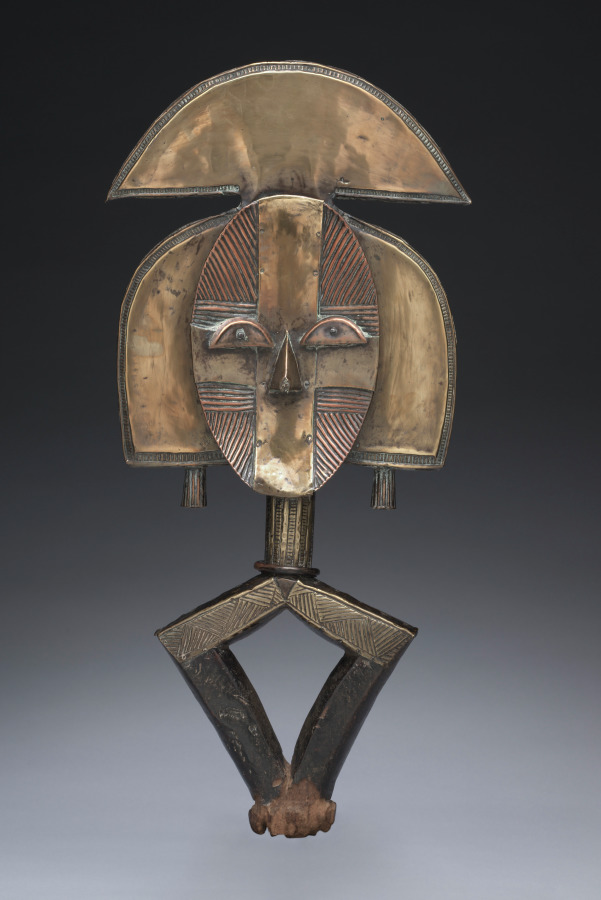
Technical Deconstruction of the *Mbulu Ngulu* Reliquary Element: A Study in Contained Energy and Negative Space
The *mbulu ngulu*, a reliquary guardian figure from the Kota peoples of Gabon, is not an object of adornment but a vessel of spiritual containment. Its defining sculptural element—the flattened, ovoid face with a prominent, downward-arching coiffure—operates on a principle of radical abstraction. For the 2026 NYC executive wardrobe, this form offers a critical lexicon: how to achieve maximum presence through minimal material intervention. The reliquary’s silhouette is a study in **compressed geometry**. The face is a near-perfect ellipse, its surface unbroken by naturalistic features. The eyes are reduced to two concave slits; the mouth, a narrow horizontal incision. This is not representation but *signification*. The form communicates authority not through volume but through the precise calibration of its boundaries.Formal Analysis: The Architecture of Restraint
The *mbulu ngulu*’s power derives from its **negative space**—the void between the face and the coiffure, the hollow of the eyes, the absence of a neck. In fashion terms, this translates to a silhouette that prioritizes **structural containment** over drape. The coiffure, often rendered as a crescent or a series of parallel arcs, creates a **counterweight** to the face’s static oval. This is a lesson in balance: the garment’s upper block—the shoulder line, the collar, the lapel—must be treated as a **sculptural frame** for the head. For the 2026 executive, this suggests a **sharp, architectural shoulder**—a clean, un-padded extension that mirrors the reliquary’s outward, protective stance. The fabric should not yield; it should *define*. The materiality of the *mbulu ngulu* is equally instructive. Traditionally constructed from wood and covered with hammered brass or copper sheets, the surface is a **field of reflective tension**. The metal is not polished to a mirror shine; it retains a matte, burnished quality that absorbs and diffuses light. This is the antithesis of high-gloss luxury. It is a **cold, controlled luminosity**. For the 2026 wardrobe, this translates to a fabric with a **dry, matte finish**—a heavy-weight **ivory wool crepe** or a **silk-cotton faille** that holds a crease without sheen. The color **Ivory** is not a neutral; it is a **charged blankness**. It functions as the reliquary’s metal surface does: it reflects the environment without being altered by it. It is a color of **strategic absence**, allowing the silhouette’s geometry to be the sole narrative.Color as Structure: The Ivory Field
In the context of the *mbulu ngulu*, **Ivory** is not a warm, creamy tone. It is a **cool, almost clinical white** with a faint, mineral undertone—like bone or unglazed porcelain. This color operates as a **structural element** rather than a decorative one. It creates a **monolithic field** that denies the eye any resting point, forcing a continuous reading of the form’s perimeter. For the 2026 executive, this is a strategic tool. An **Ivory** suit—a single-breasted, notch-lapel jacket with a high, clean armhole and a straight-leg, no-crease trouser—becomes a **mobile architectural element**. The color eliminates the distraction of pattern or texture, leaving only the **precision of cut** and the **discipline of line**. The reliquary’s coiffure, often inlaid with a contrasting metal or dark wood, introduces a **chromatic counterpoint**. This is the **accent of authority**. In the wardrobe, this translates to a **single, deliberate detail**: a **black onyx**-finished metal button at the jacket’s closure, or a **slate**-colored silk lining visible only at the cuff. This is not ornament; it is **functional punctuation**. The contrast must be minimal—a shift in value, not in hue—to maintain the **monolithic integrity** of the form.Application to the 2026 Executive Silhouette
The *mbulu ngulu*’s most radical proposition is its **rejection of the organic**. The face is not a face; it is a **sign**. The coiffure is not hair; it is a **geometric counter-form**. For the 2026 NYC executive, this demands a wardrobe that **suppresses the body’s natural contours** in favor of a **constructed, idealized line**. The **Minimalist** category is not about simplicity; it is about **reduction to essence**. The jacket must be **longer than traditional**, ending at the mid-hip to create a **continuous vertical block**. The shoulder must be **squared but not exaggerated**—a **soft architectural shoulder** that suggests structure without rigidity. The trouser must be **high-waisted and straight**, falling without break to the shoe, creating a **single, uninterrupted column**. The **Ivory** color is critical. It is the **field of possibility**—a blank canvas that absorbs the city’s light and transforms it into **controlled energy**. The garment’s surface must be **unbroken by pockets, darts, or seams** that are not structurally necessary. Every line must serve the **containment of form**. The reliquary’s **concave eyes**—those negative spaces—find their analogue in the **absence of lapel buttonholes** or the **lack of a breast pocket**. The garment becomes a **shield**, a **protective shell** that projects authority through its **impenetrable surface**.Conclusion: The Cold MBA Logic of Form
The *mbulu ngulu* is not an object of beauty in the conventional sense. It is an object of **power through abstraction**. Its form is a **calculated reduction**—a distillation of human presence into a **geometric essence**. For the 2026 executive, this translates to a wardrobe that **refuses to negotiate**. The **Ivory** suit is not a choice; it is a **statement of intent**. The **Minimalist** silhouette is not a style; it is a **methodology**. Every line, every seam, every absence is a **deliberate act of control**. The wearer does not inhabit the garment; the garment **contains** the wearer, projecting a **singular, unassailable presence** into the urban landscape. This is the **cold, MBA-level logic** of form: maximum impact through minimum means. The *mbulu ngulu* teaches us that true authority is not expressed through addition, but through the **mastery of subtraction**.
Technical Insight
NYC Perspective: Translating Ivory tones into Minimalist silhouettes.