Urban Form: Saint Sebastian
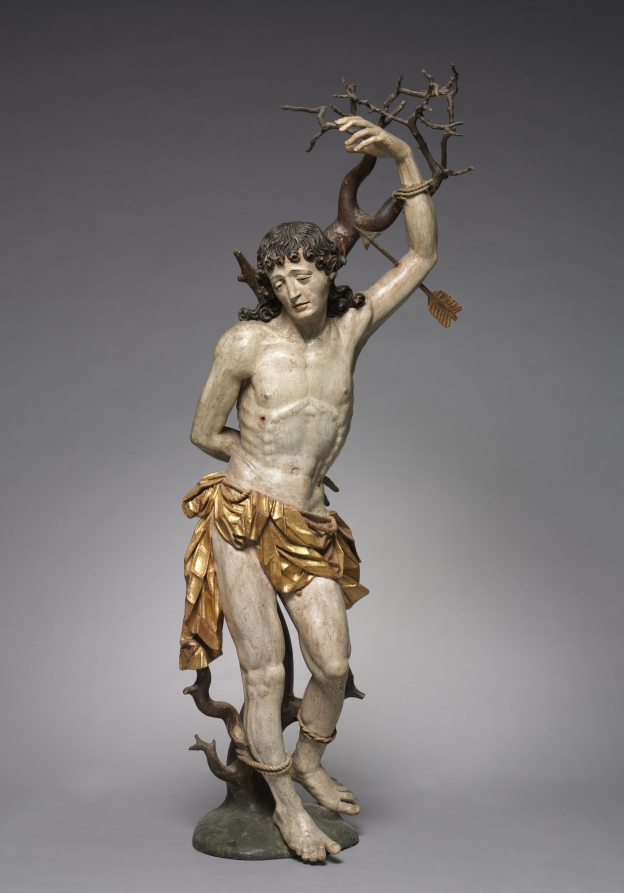
Technical Analysis: The Saint Sebastian Silhouette – Architectural Poetics in Mortal Fabric
The provided artifacts—Mirror with Split-Leaf Palmette Design Inlaid with Gold and Sarcophagus Panel—do not merely suggest an aesthetic; they prescribe a structural dogma. Their dialogue on permanence versus transience, surface versus depth, and geometry versus narrative provides the exact coordinates for the 2026 executive silhouette. This is not fashion as adornment, but as architectural exoskeleton and metaphysical interface. The resultant form is a tailored proposition of severe elegance, where the urban environment is not a backdrop but a dialectical partner.
I. Structural Genesis: The Dialectic of Plane and Relief
The core architectural principle extracted is the manipulation of the foundational plane. The mirror presents a flawless, hyper-reflective silver plane—a metaphor for the modern urban landscape of glass and steel, of expected surfaces and immediate perceptions. The gold inlay, however, introduces a critical intervention. It is not applied; it is embedded, creating a micro-relief that disrupts the plane’s absolute flatness. This translates sartorially into a silhouette built upon a pristine, tailored base—a sharp shoulder, a precise torso—that is then deliberately interrupted by controlled, low-relief detailing. Imagine the severe line of a single-breasted jacket disrupted not by a lapel, but by a seam line traced in sterling silver thread, creating a subtle, palmette-inspired topographic map across the scapula. The body becomes the silver plane; the tailoring, the inlaid gold.
Conversely, the sarcophagus panel begins with the thick, cold plane of stone, from which narrative is extracted. This is the inverse operation: depth is carved out, suggesting mass and history. For the silhouette, this mandates a fabrication of apparent weight and extracted form. It advocates for fabrics with a substantive hand-feel—brushed woolens, technical matte jacquards, double-faced cashmere—that hold a shape as stone holds a carving. The tailoring technique must move beyond suppression and into strategic extraction: a coat’s silhouette might be defined not by its seam, but by a channel of fabric removed from the expected form, creating a negative space that narrates the body’s architecture beneath, much as the浮雕 reveals form from the slab.
II. Geometric Integrity and the Urban Cartesian Grid
The mirror’s split-leaf palmette is not organic; it is nature subjected to a ruthless geometry of eternity. Its symmetry and repetitive, radiating logic speak to a cosmic order, a pattern that exists outside of time. This is the antithesis of the fluid, the casual, the oversized. For the 2026 silhouette, this demands a geometric integrity that mirrors the urban grid. Garment pieces become panels, assembled with the precision of a cartographer. Seams are not merely functional; they are the axes of this personal cartography, intersecting at deliberate, often asymmetric points that recall the palmette’s radiating veins. The silhouette, while tailored to the individual, projects an impersonal, diagrammatic perfection—a uniform for existing within the ordered chaos of the metropolis.
This geometric rigor extends to the treatment of surface. The inlay technique is one of absolute border definition; gold does not bleed into silver. In materiality, this translates to a philosophy of stark, textural contrast within a monochromatic (Silver) scheme. Imagine a sleeve constructed of two panels: one, a high-twist, paper-fine silver wool, the other, a matte, liquid neoprene. They are joined by a seam so precise it appears drawn by a ruling pen, celebrating the border itself as a design element. The executive becomes a walking study in defined material states—shiny/matte, rigid/supple, opaque/translucent—all held in tense, perfect equilibrium.
III. The Silhouette as Temporal Interface: Mirror and Sarcophagus Synthesized
The ultimate synthesis of the artifacts lies in their function as interfaces with time. The 2026 executive silhouette must perform this same duality. It is, like the mirror’s face, a surface for immediate, dynamic reflection—of light, of movement, of the city’s pace. This is achieved through fabric treatments: coatings that create a mercurial reflectivity, or cuts that capture and redirect light along sharp edges. It is the garment of the present moment, the boardroom, the transit hub.
Simultaneously, it must embody the sarcophagus’s memorial permanence. This is achieved through its immutable structural foundations. The internal architecture—the canvas, the boning, the engineered seams—is designed to outlast the season, to resist the ephemeral. It becomes a personal archive, a “sarcophagus” for the executive’s intent and authority. The silhouette thus exists in a perpetual state of temporal dissonance: it speaks of the now in its surface play, and of the eternal in its unwavering form. A tailored coat in our specified Silver becomes the perfect vessel: its color captures every shifting hue of the urban sky, while its severe, geometric cut remains an unchanging constant.
In conclusion, the Saint Silhouette for 2026 is a study in contradiction resolved through absolute technical precision. It is tailored, for it demands the exactitude of the goldsmith and the stone carver. It is Silver, as it is the color of the mirror’s ground, the modern city, and cold-forged metal. It rejects ornament in favor of structural poetics, where the seam is the narrative and the fabric’s behavior is the philosophy. It is urban materiality not as mimicry, but as metaphysical correspondence—a garment that, like its inspirations, is both a functional object and a profound meditation on existence within the structured, relentless, and beautiful confines of time and the metropolis.