Urban Form: Architecture of the Middle Ages: Rouen Cathedral, North Entrance
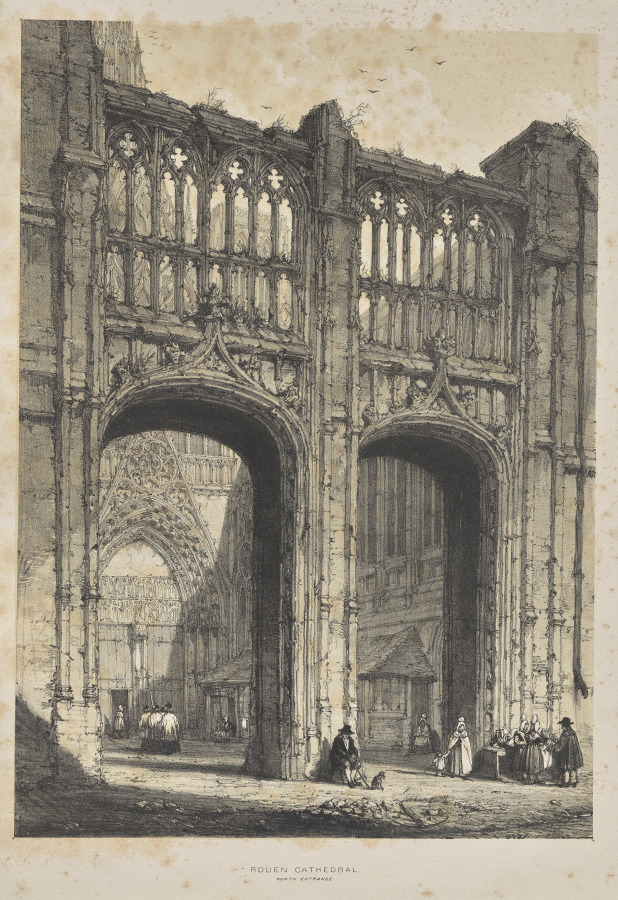
Geometric Integrity of the North Entrance: A Study in Verticality and Void
The North Entrance of Rouen Cathedral is not merely a portal; it is a thesis on the organization of mass and space. Its Gothic architecture presents a rigorous system of vertical lines, pointed arches, and recessed planes that create a rhythm of light and shadow. For the 2026 executive silhouette, this translates into a structural poetics of elongation and containment. The entrance’s multiple archivolts—concentric rings of carved stone—function as a series of frames, each drawing the eye inward toward a central void. This is the architectural equivalent of a tailored garment’s internal structure: the seams, darts, and linings that create a precise, almost architectural, fit. The silhouette must not merely drape; it must stand, with a vertical integrity that mirrors the cathedral’s soaring piers.
The materiality of the stone—weathered, porous, and layered with centuries of urban patina—informs the fabric choices. We are not speaking of pristine marble but of urban materiality: a sandstone that has absorbed the grit of the city, the moisture of the Seine, and the soot of industry. The 2026 executive silhouette must evoke this same sense of enduring presence. The color Sand is not a neutral beige; it is the color of limestone after rain, a tone that holds both warmth and austerity. It is the color of a wall that has witnessed processions, revolutions, and the quiet passage of time. In fabric, this translates to a heavy, matte wool or a densely woven linen—textiles that possess a tactile gravity, that fall with a deliberate weight rather than a fluid ease.
Structural Poetics: The Logic of the Pier and the Buttress
The cathedral’s structural logic is one of counterbalanced forces. The vertical piers bear the load, while the flying buttresses externalize the thrust. This is a system of tension and release, of visible support and hidden strength. For the executive silhouette, this translates into a jacket or coat with a defined shoulder—the pier—and a suppressed waist—the buttress. The line is not soft; it is engineered. The shoulder pad is not a suggestion but a declaration, a subtle architectural corbel that announces the garment’s capacity to hold its own form. The waist suppression is not a feminine curve but a structural necessity, a point of compression that allows the fabric to fall cleanly to the hem, like a column descending to its base.
The North Entrance’s tympanum—the semi-circular space above the doors—is a field of carved figures and narrative scenes. Yet, from a distance, it reads as a dense, textured surface, a field of information that resists easy reading. This informs the use of minimalist ornament in the 2026 silhouette. There is no superfluous decoration. Instead, the garment’s detail is integral to its structure: a seam that traces the line of a rib, a pocket that aligns with the hip bone, a button that functions as a keystone. The ornament is not applied; it is excavated from the form itself, much like the cathedral’s sculptures are carved from the living stone.
Urban Materiality: The Patina of the Everyday
The concept of urban materiality is central to this analysis. The Rouen Cathedral is not a pristine artifact; it is a living structure, marked by the city that surrounds it. Its stone is stained by pollution, eroded by wind, and worn by the touch of millions of hands. This is not decay but accumulation—a layering of time that gives the object its depth. The 2026 executive silhouette must embrace this same principle. The fabric is not a blank slate; it is a surface that will record experience. A crease is not a flaw but a memory of a gesture. A slight sheen on the elbow is not wear but a patina of use. The color Sand, in this context, is the perfect ground for such accumulation. It is a color that absorbs rather than reflects, that allows the garment to become a record of its own history.
This aligns with the internal DNA of the analysis, which contrasts the heroic narrative of David’s Death of Socrates with the silent presence of the ancient Greek jar. The cathedral’s North Entrance is neither a dramatic painting nor a silent vessel. It is a threshold, a point of passage. The executive silhouette, in its most refined form, is also a threshold—a boundary between the individual and the urban environment. It does not shout; it stands. It does not narrate; it contains. Like the jar, its value lies in its internal void—the space it creates for the body, for movement, for the wearer’s own narrative. The garment’s structure is the vessel’s wall; the wearer is the space within.
Conclusion: The 2026 Executive Silhouette as a Monument to Restraint
The definitive urban silhouette for 2026, derived from the North Entrance of Rouen Cathedral, is a study in verticality, weight, and containment. It is a silhouette that rejects the ephemeral in favor of the enduring. The color Sand provides the foundation—a tone of urban permanence. The structure, informed by Gothic engineering, provides the architectural logic. The materiality, embracing patina and use, provides the depth of time. This is not a garment for the transient moment; it is a garment for the executive who moves through the city as a monument—silent, present, and unyielding. The North Entrance does not explain itself; it simply frames the passage. The 2026 silhouette does the same: it frames the body, not as a spectacle, but as a structure of quiet authority.