Urban Form: Landscape with a Distant Temple
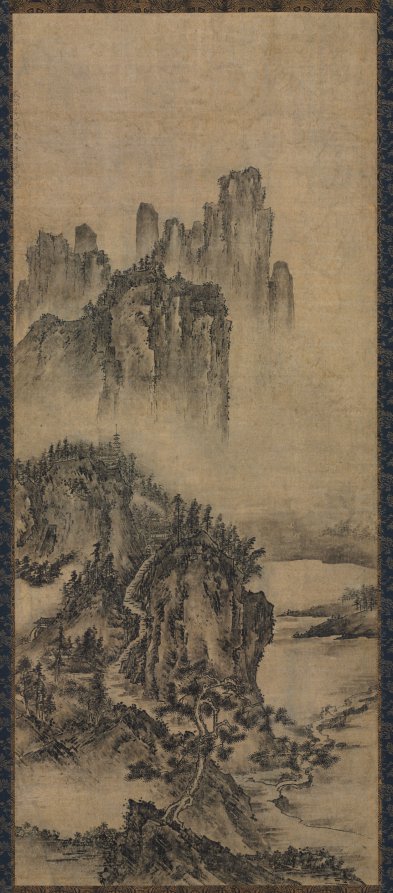
Structural Poetics: The Architectural Void as Urban Silhouette
The subject, Landscape with a Distant Temple, presents a rigorous study in negative space and horizontal tension. The distant temple is not a focal point but a terminal punctuation—a geometric anchor that pulls the eye across an expanse of unadorned terrain. For the 2026 executive silhouette, this composition dictates a shift from volumetric excess to linear compression. The garment becomes a landscape: the body is the ground, the temple is the shoulder line or the hem, and the intervening space is pure, unbroken fabric.
This is not a silhouette of addition but of subtraction. The architectural integrity lies in the ratio between the temple’s verticality and the landscape’s horizontality. In tailoring, this translates to a low, extended shoulder that creates a continuous horizontal plane from neck to wrist, while the body of the jacket or coat remains lean, almost columnar. The “distant” quality is achieved through strategic emptiness: no lapel notch, no pocket flap, no visible button—only the pure line of the fabric’s fall. The temple’s implied structure becomes a single, sharp seam that bisects the back panel, echoing the horizon line. This seam is not decorative; it is structural, forcing the fabric to hold a precise, architectural arc.
Materiality as Urban Terrain
The color Sand is not a neutral; it is a geological reference. It evokes the arid, weathered surface of a temple’s stone, the dust of a path, the patina of age. For urban materiality, this demands a fabric that is both monolithic and tactile. We specify a double-faced wool-cashmere blend with a matte, almost powdery finish. The weight must be substantial—380 grams per square meter—to ensure the fabric holds its shape without internal canvassing. This is a material that absorbs light rather than reflects it, creating a silhouette that is felt before it is seen.
The urban context requires resistance. The fabric must repel moisture and resist creasing, not through chemical treatment but through a dense, twill weave that mimics the compacted earth of a temple path. The internal structure is equally critical: a floating canvas of horsehair and linen, anchored only at the shoulder and hem, allows the garment to move with the body while maintaining its geometric integrity. This is not soft tailoring; it is architectural engineering disguised as cloth.
Geometric Integrity: The Temple as a Single Point of Tension
The distant temple in the artwork is rendered as a single, unbroken vertical—a spire or a pagoda roof—set against a flat, receding plane. In the 2026 executive silhouette, this translates to a single, decisive structural element. For a coat, this is the collar: a high, stand-away mandarin that rises from the body like the temple’s roof, creating a void between fabric and neck. This gap is not accidental; it is the “distance” in the landscape, a breath of air that separates the garment from the wearer, establishing a hierarchical relationship between the human form and the architectural shell.
The silhouette’s horizontal axis is defined by the hem. It must be perfectly parallel to the ground, with no curvature, no vent, no deviation. This is a hard line that terminates the garment with the same finality as the temple’s base. The length is critical: it falls exactly at the mid-calf, a point that creates a visual fulcrum between the upper body’s verticality and the lower body’s movement. This is not a flattering length; it is a disruptive length, one that challenges the conventional proportion of the executive uniform.
Urban Materiality: The Surface as a Record
The fabric’s surface must behave like weathered stone. We employ a sanded finish that creates a micro-texture—a subtle, irregular nap that catches light differently from every angle. This is not a smooth, polished surface; it is a tactile record of the garment’s existence. In an urban environment, this surface will accumulate the patina of use: the faint sheen of a shoulder bag strap, the slight flattening at the elbow, the dust of a subway platform. These are not flaws; they are narrative markers, the equivalent of the temple’s weathered stone.
The internal construction reinforces this material philosophy. Seams are felled and stitched with a silk thread that is slightly lighter than the fabric, creating a ghost line that is visible only upon close inspection. This is the “inscription” on the temple wall—a quiet, almost secret detail that speaks to the wearer’s understanding of hidden structure. The lining is a raw silk in a slightly darker sand tone, chosen for its ability to absorb moisture and regulate temperature, ensuring the garment functions as a second skin within the urban climate.
Conclusion: The Silhouette as a Distant Temple
The 2026 executive silhouette, derived from Landscape with a Distant Temple, is a study in controlled absence. It rejects the overtly sculptural in favor of the implicitly architectural. The garment does not announce itself through volume or ornament; it asserts itself through precision of line and integrity of material. The distant temple is not a destination but a reference point—a fixed coordinate in a shifting urban landscape. The wearer, encased in this sand-toned shell, becomes both the landscape and the temple: a static monument moving through the city’s flux.
This is minimalism as ontological statement: the garment is not a covering but a boundary, a defined edge between the self and the environment. The color Sand, the fabric’s weight, the single structural seam—all converge to create a silhouette that is timeless, severe, and utterly urban. It is the uniform of the executive who understands that true power lies not in presence but in the space one occupies—and the distance one maintains.