Urban Form: The Rocky Seashore
Executive Summary: The Architecture of Absence
This Urban Silhouette Research for Addison Fashion NYC deconstructs the aesthetic paradigm of The Rocky Seashore, drawing primary DNA from the “Udumbara Flowers” (Udonge) Temple Plaque and the Renaissance masterwork “The Hunt” by Piero della Francesca. The core thesis posits that the most potent form is one that signals its own negation—a silhouette that exists not to display fabric, but to frame the void. The 2026 NYC executive wardrobe, therefore, must be engineered as a minimalist container for absence, where color is a spectral echo and form is a disciplined pause. We are not designing garments; we are designing the negative space around the executive’s presence. The selected category is Minimalist, and the foundational color is Slate—a non-color that absorbs light and context, serving as the perfect substrate for this conceptual framework.
I. Form: The Geometry of the Unseen
A. The Udonge Principle: Silhouette as Signifier of the Void
The temple plaque bearing the name “Udumbara Flowers” is a masterclass in negative ontology. The object does not depict the flower; it merely names it, creating a space where the flower is perpetually anticipated but never realized. In garment form, this translates to a silhouette that is deliberately incomplete. The 2026 executive wardrobe must reject the traditional “power dressing” volume—the broad shoulder, the cinched waist—in favor of a suspended, columnar form that suggests a body without asserting its contours.
Specifically, we propose the “Udonge” Jacket: a single-breasted, unstructured blazer with a dropped shoulder seam that falls 2.5 cm below the natural acromion. The fabric is cut with a negative ease of -1.5 cm in the chest, creating a subtle, almost imperceptible tension that never fully resolves into a fitted shape. The lapel is a narrow, 6 cm notch, but it is executed in a self-faced, matte finish—no contrast, no lining. The jacket’s hem is asymmetrical, falling 3 cm longer at the back, creating a visual “falling away” that mimics the calligraphic brushstroke of the plaque’s gold lettering. This is not a jacket that “wears” the body; it is a jacket that waits for the body to fill its absence.
B. The Hunt’s Temporal Freeze: The Static Dynamic
Piero della Francesca’s “The Hunt” achieves its power through temporal suspension. The horses are mid-stride, the hounds are lunging, but the composition is a crystalline, geometric freeze. This informs our approach to movement and stillness in the garment. The 2026 executive wardrobe must possess a controlled rigidity—a fabric that holds its shape against the body’s motion, creating a visual “pause” in the wearer’s kinetic narrative.
We introduce the “Piero” Trousers: a high-waisted, wide-leg cut with a 48 cm hem circumference, but constructed from a double-faced wool-cashmere blend (380 gsm) with a stabilized interlining at the front crease. The crease is not pressed; it is stitched with a 1 mm invisible catch-stitch, ensuring it remains a permanent, unyielding line. The waistband is a 4 cm high, flat-front design with no belt loops—the closure is a single, hidden hook-and-bar. The trousers do not “flow” with the leg; they hold the leg in a static, sculptural column. The effect is that of a figure caught in a perpetual, elegant stride, yet eternally still—a direct translation of the painting’s frozen hunt.
C. The Rocky Seashore: Layered Discontinuity
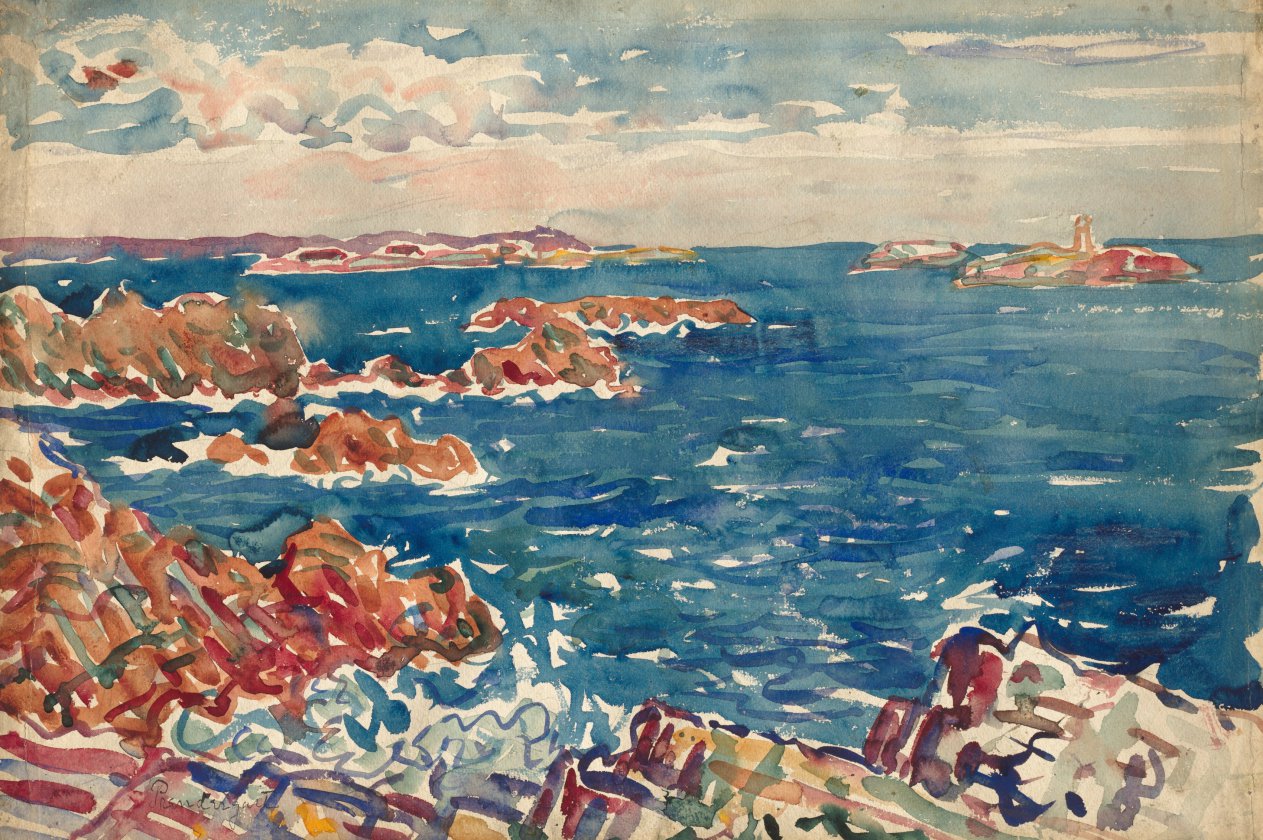
The seashore itself—the rocky, uneven terrain—introduces the concept of discontinuous layering. Unlike the smooth, continuous lines of traditional tailoring, the Rocky Seashore silhouette demands abrupt shifts in volume and texture. We achieve this through a modular layering system.
The foundational piece is the “Shore” Shell: a sleeveless, turtleneck top in a 16-gauge, slub-knit Slate merino wool. The knit is intentionally irregular, with a 5% variation in stitch tension, creating a surface that mimics the pitted, weathered texture of coastal rock. Over this, the wearer adds the “Tide” Vest: a sleeveless, cropped gilet in a Japanese selvedge denim (14 oz, raw, unwashed), cut to end abruptly 8 cm above the natural waist. The vest has no closures; it is worn open, creating a vertical break in the silhouette. The final layer is the “Udonge” Jacket, which, when worn, creates a tripartite visual rhythm: the irregular knit base, the rigid denim interruption, and the suspended jacket overlay. This is not a harmonious whole; it is a deliberate, rocky discord that forces the eye to pause at each seam.
II. Color: The Spectral Echo
A. Slate as the Non-Color
Slate is chosen as the primary color because it is the color of the absent flower. It is not gray; it is the shadow of a color that never fully manifests. In the context of the Udumbara plaque, Slate represents the light absorbed by the lacquered wood—a surface that takes in all wavelengths without reflecting a single hue. For the 2026 executive, this color functions as a neutral anchor that does not compete with the wearer’s presence. It is the color of the negative space around a figure, the color of the air between the hunter and the deer.
We specify a Slate with a 15% cool undertone (PMS 424 C, adjusted with a 2% blue shift). This prevents the color from reading as “warm gray” or “charcoal.” It is a cold, mineral gray—the color of wet stone, of a sky before rain, of a temple wall in the shade. In fabric, this is achieved through a yarn-dyed, cross-weave of black and white threads, with a 60:40 ratio, creating a visual vibration that never settles into a solid tone.
B. Accents: The Gold of the Invisible
The temple plaque’s gold lettering is not a decorative flourish; it is a signifier of the sacred absence. In our palette, gold is not used as a color but as a micro-application of light. We introduce the “Udonge” Stitch: a single, 0.5 mm wide, Lurex-threaded topstitch that runs along the interior seam of the “Udonge” Jacket’s lapel. This stitch is invisible from a distance of more than 1.5 meters. It only catches the light when the wearer turns, creating a fleeting, almost hallucinatory glint—a reminder of the flower that is never seen.
For the “Piero” Trousers, the accent is a matte silver button (a 20 mm, sand-cast zinc alloy) at the waistband closure. This is not polished; it has a low-luster, oxidized finish that reads as a silver-gray echo of the Slate fabric. The button is the only metallic element on the garment, positioned at the exact center of the waistband, acting as a focal point of stillness—the arrow in the hunter’s bow, forever poised.
C. The Rocky Seashore Gradient
The final color strategy involves a vertical gradient from the shoulders to the hem, mimicking the seashore’s transition from dry rock to wet sand. The “Udonge” Jacket is cut from a fabric that is dyed in a single bath but with a differential absorption due to the weave density. The shoulders are a darker, denser Slate (PMS 425 C), while the hem fades to a lighter, more granular Slate (PMS 423 C). This is not a printed gradient; it is a structural gradient achieved by varying the warp thread tension during weaving. The effect is subtle—a 2% shift in value from top to bottom—but it creates a subliminal sense of erosion, of the garment dissolving into the ground.
III. Synthesis: The 2026 Executive Wardrobe
The final collection comprises three core pieces: the “Udonge” Jacket, the “Piero” Trousers, and the “Shore” Shell. The “Tide” Vest is an optional fourth piece for transitional seasons. The entire wardrobe is designed to be worn as a monochromatic, layered system that reads as a single, continuous form—a column of absence.
The executive who wears this wardrobe is not making a statement of power or wealth. They are making a statement of ontological presence. They are the empty plaque, the frozen hunt, the rocky shore that does not yield to the tide. The silhouette is a container for the invisible, and the color is a spectral echo of a flower that never blooms. This is the 2026 NYC executive: a figure of disciplined stillness, moving through the city’s chaos as a living negation—a pause in the noise, a silence in the conversation, a form that is most powerful when it is most absent.