Minimalist
Slate
Urban Form: Pietà
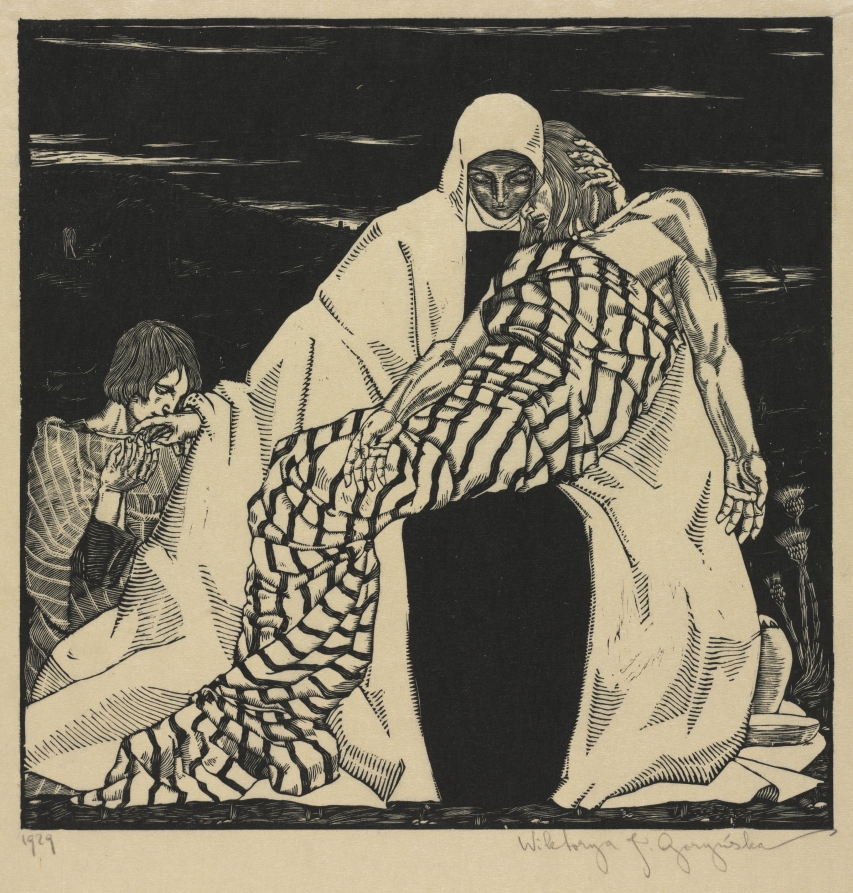
Structural Poetics: The Geometry of Terminal Composure
The Pietà, as a sculptural and painterly subject, presents a paradox of form: the collapse of the mortal body into the lap of the divine, rendered with a rigor that denies entropy. For the 2026 executive silhouette, this translates into a study of controlled tension—a geometry where the horizontal plane of the lap meets the vertical descent of the torso, creating a fulcrum of absolute stillness. The primary architectural gesture is the triangular containment: the Virgin’s draped arms form a base, while Christ’s limp figure defines a diagonal that bisects the composition. This is not softness; it is a calculated distribution of mass. The executive jacket must echo this through a sharp, dropped shoulder that mimics the gravitational pull of the Pietà’s central figure, with a hemline that terminates at the hip bone—neither elongating nor truncating, but anchoring the wearer in a state of poised finality. The fabric becomes the medium of this structural poetics. We propose a double-faced wool-silk blend in Slate—a color that absorbs light without surrendering depth, akin to the shadowed recesses of Michelangelo’s marble. The weave must be tight enough to hold a crease that cuts like a chisel mark, yet fluid enough to drape into a single, uninterrupted fold over the forearm. This is the “death fold”: a deliberate, unbroken line from shoulder to wrist, denying any decorative interruption. The silhouette rejects the soft, rounded shoulder of traditional tailoring in favor of a squared, almost architectural block—the shoulder seam extends two centimeters beyond the natural acromion, creating a shelf that visually supports the weight of the head, much as the Pietà’s marble base supports the entire composition.Urban Materiality: The Skin of the Object
The Pietà’s surface is not smooth; it is a topography of chisel marks, veins, and the subtle pitting of centuries. Urban materiality demands a fabric that wears its process. For the 2026 executive, this is achieved through a micro-ribbed cashmere with a matte finish, woven in a 2x2 twill that catches urban light—neon, halogen, sodium—as a series of micro-shadows. The color Slate is not flat; it is a composite of charcoal, blue-gray, and a whisper of violet, reminiscent of the stone’s natural patina under gallery lighting. This fabric must be weighted—a minimum of 380 grams per square meter—so that it hangs with the inertia of a sculpted form, resisting the wind of a city street. The key structural detail is the absence of a lapel notch. Instead, the jacket employs a continuous, unbroken collar that rises from the sternum to the nape, mimicking the unified drape of the Virgin’s veil. This is not a garment for gesticulation; it is a garment for stillness in motion. The pockets are hidden, set into the side seams, so that the hand’s insertion does not disrupt the line. The back panel is cut in a single piece, with a center seam that runs from the collar to the hem, echoing the spine’s central axis in the Pietà—a line of structural integrity that divides the form into two balanced halves.Geometric Integrity: The Lap as a Horizontal Plane
The most radical element of the Pietà is the lap—a horizontal plane that cradles the dead weight of the adult male body. In the 2026 executive silhouette, this translates into a peplum-like extension at the hip, but rendered in the same fabric, not as a separate piece. The jacket’s lower edge is cut with a subtle, forward-leaning curve—a millimeter-thin arc that suggests the lap’s concave form without literal imitation. This is achieved through a dartless construction at the waist, where the fabric is molded using heat and steam to create a permanent, soft curve that holds its shape against the body. The trousers, if paired, must be cigarette-slim with a front crease that bisects the knee, terminating at the ankle without break. The waistband is hidden, set below the natural waist, so that the jacket’s hem overlaps the trousers by exactly three centimeters—a ratio derived from the Pietà’s proportion of the Virgin’s knee to Christ’s torso. The overall effect is a vertical compression: the eye is drawn upward to the face, then downward to the hands, bypassing the torso as a mere conduit. This is the geometry of terminal composure—a silhouette that does not invite touch, but demands contemplation.Color as Shadow: Slate as the Absence of Light
Slate is not a neutral; it is a negative color, the color of wet stone, of the shadow beneath a marble fold. In urban environments, it absorbs the blue of twilight and the orange of street lamps, becoming a chameleon of melancholy. For the executive, this color signals authority without aggression, a refusal to compete with the city’s chromatic noise. The fabric’s surface is treated with a nano-coating that repels water and dust, ensuring that the Slate remains pure—unmarked by the city’s grime, much as the Pietà’s surface is cleaned of centuries of candle soot. This is not a color for blending in; it is a color for standing still while the world moves around you. The final element is the interior lining: a raw, unbleached silk in the same Slate tone, but with a slight sheen. This is the only moment of warmth, visible only when the jacket is opened—a private acknowledgment of the body beneath the structure. It is the equivalent of the Pietà’s hidden tears: an emotion that does not disrupt the surface, but exists as a secret within the stone.
Technical Insight
Technical Insight: Translating Slate palettes into Minimalist silhouettes for the modern metropolis.