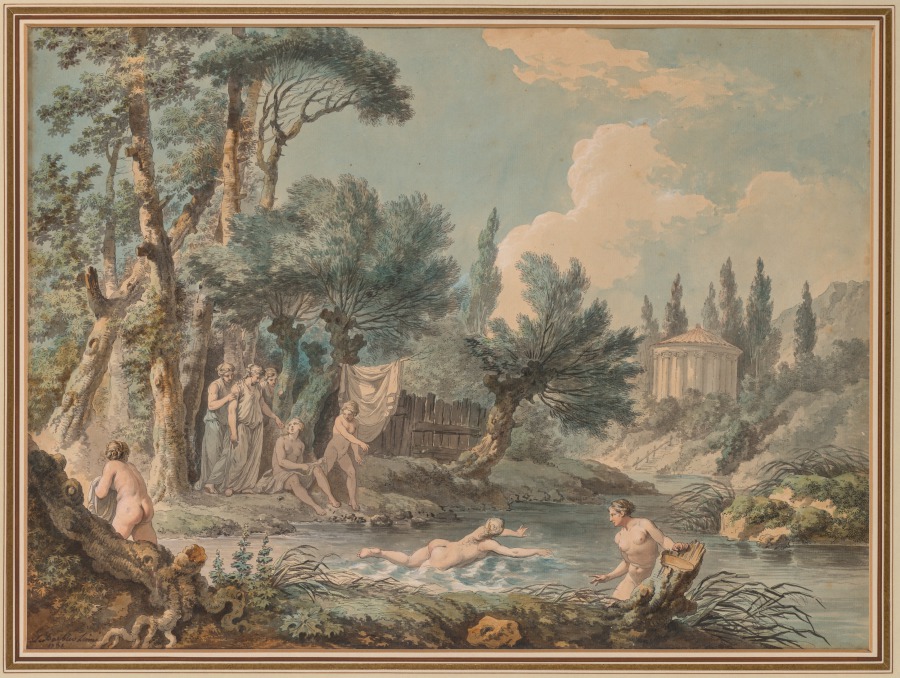
Urban Form: Nudes in a Landscape
Geometric Integrity: The Architecture of Emptiness
The Urban Silhouette Research for Addison Fashion’s 2026 executive collection begins with a radical proposition: that the most potent form is not the one that asserts, but the one that withholds. The subject, Nudes in a Landscape, is here refracted through the internal DNA of two opposing yet complementary artifacts: the “Udumbara” temple plaque and the Divine Beasts, Chariot, and White Tiger Bronze Mirror. These objects—one of carved wood, one of cast bronze—do not depict the nude form. Yet they define its silhouette with greater precision than any figurative study. They teach us that the body in the urban landscape is not a surface to be draped, but a volume to be carved.
1. The Udumbara Plaque: Negative Space as Structural Poetics
The plaque’s aesthetic power lies in its emptiness. The carved characters—bold, unadorned, almost clumsy in their simplicity—are not the subject. The subject is the void around them. The wood grain, the patina of ink, the silence between strokes: these constitute the true geometry. For the 2026 executive silhouette, this translates into a minimalist architecture of absence. The garment does not cling; it frames. Shoulders are defined not by padding but by the negative space of a dropped armhole. The waist is suggested by the withdrawal of fabric, not its compression. The silhouette is a hollow vessel—a shell that contains the body without declaring its exact contours. This is the urban poetics of restraint: a jacket that hangs like a temple gate, its lapels forming a calligraphic stroke against the chest. The material—crisp, matte, ivory-toned wool—absorbs light rather than reflecting it, mimicking the absorbent stillness of aged wood.
2. The Bronze Mirror: Dynamic Tension in a Static Form
Where the plaque is static, the mirror is kinetic. Its densely packed relief—the Queen Mother of the West, the galloping chariot, the rearing white tiger—creates a centrifugal energy that spirals outward from the center. The mirror’s geometry is not one of empty space but of compressed movement. Every line, every curve, every fold of drapery is a vector of force. For the silhouette, this translates into structural tension. The garment must appear still, yet ready to move. A coat’s back panel is cut with a subtle biomorphic curve—a reference to the tiger’s spine—that creates a dynamic line from shoulder to hem. The sleeve is set with a forward pitch, as if the arm is already in motion. The fabric—a dense, unyielding wool-cashmere blend—holds its shape like bronze in repose. The silhouette is not fluid; it is articulated. Each seam is a chiseled line, each dart a compressed energy waiting to release.
3. The Synthesis: Ivory as the Color of Silence and Motion
The chosen color, Ivory, is not a neutral. It is a loaded absence. It is the color of the plaque’s wood before ink, of the mirror’s patina before oxidation. It is the ground upon which the silhouette is drawn. In the 2026 executive wardrobe, Ivory functions as a spatial primer. It does not compete with the body; it contains it. A high-neck tunic in Ivory, cut with a monastic severity, references the plaque’s calligraphic emptiness. A pair of wide-leg trousers, pleated at the waist and falling to a razor-sharp hem, echoes the mirror’s centrifugal flow. Together, they form a landscape of the body—a nude not of flesh, but of pure form.
4. Urban Materiality: The Tactile Logic of the City
The urban environment demands armor. But the armor of 2026 is not hard; it is dense. The materials chosen for this silhouette are weighted with intention. A double-faced wool that is felted on one side, woven on the other—the felt side absorbs the city’s noise, the woven side reflects its light. A liquid silk that moves like mercury, used for linings that never touch the skin but create a second skin of air. A crisp cotton poplin that holds a crease like a fold in paper. These are not fabrics; they are architectural membranes. They do not drape; they stand. The silhouette is self-supporting, like a building that needs no scaffolding. The shoulder line is extended but soft, a cantilever of cloth. The waist is unmarked, the hip unstated. The body is a column—not hidden, but abstracted.
5. The Executive Silhouette: A Manifesto of Restraint
The 2026 executive is not a figure of excess. She is a figure of control. Her silhouette is a statement of intent: I am here, but I do not need to announce myself. The Udumbara plaque teaches her the power of what is left unsaid. The bronze mirror teaches her the power of what is held in reserve. Her jacket is a temple gate; her trousers are a chariot in motion. Her silhouette is both empty and full, still and dynamic. It is a nude in a landscape—not the body itself, but the space the body occupies. In a city of noise, she is the silence. In a city of motion, she is the still point. This is the definitive urban silhouette for 2026: minimalist, ivory, and absolute.