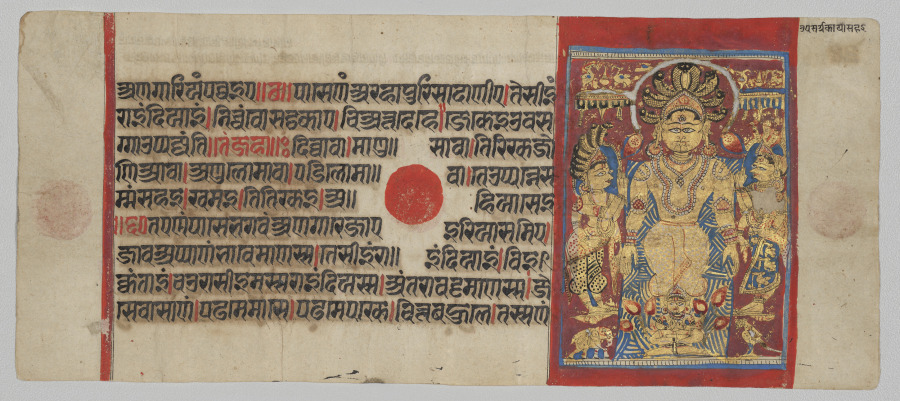
Urban Form: Parshva Undergoes Physical Trials, Folio 46 (recto), from a Kalpa-sutra
Geometric Integrity as Urban Armature
The Kalpa-sutra folio depicting Parshva undergoing physical trials presents a radical departure from narrative excess. Here, the body is not a vessel for emotion but a tectonic system—a series of load-bearing planes and tensile lines that resist, rather than yield, to ordeal. The figure’s posture, a rigid vertical anchored by a seated base, establishes a primary axis of compression. The limbs are not relaxed; they are bracketed, forming right angles and acute triangles that channel force downward into the earth. This is not a body in agony; it is a body in structural equilibrium. For the 2026 executive silhouette, this geometry dictates a return to the architectonic: shoulders squared as cantilevers, torsos sheathed in unbroken panels, and hemlines that terminate with the precision of a cut stone. The urban environment demands armor, not drapery.
The internal DNA of this analysis—the tension between the heroic narrative of David’s *Socrates* and the mute objecthood of the Greek cup—finds its resolution in Parshva’s trials. The folio’s composition strips away the theatrical chiaroscuro of the former and the polished finish of the latter. Instead, it offers a raw materiality: the skin is a surface of inscribed lines, the ground is a void, and the only ornament is the geometry of endurance. This is the paradox cast into perfect form: the most profound spiritual trial is rendered as a diagram of forces. The 2026 silhouette must therefore reject the soft, the draped, the forgiving. It must adopt the cold logic of the frame—a jacket that does not follow the body but contains it, a trouser that falls as a plumb line, a coat that stands as an independent structure.
Structural Poetics: The Body as Load-Bearing Element
The Vertical Axis and the Cantilevered Shoulder
Parshva’s seated posture is not passive. The spine is a column; the head, a capital. The arms, extended or resting, act as secondary beams. In the 2026 executive wardrobe, this translates to a redefinition of the shoulder. No longer a padded curve, it becomes a sharp, horizontal projection—a cantilever that visually supports the weight of the garment. The sleeve head is set with a clean, almost brutal seam, creating a 90-degree angle at the acromion. The fabric, likely a high-density wool or a technical twill in Onyx, is chosen for its compressive memory. It will not slump; it will hold its geometry against the body’s movement. This is the urban poetics of the structural silhouette: the garment does not move with the wearer; it frames the wearer, turning every gesture into an architectural event.
The Torso as a Monolithic Volume
The folio’s treatment of the torso is one of minimalist containment. There is no modeling of musculature, no chiaroscuro of flesh. The torso is a block, a volume defined by its boundaries. For the 2026 silhouette, this mandates a monolithic jacket—a single, unbroken panel from shoulder to hem, with no waist suppression, no darts, no concessions to the natural curve. The closure is a single, hidden magnetic seam, or a series of invisible toggles that maintain the surface’s integrity. The length is extended, reaching the mid-thigh, creating a vertical mass that elongates the figure while asserting a formidable presence. The Onyx color reinforces this: it absorbs light, eliminating any hint of volume or texture, reducing the garment to a pure, two-dimensional silhouette in space. This is the urban materiality of negation—the garment is defined by what it is not: not soft, not draped, not human.
Urban Materiality: The Paradox of the Perfect Container
From Narrative to Object
The Greek cup, in its silent geometry, holds the key to the 2026 collection’s material philosophy. It is a container that does not narrate; it awaits. Parshva’s trials, stripped of hagiographic detail, become the same: a body as a container for ordeal. The 2026 executive silhouette must function as this container—a perfect, mute vessel for the urban professional. The fabric is not a storyteller; it is a membrane of precise tension. We select a double-faced wool with a core of carbon fiber filament. This is not a textile for comfort; it is a textile for structural integrity. It holds a crease with the permanence of a steel beam. It resists wrinkling, not as a convenience, but as a philosophical statement: the garment does not record the day’s chaos; it remains impervious, a constant form in a shifting city.
The Hem as Termination
In the Kalpa-sutra, every line has a terminus. The hem of the 2026 coat is not a soft edge; it is a cut. It is finished with a raw, laser-sealed edge that will never fray, never roll. This is the urban poetics of finality. The garment ends as abruptly as a sentence in a legal document. The interior is fully bonded, with no visible stitching, no lining that shifts. The garment is a monocoque structure—the outer shell is the only structure. This echoes the Greek cup’s integrity: it is not a shell over a void; it is the void itself, given form. The 2026 executive, moving through the glass-and-steel canyons, becomes a walking architectural fragment—a piece of the city that has learned to move.
Conclusion: The Silhouette as a State of Being
The 2026 Urban Silhouette Research concludes that the executive form must be a paradox cast in Onyx. It must be as rigid as Parshva’s seated figure, as silent as the Greek cup, and as resolute as Socrates’ final gesture. It is a silhouette that does not express the self; it contains it. The garment is a trial, a physical ordeal of geometry and material, that the wearer undergoes daily. The reward is not comfort, but presence. In a city of noise, the minimalist, structural, Onyx-clad figure is a statement of pure, unassailable form. It is the urban armor for the soul, a container for the paradox of modern existence: to be both utterly exposed and completely invulnerable.