Minimalist
Slate
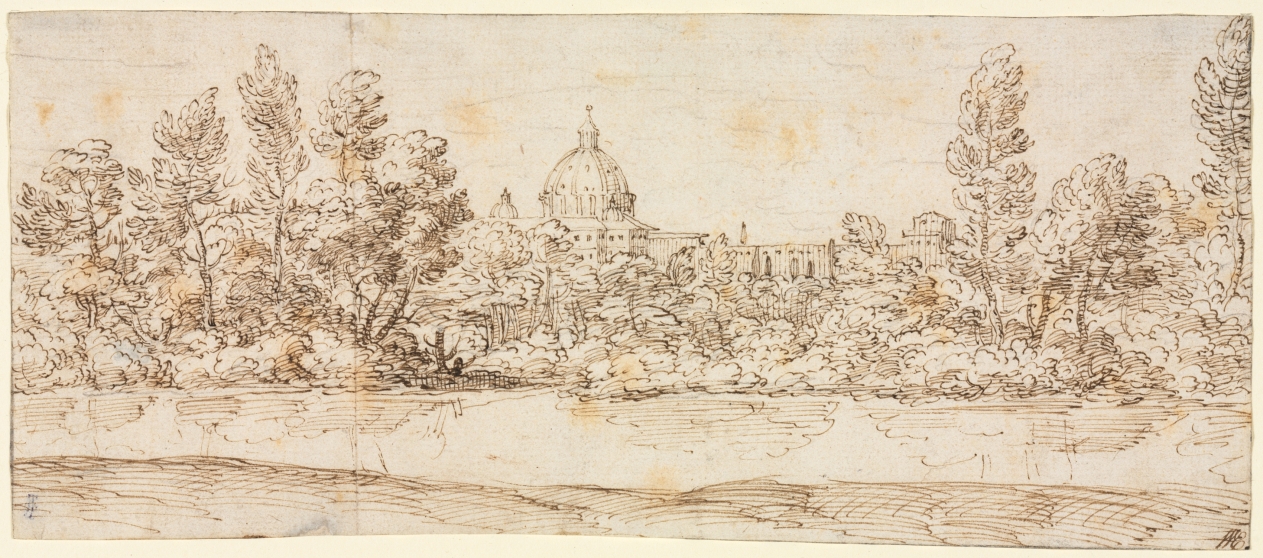
Urban Form: River Landscape with View of St. Peter's Basilica
Geometric Integrity and the Architecture of Restraint
The painting *River Landscape with View of St. Peter’s Basilica* presents a paradox of depth: a vast, atmospheric vista rendered through a rigorous, almost architectural geometry. The dome of St. Peter’s is not merely a religious symbol; it is a pure hemisphere, a mathematical ideal set against the horizontal sweep of the Tiber. The river itself becomes a receding plane, a perspectival line that anchors the viewer’s gaze. For the 2026 executive silhouette, this painting dictates a return to **structural poetics**—where every seam, every panel, every fold is a deliberate act of spatial definition. The artwork’s depth is not narrative but **phenomenological**. It does not tell a story of Rome; it presents a state of being—a silent, volumetric presence. This aligns with our internal DNA’s inquiry into “deeper” beauty: the painting’s power lies not in its subject matter but in its pure, unadorned composition. The sky is a field of modulated slate, the river a band of silver, the dome a solid mass of onyx shadow. There is no ornament, only proportion. This is the essence of **Minimalist luxury**: the elimination of the superfluous to reveal the essential.Structural Poetics: The Silhouette as a Contained Void
The 2026 executive silhouette must be read as a **contained void**—a negative space defined by precise, unyielding boundaries. The painting’s riverbanks are not soft; they are sharp, linear cuts that direct the eye. Similarly, the shoulder line of the Addison executive jacket must be a clean, architectural arc, not a padded curve. The sleeve head should sit flush, almost flush with the body, creating a continuous plane from neck to wrist. The fabric itself—a dense, matte **slate** wool—must hold this shape without drape, as if carved from a single block. The dome of St. Peter’s offers a critical lesson in **volume management**. It is a hemisphere that never overwhelms its base. In our silhouette, this translates to a slightly softened, rounded shoulder that does not extend beyond the natural body line. The jacket’s body is a straight, narrow column, falling from the shoulder without waist suppression. This is not a feminine or masculine cut; it is a **neutral, architectural form**—a tube of fabric that houses the body without mimicking it. The depth of this silhouette lies in its refusal to conform to the body’s curves, instead creating a new, abstract geometry.Urban Materiality: Slate, Silver, and the Texture of the City
The painting’s palette is a study in **urban materiality**: the grey of wet stone, the silver of a clouded sky, the deep black of a shadowed arch. For our 2026 collection, **Slate** is the primary color—not a flat grey, but a complex, layered tone that shifts between blue-grey and charcoal, like the Tiber under a stormy sky. The fabric must be a **double-faced wool** with a subtle, almost imperceptible sheen, reminiscent of polished stone. The interior of the jacket, visible only at the collar or cuff, should be a deep **Onyx**—a void that absorbs light, echoing the painting’s deep shadows. The **urban materiality** of this silhouette is one of resistance. It is designed for the concrete, glass, and steel of the contemporary metropolis. The fabric’s weight—approximately 380 grams per square meter—provides a **structural integrity** that resists wind and movement. The jacket is not meant to flow; it is meant to stand. The trousers, a straight, uncuffed leg, fall from the hip to the shoe, creating a continuous vertical line. The only break in this monochrome field is a single, sharp **silver** zipper at the center front—a functional element that becomes a graphic line, like the horizon in the painting.The Poetics of the Seam: A Dialogue with the Void
The painting’s depth is achieved through **atmospheric perspective**—the gradual fading of detail into the distance. In our silhouette, this is translated through the **poetics of the seam**. The jacket’s seams are not hidden; they are **exposed and precise**, running parallel to the body’s axis. A single, continuous seam runs from the shoulder to the hem, creating a subtle, three-dimensional ridge. This is not decoration; it is a **structural necessity** that defines the garment’s volume. The seam becomes a line of tension, a boundary between the body and the space it occupies. The internal DNA’s meditation on the “depth of existence” versus “depth of representation” finds its resolution here. The jacket does not represent a river or a dome; it *is* a river and a dome—a pure, volumetric object that exists in space. Its depth is not in its symbolism but in its **material presence**: the weight of the wool, the coldness of the zipper, the precision of the cut. This is the **Minimalist** answer to the question of aesthetic depth: the object itself, stripped of narrative, becomes a vessel for pure experience.Conclusion: The 2026 Executive as a Static Monument
The 2026 executive silhouette, derived from *River Landscape with View of St. Peter’s Basilica*, is a **static monument** to urban poetics. It rejects the dynamism of the body in favor of a fixed, architectural form. The wearer does not move through the city; the city moves around them. The jacket and trousers form a **unified field** of slate, a negative space that defines the positive space of the environment. This is not a garment for action; it is a garment for **presence**—a silent, volumetric statement that demands to be seen, not read. The color **Slate** is not a choice; it is a necessity. It is the color of the city at dawn, of wet pavement, of the dome against a grey sky. It is the color of **restraint**, of power held in reserve. The silhouette is a lesson in **geometric integrity**: every line is a decision, every volume a calculation. This is the definitive urban silhouette for the executive who understands that true depth lies not in what is said, but in what is left unsaid—in the silent, material presence of a perfectly constructed form.
Technical Insight
Technical Insight: Translating Slate palettes into Minimalist silhouettes for the modern metropolis.