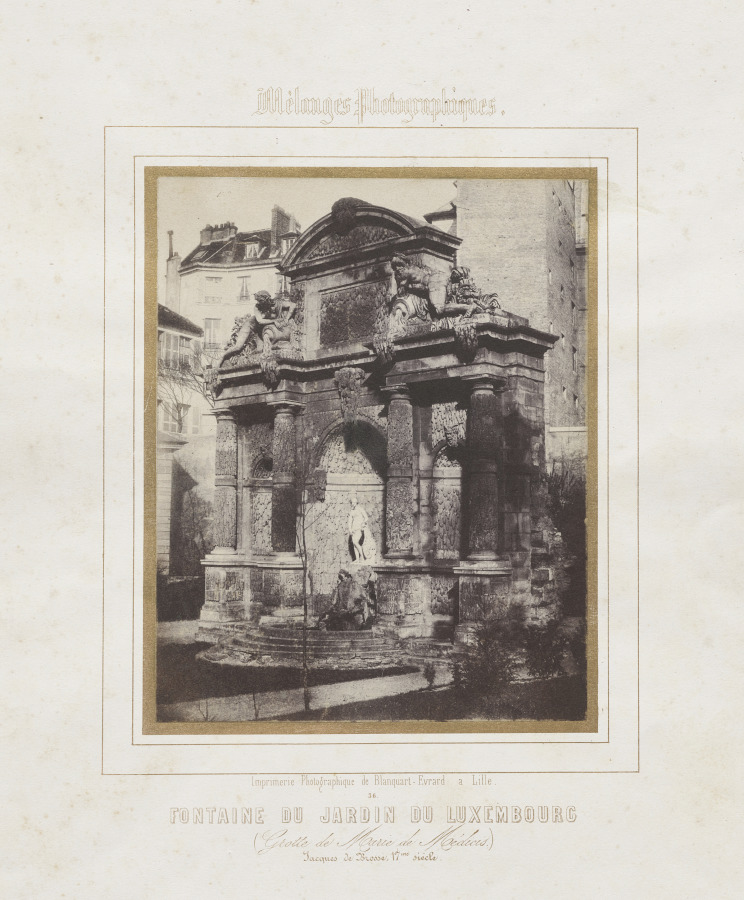
Urban Form: Fontaine du Jardin du Luxembourg (grotte de Marie de Médécis)
Technical Analysis: Structural Poetics of the Grotto & The 2026 Executive Silhouette
The Fontaine du Jardin du Luxembourg, specifically the Grotte de Marie de Médécis, presents not a singular form but a complex architectural dialogue between the hewn, the built, and the organic. Its geometric integrity is one of calculated erosion and tectonic assertion. The grotto itself is a study in the paradox of the manufactured ruin: rough, irregular volcanic rock forms a cavernous, negative space, a deliberate void carved from intention. Against this, the clean, classical lines of the architectural niche and the sculptural group are inserted with definitive precision. This is not harmony through blending, but tension through juxtaposition. The geometry is one of interrupted arcs and fractured planes—the soft curve of the archway containing the jagged texture of stone, the vertical thrust of the pilasters against the horizontal sprawl of the rock mass. This precise calibration of chaos and order forms the core of our 2026 architectural silhouette: a silhouette built on the principle of structured intrusion.
Geometric Deconstruction & Silhouette Manifestation
The primary geometric lesson is the treatment of surface as a record of force. The grotto’s rockface exhibits a faceted, non-uniform topography, a direct result of subtractive processes. For Addison Fashion, this translates into cutting techniques that move beyond flat-pattern drafting. We propose the development of a “Lithic Seam”—a signature construction method where garment panels are cut along bias lines that mimic geological fracture patterns, then rejoined with precision topstitching that acts as a “fault line.” The resulting silhouette, while fundamentally tailored and close to the body, carries an internalized record of tectonic stress, visible in the subtle, asymmetrical paneling across the torso and shoulders.
Furthermore, the grotto’s architectural frame provides the armature for the amorphous. The 2026 executive silhouette will embody this through a refined application of internal structure. Consider a single-breasted blazer where the traditional canvas and horsehair are replaced with a molded, lightweight technical mesh, shaped to create a subtle, arch-like curvature across the dorsal plane, echoing the grotto’s niche. This creates a silhouette that is rigidly defined from behind—a modern urban carapace—while allowing for a more pliant, rock-like drape in the front panels, achieved through specially weighted Slate-hued wool-cashmere blends. The silhouette is thus bi-focal: presenting geometric severity in the rear profile and controlled textural disorder in the frontal view.
Materiality as Urban Stratigraphy
The material narrative of the grotto is one of stratified history—stone, water, bronze, shadow. Our urban materiality for 2026 must perform a similar function, layering tactile memory with contemporary performance. The core color, Slate, is not a flat grey but a complex, granular hue that shifts between cool mineral and warm sediment, mirroring the grotto’s stone. Fabrics will be engineered to possess a “lithic hand-feel”: a dry, slightly porous texture achieved through innovative twisting of carbon-grey yarns with fine metallic (Silver) threads, suggesting the glint of moisture on wet rock.
Key to the material poetics is the interplay of density and permeability, mirroring the grotto’s solidity and its function as a water conduit. Outer shells will utilize dense, micro-bonded wools with a matte, stone-like finish, while linings or secondary layers will incorporate laser-perforated technical silks in contrasting Ivory, creating a subtle, vent-like pattern that suggests hidden aquifers. Hardware, limited to essential closures, will be cast in darkened, brushed pewter—not shiny, but possessing the subdued gleam of weathered lead, a direct reference to the fountain’s hydraulic origins.
The Internal DNA: Sacred Carrier & The Executive Form
The provided internal DNA—contrasting the “full overflow” of Christ Bearing the Cross with the “empty invitation” of the Roundback Armchair—finds direct expression in this silhouette’s philosophy. The tailored, architectural rigor of the grotto-inspired form acts as the “负重的形变” (burdened deformation). It is the modern executive’s cross: the weight of decision-making, the tension of leadership, and the pressure of visibility are translated into the garment’s internalized structural dynamics—the “Lithic Seam,” the dorsal arch. The wearer bears this structured silhouette as a contemporary sacred carrier, where the “sacred” is the intangible burden of responsibility.
Conversely, the “以空纳神” (using emptiness to contain the divine) principle is manifested in the silhouette’s intentional voids and negative spaces. The deep, precisely tailored armholes that allow for a full range of motion; the high, open neckline that frames the throat and collarbones; the clean, unbroken line from a narrow shoulder to a tapered cuff. These are not mere design features but prepared vacuities. They are the equivalents of the罗汉椅’s central emptiness—spaces carved out within a rigid form to allow for the “occupancy” of intellect, movement, and personal authority. The executive does not fill the suit; the suit’s structured absences are designed to be filled by the executive’s presence.
Thus, the definitive 2026 Addison executive silhouette, derived from the Grotte de Médécis, is a tailored vessel of urban poetics. It is a study in the geometric tension between the carved and the constructed, between mineral density and human absence. In Slate, it carries the color of compressed time and urban bedrock. It functions as both armor and invitation—a threshold garment that bears the weight of its own sophisticated engineering while meticulously framing the potent emptiness of the individual who inhabits it. This is minimalist luxury redefined: not as the absence of detail, but as the extreme precision of structural and philosophical intent.