Urban Form: Woman with a Veil
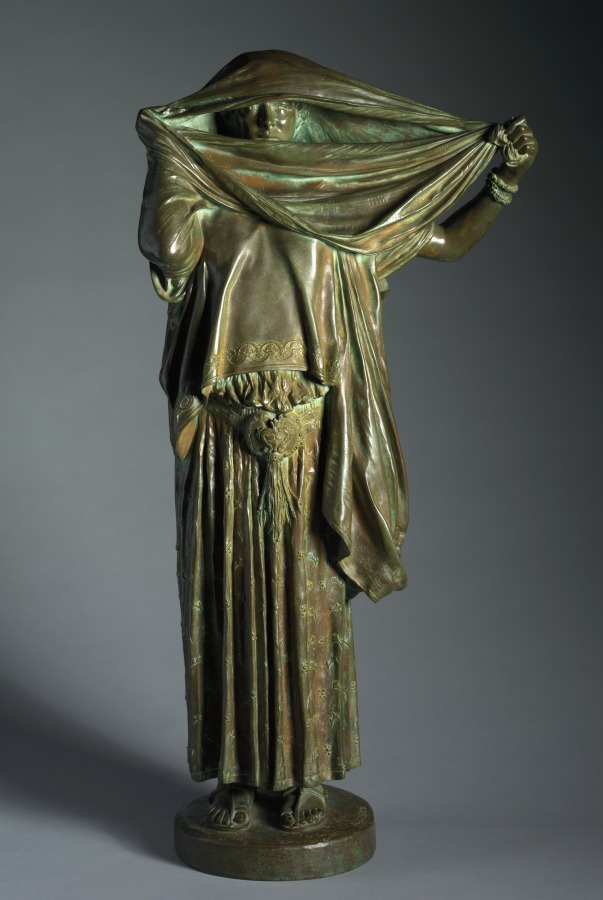
Geometric Integrity and the 2026 Executive Silhouette
The subject of the Woman with a Veil, when filtered through the internal DNA of the Addison Fashion archive—specifically the dialectical tension between the Metropolitan Museum of Art’s Bodhisattva and the Walters Art Museum’s Bull-Headed Seated Figure Amulet—yields a definitive urban silhouette for the 2026 executive. This is not a silhouette of soft drapery or romantic concealment. It is a study in compressed power and sacred geometry. The veil, in this analysis, is not a textile; it is a structural membrane, a boundary condition between the internal self and the external city. The 2026 executive silhouette is defined by the Onyx palette—a color of absolute absorption, of void made tangible, of the night sky rendered as a corporate uniform.
The Bodhisattva’s Vertical Axis: The Columnar Torso
The Bodhisattva statue presents a figure of serene, vertical elongation. The torso is a column, uninterrupted by excessive articulation. The drapery is not a separate garment but an extension of the form itself, flowing in parallel, rhythmic lines that guide the eye upward. For the 2026 executive, this translates into a monolithic top—a high-neck, sleeveless shell in Onyx wool crepe. The neckline is not a V or a scoop; it is a precise, architectural arc that mirrors the Bodhisattva’s mandorla. The fabric is cut on the bias to create a subtle, internal tension, a memory of the statue’s flowing lines, but rendered in a material that holds its shape with absolute authority. The shoulder line is dropped, not to soften, but to extend the horizontal plane of the collarbone, creating a sacred canopy over the torso. This is the urban poetics of stillness—a form that does not move, but commands the space around it.
The Amulet’s Compressed Power: The Structured Waist
In stark contrast, the Bull-Headed Amulet is a study in compression. Its miniature scale and compact posture are not diminutive; they are a concentration of force. The bull’s head, a symbol of raw, generative power, is locked into a seated human form. This is the micro-architecture of protection. For the 2026 silhouette, this translates into a high-waisted, structured trouser or a corseted belt that acts as a horizontal anchor. The waist is not cinched; it is framed. A wide, Onyx leather belt, with a single, polished silver buckle (a nod to the amulet’s metallic origins), sits at the natural waist, creating a clear demarcation between the columnar top and the lower body. This belt is not an accessory; it is a load-bearing element, a structural joint that transfers the vertical energy of the torso into the horizontal plane of the hips. The trousers themselves are cut with a straight, almost rigid leg, falling from the hip without break, ending in a clean, unhemmed line at the ankle. The fabric is a double-faced wool, heavy enough to hold a crease that could cut glass. This is the urban materiality of defense—a garment that protects its wearer from the chaos of the city by creating an impenetrable outer shell.
The Veil as a Structural Membrane: The Headpiece
The central subject—the Woman with a Veil—is not a separate entity but the synthesis of these two sacred forms. The veil itself is the critical element. It is not a scarf or a shawl. It is a rigid, architectural headpiece that extends from the crown of the head to the collarbone, framing the face as a mandorla frames a deity. Constructed from a single piece of Onyx felt, stiffened with a hidden internal wire frame, the veil does not drape; it projects. It creates a negative space around the face, a void that draws the eye inward. The front edge is cut in a clean, asymmetrical line, one side falling to the shoulder, the other to the mid-chest. This asymmetry is not decorative; it is a structural necessity, echoing the amulet’s compact, off-center power. The veil’s interior is lined with a whisper-thin layer of silver lamé, a hidden flash of the amulet’s metallic divinity, visible only when the wearer turns her head. This is the poetics of concealment and revelation—the veil does not hide the woman; it elevates her to the status of a living icon, a sacred figure navigating the secular grid of the metropolis.
Urban Materiality: Onyx and the Architecture of Night
The choice of Onyx is not arbitrary. It is the color of the void, of the deep space between stars, of the polished stone of a corporate lobby at midnight. It is a color that absorbs all light, creating a surface that is both flat and infinitely deep. The materials are chosen for their urban rigor: wool crepe for its memory, leather for its armor, felt for its sculptural possibility, and silver for its hidden, sacred flash. There is no cotton, no linen, no softness. Every surface is engineered to resist the city’s friction. The seams are felled, not serged; the hems are taped, not turned; the buttons are hidden, not displayed. This is a wardrobe for the executive who moves through the city as a Bodhisattva moves through a temple—with absolute, unassailable presence.
Conclusion: The 2026 Executive as a Sacred Vessel
The 2026 executive silhouette, as defined by the Woman with a Veil, is a Minimalist study in compressed divinity. It is the Bodhisattva’s vertical grace, locked into the amulet’s horizontal power. The veil is the membrane between the sacred and the secular, the internal and the external. The Onyx palette is the void that contains all potential. This is not fashion; it is urban liturgy. The woman who wears this silhouette is not merely dressed; she is enshrined. She is a vessel for the city’s most profound energies, a living statue of power, protection, and poise. The Addison Fashion client for 2026 does not seek to be seen; she seeks to be recognized as a force of nature, a sacred geometry made manifest in the concrete and glass of the modern metropolis.