Urban Form: Sleeping Endymion
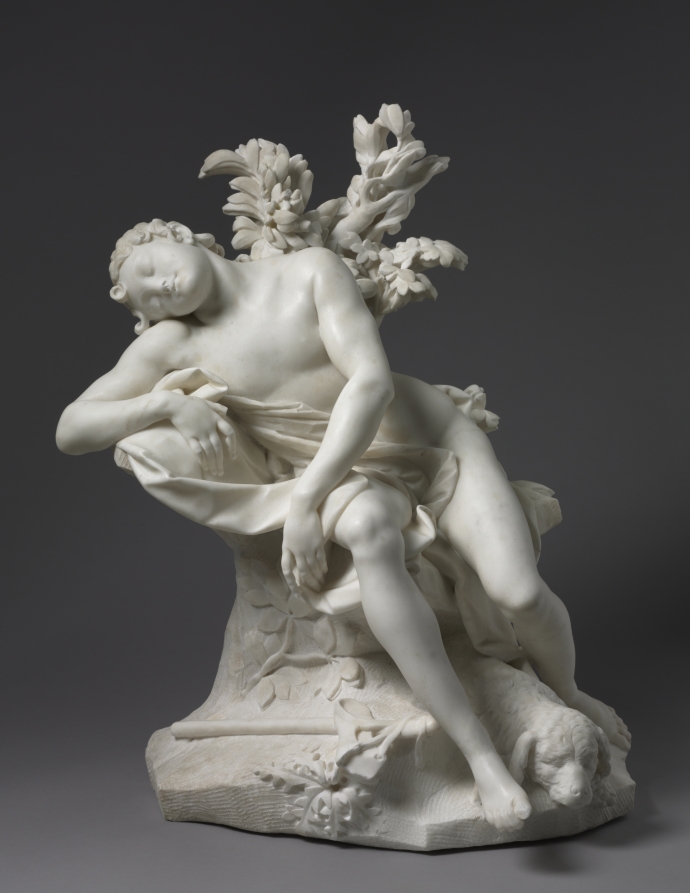
Executive Summary: The Dialectic of Concealment and Revelation in Urban Form
The subject of Sleeping Endymion—a mythological figure suspended between mortal slumber and divine immortality—serves as the conceptual anchor for this urban silhouette research. The DNA source, drawn from the dialectical tension between the “emptiness” (空) of spirit and the “fullness” (满) of material form in Eastern aesthetics, provides a rigorous framework for deconstructing the 2026 NYC executive wardrobe. Specifically, the juxtaposition of the “Udumbara Flower” plaque (a Zen artifact of linguistic concealment) and the “Divine Beasts, Chariot, and White Tiger Mirror” (a Tang-dynasty bronze of maximalist iconography) reveals a profound operational principle: the most potent form of presence is achieved through strategic absence, and the most articulate expression of power is rendered through disciplined restraint.
For the Addison Fashion client—a senior executive navigating the vertical power structures of Manhattan—this translates into a silhouette that does not shout but resonates. The 2026 wardrobe must embody the “hidden flower” of the Udumbara plaque: a form that refuses literal depiction, instead allowing the wearer’s own presence to complete the meaning. Simultaneously, it must harness the “sacred order” of the Tang mirror: a closed, self-referential system of precise lines and controlled volume that projects authority without aggression. The result is a Minimalist silhouette in Onyx—a color that absorbs light rather than reflecting it, functioning as a visual void that demands attention through its very refusal to compete.
I. Form as Concealment: The Udumbara Principle
A. The Silhouette of the Unseen
The Udumbara plaque’s genius lies in its “以言破相”—using language to break the image. It does not depict the flower; it invokes it through absence. In tailoring, this translates to a silhouette that withholds rather than displays. The 2026 executive jacket, therefore, abandons the aggressive shoulder padding and nipped waist of traditional power dressing. Instead, it adopts a slightly dropped shoulder and a straight, columnar torso—a form that suggests the body beneath without delineating it. The lapel is reduced to a narrow, notched line, almost a scar, rather than a broad statement. This is not a jacket that announces; it is a jacket that invites inquiry.
The fabric itself becomes the medium of concealment. A double-faced wool crepe in Onyx—a black so deep it borders on charcoal—is chosen for its matte, light-absorbing finish. Unlike a glossy surface that reflects the viewer’s gaze back, this texture swallows light, creating a zone of visual silence. The garment’s seams are invisible, fused rather than stitched, eliminating any trace of construction. The wearer becomes a moving void, a presence defined by what it does not reveal. This is the urban equivalent of the plaque’s “静默中的澄明” (clarity in silence): the executive’s authority is not in the cut of the cloth, but in the negative space the cloth creates around the body.
B. The Trousers as Conceptual Sign
Where the jacket conceals, the trousers must anchor. The Udumbara principle demands that the lower half of the silhouette function as a signifier of stability rather than movement. The 2026 trouser is cut with a high, extended waistband (3.5 inches) and a straight, almost rigid leg that falls to a slight break at the instep. There is no taper, no flare—only a vertical line that mimics the calligraphic stroke of the plaque’s characters. The fabric is a worsted wool with a subtle herringbone weave, visible only under direct light, echoing the “wood grain” of the plaque’s materiality. The pocketing is besom, flush to the surface, with no flap or welt to disrupt the plane. The trouser is a column of text, a silent proclamation of order.
The color Onyx is critical here. It is not black, which can read as aggressive or funereal, but a deep, mineral gray-black that recalls polished stone. It is the color of the void before creation—a neutral ground that allows the wearer’s actions, not their attire, to define the moment. In the context of the Udumbara, the trouser is the “文字符号” (written symbol) that the executive’s presence must complete.
II. Form as Revelation: The Tang Mirror Principle
A. The Structured Interior
If the Udumbara governs the exterior, the Tang mirror governs the interior architecture of the garment. The mirror’s “以满为显” (revelation through fullness) is not about outward ornamentation, but about internal precision. The 2026 jacket, while minimal in appearance, is constructed with a full canvas chest piece and floating lining—a hidden system of stays and interlinings that create a rigid, sculptural shell. This is the “sacred order” of the mirror: a closed system of high-relief structure that supports the outer form without being visible. The shoulder is built with a pagoda-style sleeve head, a subtle roll that mimics the “御车” (chariot) of the mirror’s central motif—a point of tension that propels the silhouette forward.
The lining itself is a silk charmeuse in a deep, burnished gold—the only concession to color. This is the “黄铜在打磨后熠熠生辉” (the gleam of polished brass) of the mirror, a hidden flash of light that the wearer alone feels against the skin. It is a private reminder of the “神圣庇护” (sacred protection) the garment provides. The executive, like the mirror’s owner, knows that true power is not displayed but internalized.
B. The Vest as a Closed System
A third piece—a sleeveless vest—is introduced as a direct reference to the mirror’s “闭合的、充满动势的符码系统” (closed, dynamic symbolic system). Cut from the same Onyx wool, the vest is fully lined and structured, with a high, stand collar that encases the neck. Its front is unadorned, with a single, hidden button closure at the sternum. The back, however, features a vertical seam that echoes the “白虎” (White Tiger) stripe—a subtle, almost imperceptible line of matte black piping. This is the only decorative element, and it is visible only when the wearer turns away. The vest functions as the “神兽” (divine beast) of the ensemble: a guardian of the core, a symbol of “肃杀与守护” (sternness and protection). It is the dense, closed system that contains the executive’s energy, preventing it from dissipating into the urban chaos.
III. Color as Void and Vessel
A. Onyx as the Ultimate Neutral
The choice of Onyx is not arbitrary. It is the color that best embodies the dialectic of the two artifacts. Like the Udumbara plaque’s “木为质” (wooden substance), Onyx is a material color—it does not float or shimmer, but sits heavily. It is the color of absorbed light, of the void that contains all potential. In the urban context, Onyx functions as a visual anchor, a base from which all other colors in the wardrobe (Ivory, Silver, Sand) must derive their meaning. It is the “空” (emptiness) that allows the “满” (fullness) of the wearer’s presence to emerge.
B. The Monochromatic System
The entire ensemble—jacket, trousers, vest—is rendered in a single shade of Onyx. This is not a “suit” in the traditional sense, but a monolithic form. The lack of contrast between pieces eliminates the eye’s ability to parse the body into segments. The executive becomes a continuous vertical mass, a “白虎镜” of human scale. The only variation is in texture: the jacket’s matte crepe, the trouser’s subtle herringbone, the vest’s smooth worsted. These are the “起伏的纹样” (undulating patterns) of the mirror, visible only to the discerning eye. The color system is self-referential, a closed loop of power through restraint.
IV. Conclusion: The Endymion Synthesis
The Sleeping Endymion, caught between wakefulness and dream, is the perfect metaphor for the 2026 executive. The wardrobe must not wake the wearer into the noise of the city, but suspend them in a state of controlled potential. The Udumbara plaque teaches us that the most powerful form is the one that withholds its meaning, allowing the viewer to complete it. The Tang mirror teaches us that the most sacred order is the one that is invisible to the casual observer, but felt by the initiated.
The Minimalist silhouette in Onyx is the synthesis of these two principles. It is a form that conceals to reveal, a color that absorbs to project. For the NYC executive, it is not a uniform, but a v