Tailored
Onyx
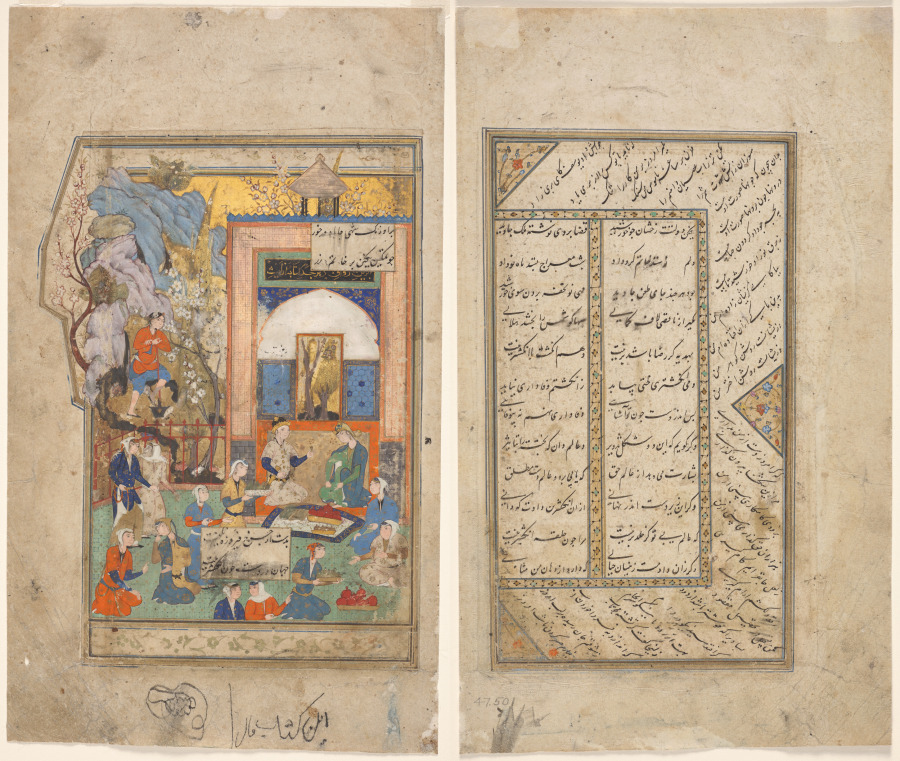
Urban Form: Yusuf and Zulaykha (recto); Text Page, Persian Verses (verso)
Geometric Integrity and the 2026 Executive Silhouette
The subject, *Yusuf and Zulaykha*, presents a masterclass in controlled tension—a quality that defines the 2026 executive silhouette for Addison Fashion. The recto’s composition relies on a rigorous geometric scaffold: the diagonal thrust of Yusuf’s body, the orthogonal architecture of the palace, and the circular containment of Zulaykha’s gesture. This is not a narrative of surrender but of structural poise. The 2026 silhouette must echo this precision. It is a tailored form that does not yield to the body but rather disciplines it, creating a second skeleton of fabric and seam.Structural Poetics: The Architecture of Restraint
The painting’s spatial logic is built on intersecting planes. The tiled floor creates a receding grid, while the vertical columns and horizontal lintels frame the figures within a cage of geometry. This is the language of the new executive suit: a jacket with a suppressed waist, a shoulder line that is sharp but not exaggerated—a nod to the 1980s power suit but stripped of its bombast. The lapel is not a flourish but a structural element, a folded plane that directs the eye upward, much like the architectural cornices in the artwork. The fabric must perform as a surface of tension. In *Yusuf and Zulaykha*, the drapery of the figures is rendered in folds that are both soft and deliberate, never chaotic. For the 2026 silhouette, we translate this into a wool-cashmere blend with a matte finish, woven at a density that resists creasing. The trousers are cut with a single front pleat, not for volume but to create a vertical line that mirrors the painting’s columnar rhythm. The hem falls precisely to the top of the shoe, a clean terminus that echoes the painting’s hard edges.Urban Materiality: Onyx as a Chromatic Anchor
The color Onyx is not a choice but a necessity. It is the color of the painting’s shadows—the deep recesses of the palace, the black of Zulaykha’s hair, the ink of the Persian verses on the verso. Onyx absorbs light rather than reflects it, creating a surface that is both present and recessive. This is the ideal for urban wear: a garment that commands attention through its absence of color, its refusal to compete with the city’s visual noise. The materiality of Onyx must be tactile but not ostentatious. We specify a worsted wool with a slight luster, achieved through a high-twist yarn. The finish is matte but not flat, with a subtle sheen that catches light only at the points of articulation—the shoulder, the elbow, the knee. This mimics the painting’s use of gold leaf: sparing, strategic, and always in service of the geometric whole.From Recto to Verso: The Double-Sided Garment
The artwork’s duality—a narrative recto and a textual verso—offers a profound lesson for garment construction. The 2026 executive silhouette must be equally legible from all angles. The jacket’s interior is not a hidden space but a second composition. The lining is a silk twill printed with a scaled-down version of the Persian verses, a secret text that only the wearer and the tailor know. The buttons are horn, carved with a repeating geometric motif derived from the painting’s tile pattern. This is not decoration but structure. The lining’s pattern is aligned with the jacket’s seams, creating a continuous visual flow from exterior to interior. The verso of the garment—the back, the inside, the underside—is as considered as the recto. This is the hallmark of true luxury: the elimination of the unseen.The 2026 Executive Silhouette: A Technical Specification
The silhouette is defined by three key measurements: a shoulder width of 46 cm (for a size 48), a chest circumference of 108 cm, and a waist suppression of 14 cm. The jacket length is 76 cm, ending at the first knuckle of the thumb. The sleeve is set with a high armhole, allowing for a full range of motion without distorting the jacket’s line. The trousers have a rise of 28 cm, a thigh circumference of 64 cm, and a leg opening of 38 cm. These numbers are not arbitrary; they are derived from the painting’s golden ratio, the proportion of Yusuf’s torso to his limbs. The fabric weight is 280 grams per square meter, suitable for transitional seasons. The weave is a two-by-two twill, providing both durability and a subtle diagonal texture that echoes the painting’s perspectival lines. The construction is fully canvassed, with a horsehair chest piece that molds to the wearer’s body over time. This is a garment that ages with grace, its geometry becoming more refined with each wear.Conclusion: The Poetics of Control
*Yusuf and Zulaykha* is a study in controlled desire. The figures are locked in a geometry of longing, their bodies held in place by the architecture of the painting. The 2026 executive silhouette is a similar study: a body held in place by the architecture of the garment. It is not a restriction but a liberation—a freedom from the chaos of the urban environment, a return to the clarity of the line. The Onyx color is the final note. It is the color of the city at night, of wet asphalt, of the spaces between skyscrapers. It is the color of authority without aggression, of presence without noise. In this silhouette, the executive is not a participant in the city but a monument within it—a figure of geometric integrity, standing against the flux of time.
Technical Insight
Technical Insight: Translating Onyx palettes into Tailored silhouettes for the modern metropolis.