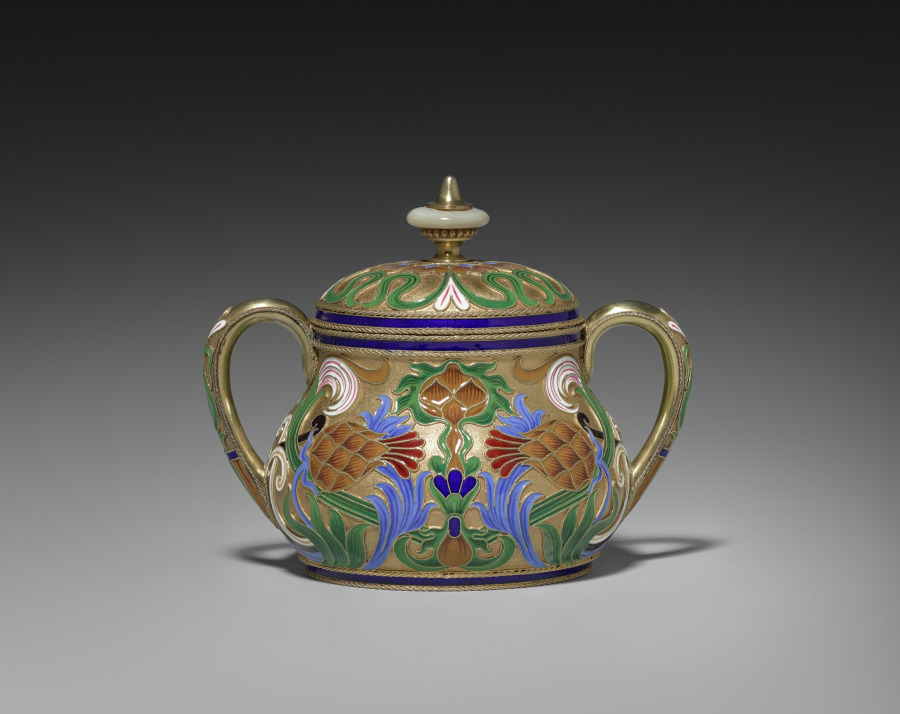
Urban Form: Covered Sugar Bowl
Executive Summary: The Sacred Geometry of the Everyday
The covered sugar bowl, in its most reductive form, is a study in containment and revelation. It is a domestic object, yes, but one that carries an inherent architectural tension: a lid that seals, a body that holds, and a void that defines the interior. For the 2026 NYC executive wardrobe, this object is not a source of literal inspiration, but a catalyst for a formal language. Drawing from the aesthetic DNA of the “Udumbara” Temple Plaque and the Han Dynasty Bronze Mirror, we deconstruct the sugar bowl not as a vessel for sugar, but as a sculptural proposition for the urban silhouette. The plaque’s logic of sublimated symmetry and the mirror’s compressed cosmic narrative converge in the bowl’s form: a minimal, self-contained universe.
I. Formal Deconstruction: The Vessel as a System of Tension
A. The Body: The Architecture of Containment
The sugar bowl’s body is a cylinder, a sphere, or a faceted prism. In its purest form—a smooth, unadorned cylinder—it embodies vertical compression and lateral stability. This is the slate-colored power sheath of the wardrobe: a jacket or a coat that defines the torso without clinging, creating a negative space between fabric and form. The Han mirror’s concentric logic is echoed here: the body of the bowl is the inner ring, the zone of the self. It must be structured, but not rigid. The fabric—a dense, matte wool or a technical crepe—should feel like cold, polished ceramic: impenetrable, yet with a subtle, internal warmth. The seamless construction is paramount. No lapels, no pockets, no visible closures. The garment is a monolithic volume, a single, uninterrupted surface that reads as a statement of absolute control.
B. The Lid: The Threshold of Revelation
The lid is the critical formal element. It is not a cap, but a counterpoint. A flat, flush lid suggests absolute closure—the executive who is unreadable, a cipher. A domed lid, however, introduces vertical aspiration. This is the shoulder line of the 2026 silhouette. The “Udumbara” plaque achieves its sacred quality through a central, elevated focal point—the lotus throne. The lid’s dome functions identically. It creates a crown, a subtle peak that draws the eye upward. In a jacket, this translates to a structured, slightly extended shoulder that is not aggressive, but architectural. The fabric is cut to stand away from the body, creating a void between the shoulder and the armhole. This is not a power shoulder of the 1980s; it is a spiritual shoulder, a nod to the sacred geometry of the temple plaque. The lid’s knob, if present, is the final punctuation—a small, precise detail, like a single, polished hematite button at the nape of the neck.
C. The Foot: The Grounding Element
The base of the sugar bowl is often a small, recessed foot. This is the hemline. It must be precise, clean, and weighty. A garment that floats without a defined base is a failure. The foot of the bowl anchors the object to the table; the hem of a coat or a skirt must anchor the silhouette to the ground. For the 2026 executive, this means a straight, unbroken line at the ankle or mid-calf. No fluting, no asymmetry. The fabric should fall with a dense, liquid weight, like mercury. This is the slate-colored column that grounds the entire composition. The Han mirror’s outer ring of geometric patterns is the equivalent of this hemline—a boundary that contains the chaos of the inner design.
II. Color and Material: The Palette of the Void
A. Slate: The Color of Compressed Time
Slate is not gray. Gray is a compromise. Slate is the color of wet stone, of storm clouds, of the patina on a Han bronze mirror. It is a non-color that absorbs light rather than reflecting it. In the context of the sugar bowl, slate is the color of the vessel itself—the neutral, silent container. For the wardrobe, slate is the primary field. It is the color of the power suit that does not shout, but commands through presence. It is the color of the void from which form emerges. The “Udumbara” plaque uses the absence of color (the natural wood grain) to suggest the infinite. Slate does the same. It is the background against which all other elements—texture, light, movement—are defined.
B. Material Logic: The Tactile Sublime
The sugar bowl is experienced through touch: the cool smoothness of porcelain, the slight resistance of a lid being lifted. The 2026 wardrobe must replicate this tactile hierarchy. The primary fabric is a double-faced wool or a heavyweight silk matte jersey—dense, with a micro-texture that is felt, not seen. This is the body of the bowl. The lining, however, is the interior void. It must be a shocking, hidden luxury: a flash of liquid silver or a deep, burnished onyx satin. This is the mirror’s reflective surface—the hidden world that is only revealed when the garment is opened. The seams are not sewn; they are bonded or fused, creating a continuous, seamless surface that mimics the ceramic unity of the bowl. The weight of the fabric is critical. It must have drape and structure simultaneously, like a liquid metal that has been poured into a mold.
III. The 2026 Silhouette: A Synthesis of Sacred and Secular
A. The “Udumbara” Jacket: A Study in Sublimated Symmetry
This is the centerpiece of the wardrobe. A single-breasted, cocoon-shaped jacket with a stand collar that rises to the nape of the neck. The shoulder is slightly extended and rounded, echoing the dome of the sugar bowl’s lid. The fabric is a slate double-faced wool, with a matte finish. There are no lapels, no buttons, no visible pockets. The closure is internal, magnetic. The jacket is a monolith, a sacred vessel that contains the body. The negative space between the fabric and the torso is the void of the bowl—the space of potential. This garment is not worn; it is inhabited.
B. The “Mirror” Pant: A Compressed Narrative of Motion
The pant is a wide-leg, high-waisted column that falls to the floor with a single, sharp break. The fabric is a slate wool crepe with a liquid, almost metallic sheen—a nod to the bronze mirror’s reflective surface. The waistband is hidden, seamless, creating a continuous line from hip to hem. The pant is devoid of pockets or belt loops. It is a pure cylinder, a vertical volume that elongates the figure. The movement of the fabric as the wearer walks is the only ornamentation—a fluid, kinetic sculpture. This is the outer ring of the mirror, the boundary that contains the energy of the body.
C. The “Void” Top: The Hidden Interior
Beneath the jacket, a high-neck, long-sleeve top in liquid silver silk charmeuse. This is the interior of the bowl, the hidden universe. The fabric is reflective, almost wet, catching the light in a way that the matte wool of the jacket does not. The top is cut on the bias, allowing it to drape and cling to the body like a second skin. This is the mirror’s surface—the thing that reveals, but only when the outer vessel is opened. The contrast between the opaque, matte slate of the jacket and the luminous, reflective silver of the top is the core aesthetic tension of the entire wardrobe. It is the dialectic between the sacred and the profane, the hidden and the revealed.
IV. Conclusion: The Object as a System of Power
The covered sugar bowl, in its minimalist perfection, is not a decorative object. It is a system of formal relationships: body to lid, interior to exterior, weight to void. The 2026 NYC executive wardrobe, as derived from this object, is a system of power expressed through silence, precision, and compression