Minimalist
Slate
Urban Form: Eighteen Views of Rome: The Piazza Farnese (recto)
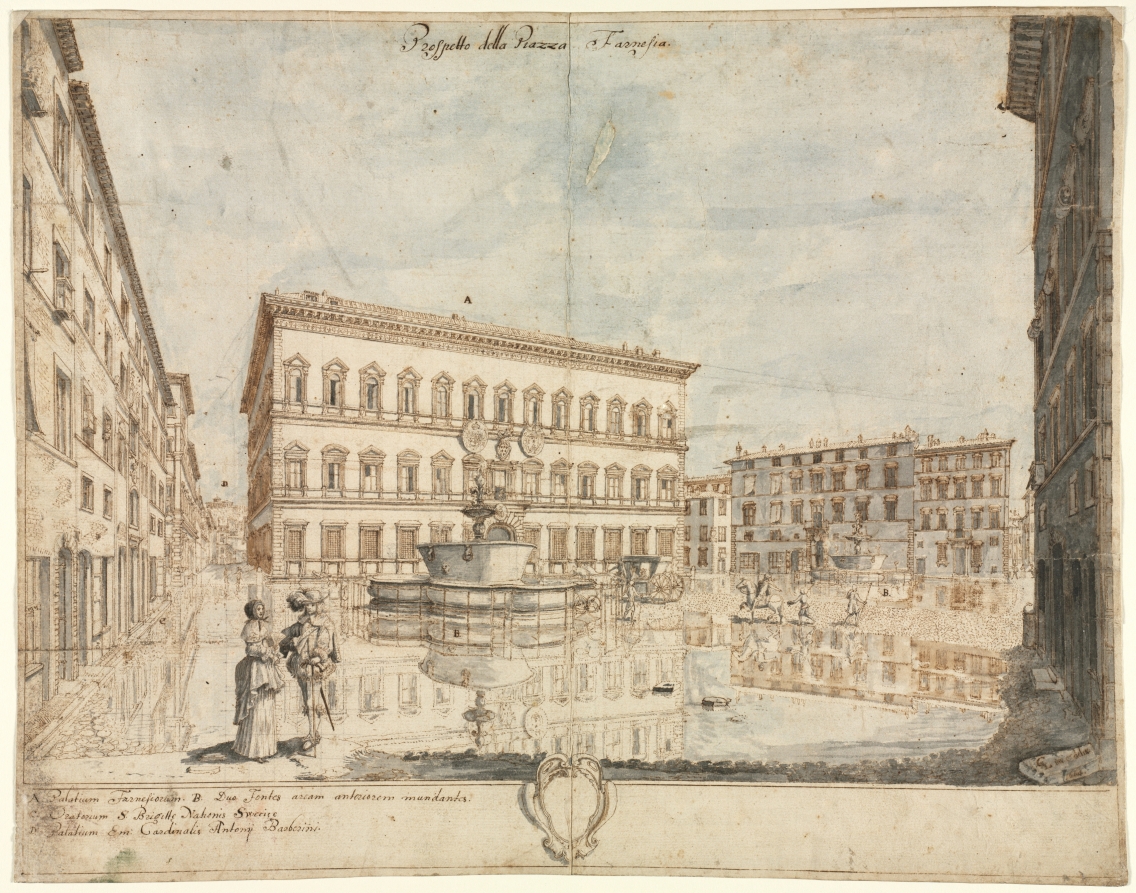
Geometric Integrity and the Architectural Frame
The recto of *Eighteen Views of Rome: The Piazza Farnese* presents a study in contained monumentality. The piazza’s defining feature—the twin granite basins from the Baths of Caracalla—establishes a dialogue between mass and void that is central to the 2026 executive silhouette. The basins are not merely decorative; they are geometric anchors. Their elliptical forms, rendered with precise axial symmetry, create a gravitational pull that organizes the entire visual field. This is not the soft, organic geometry of nature, but the cold, calculated geometry of urban planning. For the Addison Fashion silhouette, this translates into a structural poetics of the frame. The 2026 executive must embody a similar sense of anchored presence. The shoulders are not padded in the traditional sense; they are *architectural*. A tailored jacket’s shoulder line should mimic the clean, unyielding edge of the Farnese palace façade—a horizontal plane that declares authority without aggression. The silhouette is defined by a high, structured armhole that allows for a clean, uninterrupted line from the shoulder to the hem. The torso is a column, not a cylinder. It is shaped with subtle, internal darts that create a slight, almost imperceptible taper at the waist, echoing the verticality of the palace’s pilasters. This is not about constriction; it is about *definition*. The garment becomes a second skin of urban stone.Structural Poetics: The Void as Volume
The piazza’s power lies in its emptiness. The vast, open space is the true subject, not the buildings that enclose it. This is the core of minimalist luxury: the void is not an absence, but a presence. The 2026 silhouette must operate on this principle. Volume is not created by adding fabric, but by subtracting it, by carving space around the body. Consider the coat. A minimalist, floor-length overcoat in a dense, matte wool-silk blend. The fabric is heavy enough to hold its own shape, yet fluid enough to drape with a quiet, liquid grace. The silhouette is a modified A-line, but the flare is not achieved through goring or pleating. Instead, the coat is cut with a single, continuous seam from the shoulder to the hem, the fabric’s own weight creating a subtle, controlled bell shape. The front closure is a single, hidden placket—a clean, unbroken plane of slate grey. The collar is a high, standing band, a direct reference to the unadorned cornice line of the Farnese palace. The entire garment is a study in negative space. The body within is the void, and the coat is the architectural frame that defines it. This principle extends to the trouser. The 2026 executive trouser is not a wide leg, nor a skinny leg. It is a *straight leg* with a precise, architectural break. The fabric—a heavyweight, double-faced wool—is cut with a front crease that is pressed to a razor-sharp edge. The waistband is high and flat, with no belt loops. The closure is a concealed hook and bar. The trouser falls from the hip, not the waist, creating a long, uninterrupted line from the torso to the floor. The hem is clean, with no cuff, allowing the fabric to pool slightly over the shoe—a subtle, urban gesture of materiality.Urban Materiality: The Palette of Slate
The color Slate is not a neutral; it is a statement. It is the color of wet Roman cobblestones, of the patina on ancient bronze, of the sky before a storm. For the 2026 executive, Slate is the foundation. It is the primary color, not an accent. It is used in its purest form: a deep, matte, almost powdery grey that absorbs light rather than reflects it. The materiality of Slate is key. It must feel dense, substantial, and cool to the touch. Think of a 100% virgin wool suiting with a tight, felted finish. Or a cashmere-silk blend with a subtle, brushed surface that catches the light in a soft, diffused glow. The fabric must have *weight*. It must fall with a sense of purpose. This is not the flimsy, ephemeral fabric of fast fashion; it is the enduring, architectural fabric of a garment that will last a decade.Textural Contrast and the Urban Canvas
Within the monolithic Slate palette, textural contrast becomes the primary vehicle for visual interest. The piazza’s surfaces—smooth travertine, rough cobblestone, polished granite—offer a lesson in material dialogue. For the 2026 executive, this translates into a layering of textures within a single tonal range. A Slate-grey, double-breasted vest in a smooth, worsted wool is worn over a Slate-grey, high-neck top in a ribbed, micro-cashmere. The trousers are in a flat, matte wool, while the outer coat is in a slightly napped, brushed wool. The difference is subtle, almost imperceptible from a distance. But up close, the interplay of textures creates a rich, sophisticated visual experience. It is a study in restraint, a demonstration of the wearer’s refined eye. Accessories are minimal and architectural. A belt is a thin, flat strip of black matte leather with a brushed silver buckle—a single, clean line at the waist. The shoe is a lace-up Oxford in polished black calfskin, with a sleek, elongated toe and a low, stacked leather heel. The sole is thin and flat, echoing the clean lines of the piazza’s paving stones. There is no logo, no branding. The garment itself is the statement.Conclusion: The Executive as Urban Monument
The 2026 Addison Fashion executive silhouette, as derived from the geometric integrity of *Eighteen Views of Rome: The Piazza Farnese*, is not a trend. It is a return to first principles. It is a silhouette of containment, of power expressed through restraint, of presence defined by absence. The body is the void; the garment is the frame. The color is Slate, the material is urban, and the attitude is one of quiet, unassailable authority. This is the uniform for the executive who commands the room not by entering it, but by occupying it. The garment is a monument to the self, carved from the stone of the city.
Technical Insight
Technical Insight: Translating Slate palettes into Minimalist silhouettes for the modern metropolis.