Urban Form: Architecture of the Middle Ages: St. Andre, Antwerp
Structural Poetics: The Medieval Frame as Urban Armature
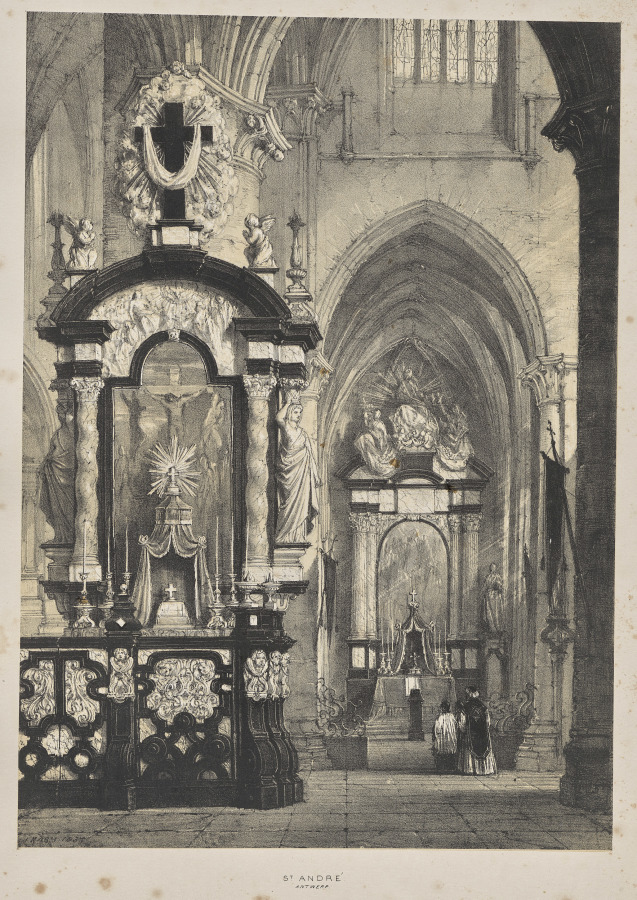
The architecture of St. Andre, Antwerp, presents a verticality that is at once severe and devotional. Its Gothic ribbed vaults and flying buttresses are not merely functional; they are a grammar of compression and release. For the 2026 executive silhouette, this translates into a rigorous vertical elongation that rejects superfluous volume. The medieval mason’s logic—where every stone bears weight and every line directs the eye upward—becomes the blueprint for a garment that disciplines the body into an architectural column. The silhouette is not draped; it is constructed. Shoulders are defined by a clean, slightly extended line, echoing the corbels that support the nave. The waist is not cinched but implied through a subtle inward sweep of the fabric, akin to the narrowing of a pier as it rises toward the vault. This is a silhouette of restrained power, where the body is a load-bearing element within the urban landscape.
Geometric Integrity: The Logic of the Pointed Arch
The pointed arch is the defining geometric motif of St. Andre. It is not a semicircle of passive support but an active, dynamic form that channels force into a single apex. In the 2026 executive silhouette, this geometry is internalized through sharp, angular seam lines that bisect the torso and limbs. A jacket’s lapel, for instance, does not curve gently; it cuts a precise, acute angle from the collarbone to the sternum. The hem of a coat is not straight but terminates in a subtle V-shape, mirroring the arch’s upward thrust. This is not ornamentation but structural poetics: every line is a vector of energy. The garment becomes a diagram of forces, with the wearer’s spine as the central axis. The result is a silhouette that feels both grounded and ascendant, a paradox of heavy stone and soaring light.
Urban Materiality: Onyx as the New Black
The color Onyx is not a mere shade; it is a material condition. It absorbs light rather than reflecting it, creating a surface that is deep, monolithic, and impenetrable. This aligns with the urban materiality of the 2026 executive: a professional who navigates glass-and-steel canyons requires a garment that offers visual and psychological armor. Onyx, in this context, is the color of authority without aggression. It is the negative space of the city at night, the shadow between skyscrapers. The fabric must be dense—a double-faced wool or a compacted microfiber—to achieve a matte, almost mineral finish. This is not the glossy black of evening wear but the matte black of basalt, of the cathedral’s dark interior after the candles are extinguished. The garment’s surface should feel like a wall: smooth, cold, and unyielding to the touch.
The Dialectic of Stasis and Motion
Drawing from the internal DNA of the research—the tension between the static “优昙花” temple plaque and the dynamic Han bronze mirror—the St. Andre silhouette must embody a similar dialectic. The garment’s structure is static, like the plaque’s eternalized bloom: a fixed, architectural form that resists time. Yet the wearer’s movement introduces motion, like the galloping chariots on the mirror’s surface. The fabric is cut with a slight asymmetry in the hem or a hidden pleat at the shoulder, so that when the executive walks, the garment shifts and folds in a controlled, almost choreographed manner. The Onyx color deepens this effect: in motion, the fabric catches ambient light, revealing subtle tonal variations that are invisible at rest. This is the urban poetics of the commute—a body in transit, framed by a garment that is both a shelter and a statement.
Minimalist Luxury: The Absence of Decoration
There are no buttons, zippers, or pockets visible on the primary surface. All closures are hidden within the seams, preserving the monolithic integrity of the silhouette. This is not austerity but extreme refinement. The luxury lies in the precision of the cut, the weight of the fabric, the exactness of the shoulder seam. The garment is a negative space that the wearer fills. It is the architectural equivalent of a blank wall in a cathedral—not empty, but pregnant with potential. The only “decoration” is the play of light across the Onyx surface, which shifts from deep charcoal to near-black depending on the angle. This is a minimalism of intention, where every absence is a presence.
Conclusion: The Silhouette as Urban Relic
The St. Andre executive silhouette for 2026 is not a trend but a typology. It is the garment as a fragment of medieval architecture, translated into the language of urban professionalism. The pointed arch becomes the lapel; the ribbed vault becomes the seamed sleeve; the Onyx color becomes the stone itself. This is a silhouette for the executive who understands that power is not expressed through volume but through structural clarity. It is a garment that does not follow the body but frames it, turning the wearer into a living column of authority. In a city of glass and steel, this silhouette offers the permanence of stone—a quiet, immovable presence in the flow of time.