Minimalist
Ivory
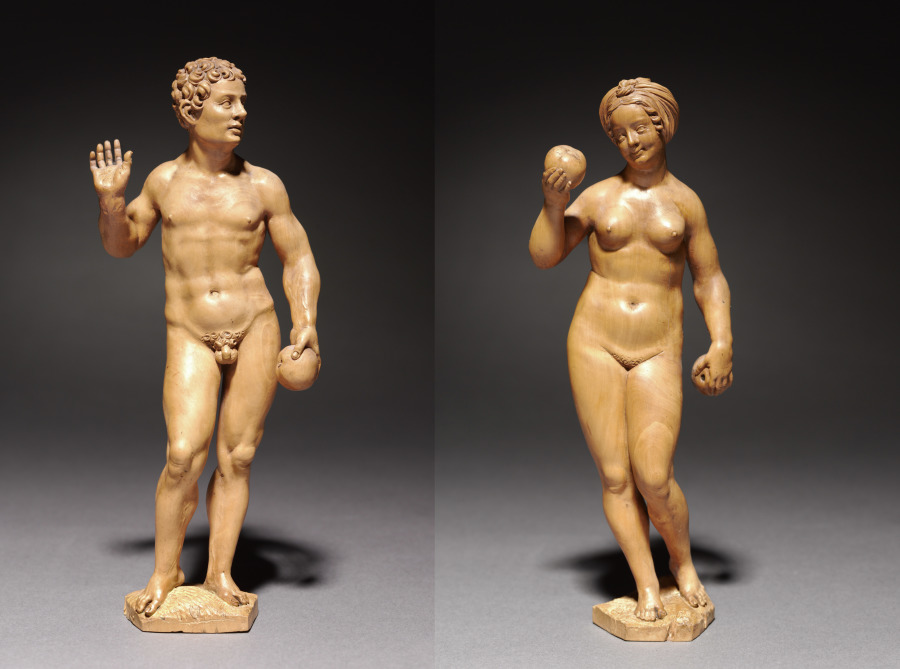
Urban Form: Adam and Eve (pair of statuettes)
Geometric Integrity as a Structural Mandate
The pairing of Johannes Vermeer’s *A Maid Asleep* and George Caleb Bingham’s *A Vignette of Life on the Frontier* presents a singular thesis for the 2026 executive silhouette: that form must emerge from the tension between stasis and latent motion. Both works, separated by centuries and continents, operate within a rigorous geometric framework that does not suppress the organic but rather contains it. For Addison Fashion, this translates into a silhouette defined by controlled volume, precise axial alignment, and a material vocabulary that echoes the quiet monumentality of these painted interiors and exteriors.The Vermeerian Axis: Vertical Restraint and Horizontal Drift
In *A Maid Asleep*, the compositional spine is a network of vertical and horizontal lines—the doorframe, the table edge, the picture frame—that anchor the sleeping figure. The woman’s slumped posture is an anomaly within this grid, a soft diagonal that suggests surrender. Yet the grid does not break; it holds. This is the core of the 2026 executive silhouette: a body that is structured by clean, unbroken lines at the shoulder, waist, and hem, while the fabric itself is allowed to drape, fold, or pool in a manner that implies a momentary lapse in discipline. The aesthetic principle here is *controlled release*. The jacket should feature a sharp, architectural shoulder—a horizontal line that mirrors the table’s edge in Vermeer’s composition. The lapel should be narrow and elongated, creating a vertical axis that draws the eye downward, much like the light falling from the window onto the maid’s face. The trousers or skirt must maintain a straight, columnar fall, but with a subtle break at the ankle or a single, deliberate pleat that introduces a diagonal counterpoint. This is not chaos; it is a calculated deviation that humanizes the grid. The palette of Ivory is essential. It is not a pure white but a weathered, bone-like tone that absorbs light rather than reflects it. This mimics the soft, diffused illumination in Vermeer’s interior—a light that does not glare but settles. In urban materiality, this translates to a double-faced wool or a matte silk crepe that holds its shape without stiffness. The fabric must feel substantial yet breathable, like the air in a 17th-century Dutch room: still, but alive with the possibility of a sigh.The Bingham Horizon: Horizontal Banding and Monumental Stillness
Bingham’s frontier scene operates on a different axis: the horizontal. The riverbank, the boat, and the figures are arranged in a frieze-like band across the canvas. There is no single focal point; the eye moves laterally, scanning the ensemble. This is the second structural principle for the 2026 silhouette: *lateral expansion without weight*. The executive silhouette must not be narrow or constricted; it must have a presence that extends outward, but only through the careful stacking of horizontal planes. Consider a coat or a long vest that falls to the knee, with a hem that is perfectly parallel to the ground. The shoulders are broad but not padded—they are cut in a single, seamless line from the collar to the sleeve head, creating a continuous horizontal plane. The waist is not cinched but allowed to exist as a subtle indentation within the overall rectangle. This is the Bingham effect: a body that is part of a larger landscape, not a solitary figure. The silhouette becomes a container for the urban environment, absorbing its rhythms without being disrupted by them. The color Sand would be a logical alternative, but Ivory is superior here because it retains a sense of interiority. Bingham’s frontier is raw, but his composition is classical. The Ivory tone bridges the gap between the domestic and the monumental. It is the color of unbleached linen, of parchment, of the light that falls on a river at dawn. In fabric, this means a heavy linen-cotton blend or a compacted wool that has a slight tooth, a tactile resistance that speaks to the frontier’s roughness while maintaining the painter’s refined order.Structural Poetics: The Edge as a Site of Transition
Both paintings are about edges—the edge of sleep, the edge of civilization. The 2026 executive silhouette must treat the body’s edges with the same precision. The collar should be a clean, sharp line that defines the neck without choking it. The cuff should be a distinct band that separates the hand from the sleeve, like the frame separating the maid from the viewer. The hem should be a deliberate terminus, not a frayed afterthought. This is where urban materiality becomes critical. The fabric must be able to hold a crease, a fold, a seam that is as sharp as a painter’s brushstroke. A double-faced wool allows for a raw edge that does not unravel, creating a line that is both finished and unfinished—a paradox that echoes the “between” state of both artworks. The interior of the garment should be as considered as the exterior, with exposed seams and minimal lining, so that the structure is visible, like the grid of Vermeer’s room or the horizon line of Bingham’s river.Conclusion: The Silhouette as a Mirror of the In-Between
The 2026 executive silhouette for Addison Fashion is not a statement of power in the traditional sense. It is a statement of *presence through absence*. It does not shout; it holds. It is a rectangle that contains a diagonal, a horizontal band that implies a landscape, a color that absorbs light rather than reflecting it. This is the legacy of Vermeer and Bingham: the ability to find order in the ordinary, monumentality in the marginal, and poetry in the pause. The garment becomes a second skin that is both armor and invitation. It protects the wearer from the chaos of the urban frontier while allowing for the momentary drift—the diagonal of a hand in a pocket, the break of a trouser leg over a shoe. In this, the silhouette is not merely worn; it is inhabited. And in that inhabitation, the wearer becomes both the maid and the boatman, suspended in a timeless moment of quiet, controlled grace.
Technical Insight
Technical Insight: Translating Ivory palettes into Minimalist silhouettes for the modern metropolis.