Fluid
Slate
Urban Form: Women worshiping a Shiva linga: Devagandhari Ragini of Hindol Raga, from a Ragamala
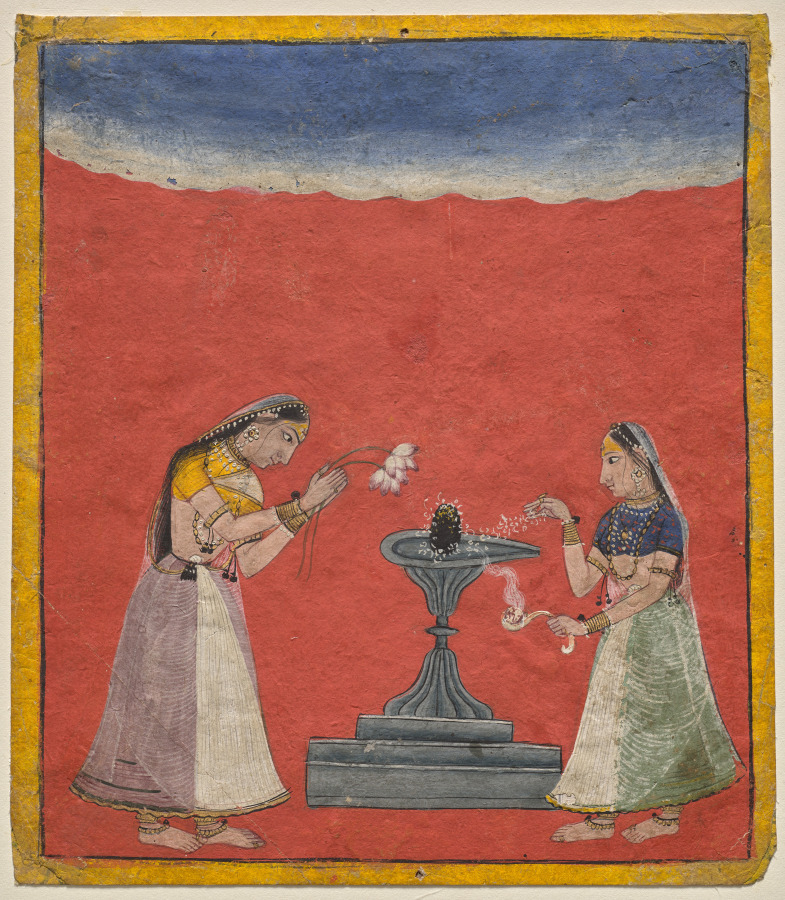
Technical Analysis: The Devagandhari Ragini as a Blueprint for Urban Poetics
The subject—a woman worshiping a Shiva linga, rendered in the Devagandhari Ragini of Hindol Raga—presents a paradox of stillness and kinetic devotion. For the 2026 NYC executive wardrobe, this Ragamala miniature offers a radical re-reading of form: not as structure, but as a vessel for spiritual and temporal flow. The analysis below deconstructs the painting’s formal language—its silhouette, color, and spatial logic—to derive a technical lexicon for modern, minimalist womenswear.I. Silhouette as Sacred Geometry: The Fluid Architecture of Devotion
The central figure, the woman, is not defined by rigid tailoring but by a cascading, almost liquid silhouette. Her *ghagra* (skirt) and *odhni* (veil) are rendered as continuous, unbroken planes of color—a deep, muted slate blue—that drape from the shoulder to the ground. This is not a garment that clings; it is a garment that *moves* with the body’s devotion. The form is fundamentally fluid, rejecting the sharp, angular lines of Western power dressing in favor of a volumetric, gravity-defying softness. From a technical standpoint, this silhouette is achieved through three key principles: - **Uninterrupted Verticality:** The fabric falls in a single, unbroken line from the shoulder to the hem. There are no waist seams, no darts, no structural interruptions. This creates a visual column of color, elongating the figure and emphasizing a quiet, meditative presence. - **Asymmetrical Drape:** The *odhni* is not symmetrically placed. It falls over one shoulder, creating a diagonal tension that counterbalances the verticality of the skirt. This asymmetry introduces a subtle, kinetic energy—a suggestion of movement within stillness. For the executive wardrobe, this translates to a single-shoulder top or a draped, one-sleeve jacket. - **Negative Space as Form:** The space between the woman’s body and the Shiva linga is not empty; it is a charged void. The fabric of her garment does not touch the linga, creating a halo of negative space around the object of worship. This is a critical lesson in modern silhouette: the garment must not merely cover the body, but must create a deliberate, architectural distance between the wearer and the environment. Think of a wide-leg trouser that floats an inch above the shoe, or a cape that never touches the arm. The result is a silhouette that is both monumental and ephemeral. It commands space without aggression, suggesting a power derived from inner stillness rather than external assertion. This is the antithesis of the 1980s power suit. It is a 2026 power *presence*.II. Color as Cosmic Code: The Slate Spectrum of Devotion
The color palette of the Devagandhari Ragini is deliberately restrained, dominated by a single, complex hue: a deep, mineral Slate. This is not a flat gray. It is a living color, shifting between blue, gray, and green depending on the light. In the painting, the woman’s garment is a cool, almost indigo slate, while the linga itself is a warmer, charcoal slate. The background is a pale, dusty slate. This monochromatic approach is not a limitation but a sophisticated strategy for creating depth and hierarchy. For the 2026 executive wardrobe, we translate this into a tonal layering system: - **Base Layer (Deep Slate):** The foundational piece—a high-neck, long-sleeve knit or a silk shell—in the darkest slate. This anchors the look, providing a visual weight and grounding the silhouette. - **Mid Layer (Mid Slate):** The primary garment—a fluid, wide-leg trouser or a draped midi skirt—in a medium slate. This is the volume, the movement, the core of the silhouette. - **Accent Layer (Pale Slate):** The outer layer—a lightweight, unstructured coat or a shawl—in a pale, dusty slate. This introduces a subtle gradient, creating a sense of depth and atmosphere. It is the “air” around the form. The critical insight from the Ragamala is that color is not decorative; it is structural. The slate spectrum here functions as a visual architecture, guiding the eye through the composition. The absence of high-contrast colors (no red, no gold, no white) forces the viewer to focus on the interplay of light and shadow, texture and drape. This is a color strategy for the executive who does not need to shout. Her presence is felt through the density of her tonal field.III. The Urban Poetics of Devotion: Translating Ritual into Wardrobe
The woman in the painting is not performing a public act. She is in a private, devotional space. This intimacy is key to the urban poetics of the 2026 wardrobe. The executive’s uniform must function as a portable sanctuary—a space of personal focus and ritual within the chaos of the city. The formal translation is threefold: - **The “Linga” as Core:** The Shiva linga, a smooth, cylindrical form, represents the axis of the composition. In the wardrobe, this is the central seam or the vertical closure. A center-front seam on a coat, a hidden zipper on a dress, or a single, long line of buttons. This vertical axis is the spine of the garment, providing a point of stillness and order around which the fluid fabric moves. - **The “Worship” as Gesture:** The woman’s gesture—her hands joined in *anjali mudra*—is a form of controlled asymmetry. One hand is slightly higher than the other, creating a subtle, asymmetrical line. This translates to a single, oversized pocket on a coat, a diagonal seam across a bodice, or a single, long sleeve that extends beyond the wrist. These are not random details; they are deliberate, asymmetrical gestures that break the symmetry of the silhouette, introducing a human, devotional element. - **The “Raga” as Rhythm:** A Raga is a melodic framework for improvisation. Similarly, the wardrobe is a system of fixed forms (the silhouette, the color) within which the wearer can improvise. The fluidity of the fabric allows for constant, subtle shifts in shape. A scarf can be draped differently. A coat can be worn open or closed. The garment is not a static object; it is a score for daily performance.IV. Conclusion: The 2026 Executive as a Devotee of Form
The Devagandhari Ragini is not a literal source for a print or a silhouette. It is a formal algorithm. It teaches us that power in the 2026 NYC wardrobe is not about sharp shoulders or aggressive tailoring. It is about controlled fluidity, tonal depth, and asymmetrical gesture. The woman in the painting does not demand attention. She *commands* it through her stillness, her focus, and her absolute command of her own form. The Addison Fashion 2026 collection will be a series of such forms: Slate-toned, fluid, and architectural. Garments that are not worn, but *inhabited*. They are the urban devotee’s uniform—a quiet, powerful, and deeply personal expression of presence in a city that never stops moving.
Technical Insight
NYC Perspective: Translating Slate tones into Fluid silhouettes.