Urban Form: War Club ('U'u)
Geometric Integrity of the War Club (‘U’u) as a Silhouette Archetype
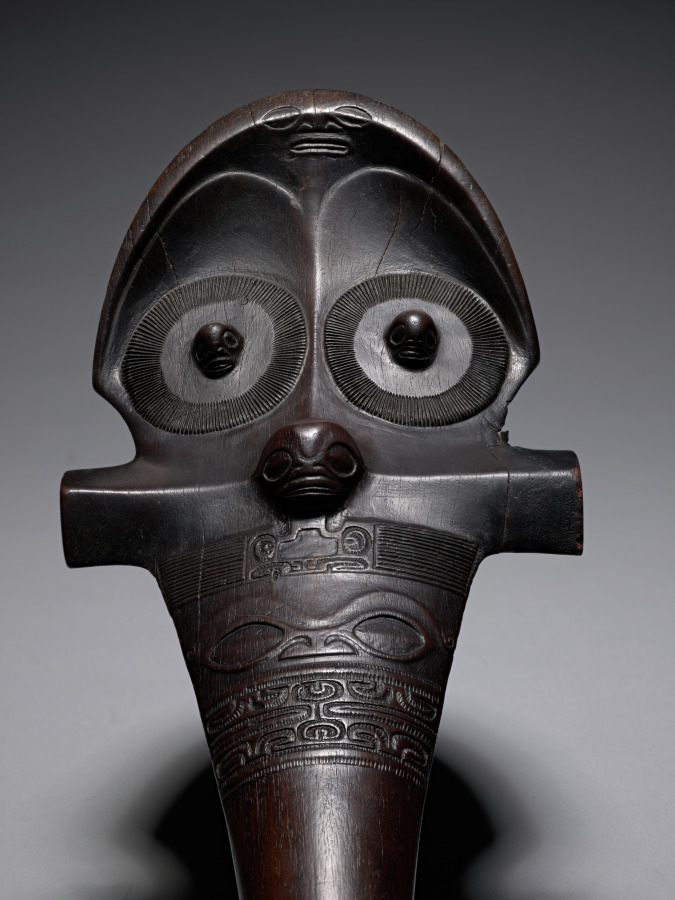
The War Club, or ‘U’u, from the Marquesas Islands, presents a paradox of form: a weapon of brutal function rendered with the geometric precision of a ceremonial object. Its defining characteristic is the vertical axis of power—a long, rigid shaft that terminates in a broad, flared head. This is not a silhouette of organic growth but of controlled expansion. The club’s head widens with a deliberate, almost architectural logic, creating a trapezoidal or fan-shaped volume that counterbalances the linear thrust of the handle. For the 2026 executive silhouette, this translates into a structural poetics of the shoulder: a sharp, extended shoulder line that projects outward from a narrow, compressed torso. The ‘U’u’s geometry demands a garment that is axial and grounded, where the upper body becomes a monument to restraint and the lower body remains a clean, uninterrupted column.
Structural Poetics: The Dialectic of Compression and Release
The internal DNA of the ‘U’u is a study in tension and release. The shaft is a zone of pure compression—a narrow, unadorned length that channels energy upward. The head is the zone of release, where the form explodes into a broad, often carved surface. This is not a gentle curve but a hard, angular break. In the 2026 executive silhouette, this manifests as a structured jacket with a defined waist and a dramatic, sculpted shoulder. The shoulder pad is not a soft insert but a geometric extension of the garment’s architecture, cut from a single piece of fabric or constructed with a rigid interfacing to mimic the club’s flared terminus. The sleeve is set into the armhole with a clean, sharp seam, eliminating any drape or gather. The result is a silhouette that is static yet poised, like the club held at rest—a form that suggests immense potential energy without any visible movement.
The urban materiality of this silhouette is critical. The ‘U’u’s surface is often carved with intricate, repetitive motifs—tiki figures or geometric patterns—that add texture without disrupting the overall shape. For the executive wardrobe, this translates into fabric as armor. We select a double-faced wool crepe in Onyx, a color that absorbs light and flattens volume, emphasizing the silhouette’s hard edges. The fabric is not soft; it has a dry, crisp hand that holds a crease and resists draping. Alternatively, a bonded neoprene or a stiffened cotton sateen can achieve the same effect, creating a shell that stands away from the body. The interior construction is equally important: the jacket is fully canvassed with a horsehair chest piece that extends into the shoulder, ensuring the form remains rigid and does not collapse under its own weight. This is not a garment that moves with the body; it is a garment that defines the body’s space.
Urban Materiality: The Language of Hard Surfaces and Controlled Light
The ‘U’u’s aesthetic is one of hard surfaces and controlled light. The polished wood of the club catches light in sharp highlights, while the carved recesses create deep shadows. This chiaroscuro effect is essential to the 2026 executive silhouette. The Onyx color choice is not arbitrary; it is a strategic darkness that allows the silhouette’s geometry to be read as pure form, unmediated by color distraction. The fabric’s surface must be matte or semi-matte, with a subtle texture that catches light only at the edges of the garment’s construction—the shoulder seam, the lapel roll, the hemline. We avoid any sheen or reflective finish, as this would soften the silhouette’s hard lines. The urban context demands a material that can withstand the city’s abrasive surfaces: the fabric is tightly woven, resistant to pilling, and treated for water repellency. It is a material that endures, like the club itself.
The pants that complete this silhouette are a direct response to the ‘U’u’s shaft. They are a straight-leg, high-waisted trouser with no break at the hem. The waistband is cut wide and flat, sitting at the natural waist to create a continuous line from the jacket’s hem to the floor. The fabric is the same Onyx wool crepe, but with a slightly softer hand to allow for movement. The leg is cut with a negative ease through the hip and thigh, tapering to a narrow ankle. This creates a vertical compression that mirrors the club’s shaft, grounding the silhouette and preventing the broad shoulder from appearing top-heavy. The overall effect is one of controlled verticality: the eye moves from the wide, powerful shoulder down the narrow, uninterrupted line of the body, ending at the shoe—a simple, unadorned Oxford in matte black leather.
Conclusion: The 2026 Executive as a Monument of Restraint
The War Club (‘U’u) is not a weapon of chaos but of ceremonial order. Its geometric integrity lies in the absolute clarity of its parts: a shaft and a head, a line and a plane. The 2026 executive silhouette, derived from this artifact, is a monument to restraint. It rejects the fluidity of the organic body in favor of a constructed, architectural form. The broad shoulder is not an expression of power but of structural necessity—a counterbalance to the vertical thrust of the body. The Onyx color is not a choice of mood but of material logic, absorbing light to emphasize form. This is a silhouette for the executive who understands that presence is not about movement but about stillness, that the most powerful statement is one of controlled geometry. In the urban landscape of 2026, this silhouette stands as a fixed point, a reference of order in a world of flux.