Urban Form: Composition with Red, Yellow, and Blue
Geometric Integrity as Structural Poetics
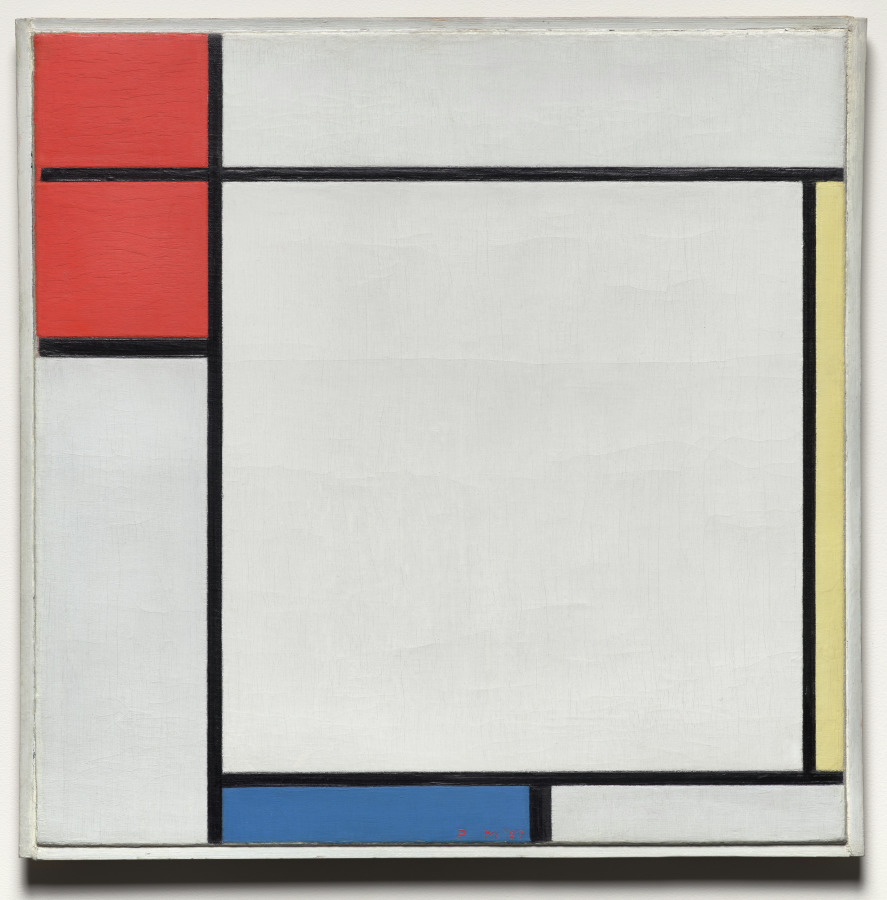
The artwork Composition with Red, Yellow, and Blue by Piet Mondrian operates on a principle of absolute geometric reduction: a grid of black lines partitioning a white field into asymmetrical rectangles, with primary colors occupying select zones. For the 2026 executive silhouette, this is not merely a visual reference but a structural manifesto. The painting’s integrity lies in its refusal of ornament—every line is a boundary, every color block a volume. This translates directly into garment architecture: the silhouette must be built from discrete, planar elements that intersect without overlap, creating a visual tension between containment and release.
The Mondrian grid imposes a hierarchy of proportions. The largest white rectangle anchors the composition, while smaller red, yellow, and blue fields act as counterweights. In tailoring, this becomes the asymmetric paneling of a double-breasted jacket—the left side cut in slate wool, the right side in a matte black, with a single seam running vertically from shoulder to hem. The color blocks are not decorative; they are load-bearing. The red panel, for instance, is positioned at the hip to visually shorten the torso, while the blue square near the collarbone elongates the neck. This is structural poetics: geometry as a tool for reshaping the human form into an abstract composition.
Urban Materiality: The Slate Palette
The chosen color, Slate, is a direct response to Mondrian’s black-and-white foundation. Slate is not gray; it is a compressed darkness that holds the memory of stone and rain. In urban environments, slate absorbs light rather than reflects it, creating a matte, non-reflective surface that aligns with the painting’s flatness. For the 2026 executive, this materiality is critical: the suit must appear as a single, monolithic volume—a building facade in miniature. We achieve this through heavyweight wool crepe with a tight weave, finished with a satin-less edge (no lapel shine, no button luster). The buttons are oxidized steel, flush-set into the fabric to preserve the planar surface.
The urban context demands functional austerity. The slate palette is punctuated by primary color accents—a red silk lining inside the jacket, a yellow grosgrain trim on the trouser hem, a blue leather tab on the interior pocket. These are not visible in static posture; they are revealed only through movement—when the executive sits, the red lining flashes; when they walk, the yellow hem catches light. This is urban materiality at its most sophisticated: color as a secret, not a statement.
The 2026 Executive Silhouette: Asymmetric Planar Construction
The silhouette is Minimalist by classification, but it is a minimalism of extreme precision. The jacket is cut with a single-button closure placed off-center, mimicking the painting’s asymmetrical grid. The shoulder is squared but unpadded, relying on the fabric’s own stiffness to hold the line. The sleeve is set in at a 90-degree angle to the body, creating a sharp, architectural break at the armhole. The trousers are straight-leg, high-waisted, with a front crease that aligns exactly with the jacket’s vertical seam. The overall effect is a vertical elongation punctuated by horizontal color blocks—a red panel at the hip, a blue panel at the collarbone, a yellow panel at the hem.
This is not a suit for the boardroom; it is a suit for the urban landscape as gallery. The executive who wears it becomes a walking Mondrian—a composition of planes and lines that interacts with the city’s own grid of windows, streets, and shadows. The structural poetics lie in the tension between the garment’s static geometry and the wearer’s dynamic movement. When the arm lifts, the red panel shifts; when the leg bends, the yellow hem disappears. The silhouette is never fixed; it is perpetually re-composing itself against the urban backdrop.
Technical Execution: Seams, Weights, and Tensions
To achieve this, the garment must be constructed with architectural rigor. The seams are flat-felled and exposed, rendered in a contrasting black thread that echoes Mondrian’s black lines. Each seam is a boundary—a line that separates one color field from another. The weight of the fabric is critical: too light, and the panels will drape; too heavy, and they will bulge. We specify a 380-gram wool for the body, with a double-layer construction in the color-blocked areas to maintain flatness. The lining is silk charmeuse in the accent colors, but it is unattached at the hem to allow the outer shell to remain rigid.
The tension points are the shoulders and hips, where the color blocks meet. Here, we use a hidden stay of horsehair canvas to prevent the fabric from buckling. The result is a garment that feels armored—not in weight, but in structure. The executive experiences the suit as a second skin of geometry, a constant reminder of the painting’s discipline. This is urban materiality at its most refined: the suit as a portable architecture, a fragment of the city’s own grid.
Conclusion: The Silent Geometry of Power
The 2026 executive silhouette, derived from Composition with Red, Yellow, and Blue, is a study in controlled asymmetry. It rejects the softness of draped fabrics and the chaos of pattern in favor of pure, planar form. The slate palette grounds the garment in the urban landscape, while the primary color accents inject moments of quiet intensity. This is not a suit for the timid; it is a suit for the executive who understands that power is not in volume, but in precision. The Mondrian grid is not a pattern to be printed; it is a structural philosophy to be worn.