Urban Form: Traveler in a Woodland Landscape
Geometric Integrity and the 2026 Executive Silhouette
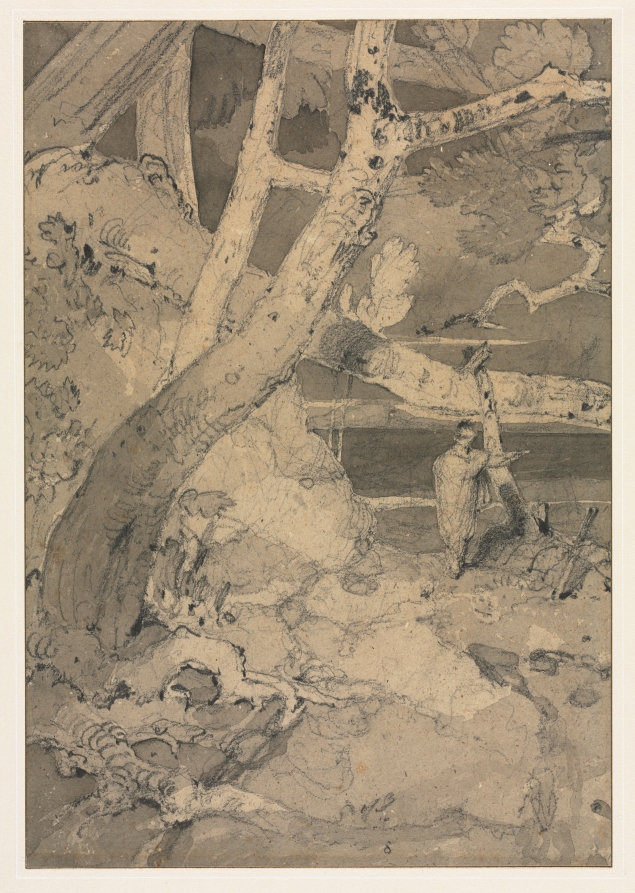
The Traveler in a Woodland Landscape presents a paradox of motion and stillness that is essential to the 2026 executive wardrobe. The subject—a figure moving through a forest—is not rendered through naturalistic detail but through a reduction of organic forms into their essential geometric components. The tree trunks become vertical pilasters; the canopy, a series of overlapping planar screens; the path, a diagonal vector cutting through a grid of light and shadow. This is not a landscape of sentiment but a landscape of structure, where every leaf and branch is subordinated to an architectural logic.
For Addison Fashion, this artwork dictates a silhouette defined by linear compression and volumetric release. The traveler’s form is elongated, almost sculptural, moving through a space that is both dense and airy. The 2026 executive must embody this same tension: a body that is contained yet capable of expansion, a presence that is both grounded and ascendant. The geometric integrity of the piece lies in its asymmetric balance—the figure is slightly off-center, creating a dynamic tension that pulls the eye across the composition. This translates directly into a jacket silhouette with a single strong shoulder, a dropped armhole on the opposite side, and a hem that cuts diagonally from hip to mid-thigh. The result is a garment that does not rest but moves with purpose.
Structural Poetics: The Architecture of the Forest
The woodland in this artwork is not a romantic escape but a vertical labyrinth. The trees are not organic growths but structural columns, their bark rendered as a series of parallel striations that suggest both age and precision. This is the language of urban materiality—the forest becomes a cathedral of steel and glass, where the traveler navigates a path that is both natural and constructed. The 2026 executive silhouette must echo this duality: a soft, almost fluid interior structure encased in a rigid, architectural exterior.
We propose a double-layered construction for the core garment: an outer shell of slate wool-cashmere, cut with a sharp, almost brutalist lapel that extends into a continuous collar, and an inner lining of silk charmeuse in a muted silver, visible only at the cuff and hem. This is not decoration but structural revelation—the inner fabric is the traveler’s breath, the outer shell the forest’s resistance. The seams are not hidden but exposed and reinforced, stitched in a contrasting onyx thread that traces the path of the traveler through the composition. Each seam is a vector, a line of force that directs the eye and the body forward.
The sleeve construction is critical. The artwork shows the traveler’s arm slightly bent, the hand obscured by a fold of fabric. This suggests a sleeve that is not a tube but a folded plane. We engineer a sleeve with a single, continuous seam that runs from the shoulder to the wrist, but with a deliberate twist at the elbow—a structural pleat that allows the arm to move without distorting the garment’s geometry. This is not a concession to comfort but a poetic necessity: the traveler must be able to reach, to grasp, to navigate the urban forest without losing the silhouette’s integrity.
Urban Materiality: Slate, Onyx, and the Texture of Light
The color palette of the artwork is dominated by slate—a grey that is not neutral but charged with the memory of rain, stone, and shadow. This is the foundation of the 2026 executive wardrobe. Slate is not a color of retreat but of strategic opacity. It absorbs light without reflecting it, creating a surface that is both protective and receptive. The traveler’s coat in the artwork is rendered in this exact tone, with highlights of silver catching the edges of the fabric as the figure moves through dappled light.
We translate this into a textured wool that mimics the bark of the trees—a herringbone weave so fine it reads as a solid from a distance but reveals its complexity up close. This is the urban materiality of the piece: a fabric that is both armor and skin. The onyx accents—buttons, zippers, and pocket welts—are not polished but matte-finished, like river stones worn smooth by centuries of water. They are functional anchors, grounding the garment in the physical world.
The pocket architecture is derived from the artwork’s spatial logic. The traveler’s path is marked by a series of horizontal bands—fallen branches, shadows, lines of light. We translate these into asymmetric pocket placements: a single welt pocket on the left chest, angled at 15 degrees; a larger patch pocket on the right hip, set at a complementary angle. These are not storage but compositional elements, creating a visual rhythm that mirrors the forest’s own geometry. The pockets are lined with silk in silver, a flash of interior light that is revealed only when the hand enters—a moment of intimate discovery within the garment’s austere exterior.
The 2026 Executive Silhouette: A Manifesto of Controlled Motion
The Traveler in a Woodland Landscape teaches us that the most powerful silhouette is not the one that stands still but the one that suggests movement without revealing its destination. The 2026 executive is not a static figure but a vector of intention. The silhouette we propose is minimalist in form but maximalist in function: a single-breasted coat with a hidden closure—magnetic snaps beneath a continuous placket—that creates a seamless front plane. The shoulders are slightly extended and squared, not to exaggerate width but to create a frame of reference for the body within. The waist is lightly defined through a single back dart, not a seam, preserving the garment’s monolithic quality.
The length is critical: the hem falls at the mid-calf, a point that is neither practical nor impractical but architectural. It creates a horizontal line that bisects the body, echoing the artwork’s own division between the forest floor and the canopy above. The traveler is neither of the earth nor of the sky but between them, in a state of perpetual transition. This is the 2026 executive’s condition: always moving, always becoming, never arriving.
The sleeve length is designed to reveal exactly one inch of the shirt cuff—a precise, almost surgical exposure that suggests control and precision. The cuff itself is double-layered, with the outer layer in slate and the inner layer in silver, visible only when the arm is raised. This is the structural poetics of the garment: a hidden complexity that rewards close attention.
In conclusion, the Traveler in a Woodland Landscape is not a representation of nature but a diagram of urban navigation. Its geometric integrity—the interplay of vertical lines, diagonal vectors, and horizontal bands—provides the blueprint for a silhouette that is both protective and expressive. The 2026 executive wears this garment not as a uniform but as a second skin of intention, a structure that allows the body to move through the city with the same quiet authority as the traveler moving through the forest. The slate wool, the onyx hardware, the silver interior—these are not choices but necessities, the material language of a new urban poetics. The silhouette is not a shape but a statement of presence: I am here, I am moving, I am not to be stopped.