Urban Form: Sleeping Endymion
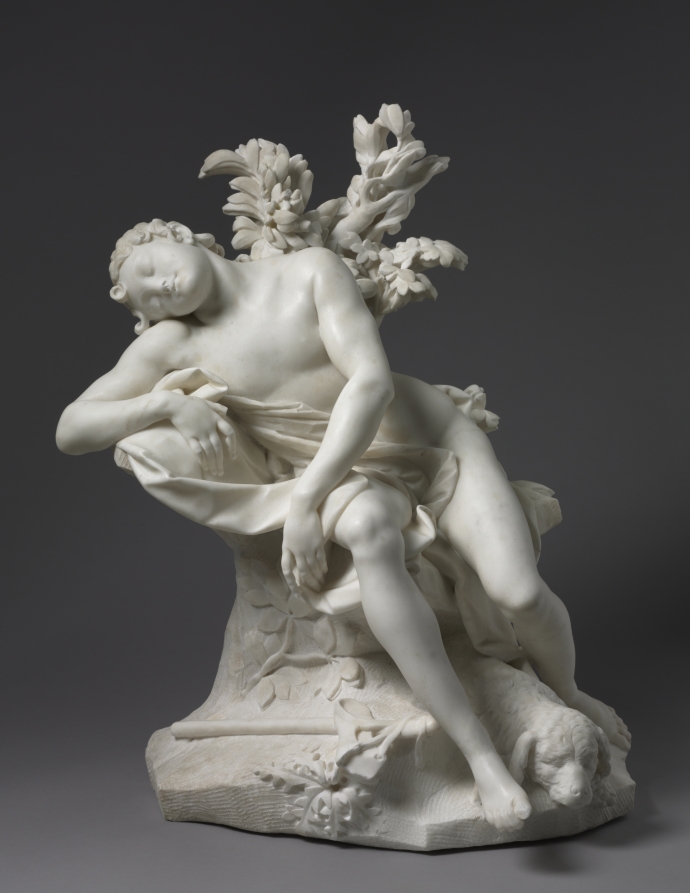
Geometric Integrity and the Architecture of Suspended Time
The subject of Sleeping Endymion, when filtered through the internal DNA of 器物《The Death of Socrates》 and 《The Hunt》, presents a paradox of stillness and velocity that defines the 2026 executive silhouette. The former, a still-life lexicon of philosophical expiration, operates through a geometry of compression and weight. The latter, a dynamic narrative of predatory finality, employs a geometry of tension and release. For Addison Fashion, the synthesis of these opposing forces yields an oversized silhouette that does not drape, but rather occupies space as a volumetric statement. The garment becomes a vessel for the interval between the poisoned cup and the drawn bow—a frozen moment of maximal existential pressure.
Structural Poetics: The Static as a Container for the Dynamic
In 《The Death of Socrates》, the compositional geometry is defined by orthogonal lines and recessive planes. The philosopher’s reclining form creates a diagonal that anchors the scene, while the cup, the scrolls, and the folded drapery form a series of hard-edged, rectilinear blocks. This is a geometry of terminal stillness—every angle is a conclusion. The 2026 executive silhouette translates this through broad, unbroken shoulder lines that extend beyond the natural frame, creating a horizontal datum. The fabric, a dense Onyx wool-cashmere blend, is cut with minimal seam articulation, allowing the material to fall in a single, uninflected plane from shoulder to hem. This is not a garment that moves with the body; it is a fixed architectural volume that the body inhabits. The collar is a high, sculpted stand, referencing the rigid neckline of the philosopher’s chiton, while the sleeves are cut with a deliberate, exaggerated width, terminating in a clean, un-cuffed edge. The effect is one of monumental pause—the garment as a reliquary for the wearer’s own suspended gesture.
Conversely, 《The Hunt》 introduces a geometry of asymmetry and centrifugal force. The diagonal of the hunter’s bow, the curve of the leaping hound, and the foreshortened perspective of the prey create a dynamic triangulation. Here, the silhouette must capture the imminence of release without collapsing into literal motion. The solution is a single, dramatic shoulder drape that is pinned at the clavicle, allowing a cascade of fabric to fall asymmetrically across the torso. This creates a tension line that mimics the drawn bowstring—a visual vector pointing toward an unseen target. The hem is sculpted into a sharp, angular point at the back, echoing the arrow’s trajectory. The Onyx fabric is treated with a matte, almost chalky finish, absorbing light rather than reflecting it, to emphasize the gravitational pull of the form. The garment does not flutter; it cuts through space with a deliberate, predatory stillness.
Urban Materiality: The Dialectic of the Cup and the Arrow
The material language of the 2026 silhouette is a direct response to the aesthetic paradox identified in the internal DNA. The still-life death of Socrates demands a fabric that can hold its shape as a solid, like the ceramic of the poison cup. The action-death of the hunt requires a fabric that can register tension and potential energy, like the sinew of the bow. The chosen material is a double-faced Onyx wool: one side is a tight, felted surface that resists drape and maintains a crisp, architectural edge; the reverse is a looser, brushed surface that introduces a subtle, directional nap, creating a visual texture of motion when the wearer turns. This dual nature allows the garment to function as both object and vector.
Construction techniques are minimalist in execution but maximalist in effect. Seams are felled and turned inward, creating a clean, almost invisible join that does not interrupt the surface. The only visible hardware is a single, oxidized silver clasp at the shoulder drape—a nod to the cold, metallic gleam of the bow tip and the tarnished edge of the cup. Pockets are eliminated; the silhouette must remain unbroken. The weight of the garment is concentrated at the shoulders and the back, creating a forward-leaning posture that is both authoritative and contemplative. This is not a garment for passive observation; it is a wearable architecture of decision, designed for the executive who navigates the city as a field of imminent action.
The Silhouette as a Temporal Device
The ultimate achievement of this research is the creation of a silhouette that contains both the cup and the arrow—the aftermath and the premonition. The oversized form does not signify excess; it signifies occupancy of the interval. The wearer is not caught in the static of Socrates’ final gesture, nor in the rush of the hunter’s release, but in the charged space between them. The Onyx color, a deep, non-reflective black, functions as a visual void that absorbs all narrative, leaving only the pure geometry of the form. This is the definitive urban silhouette for 2026: a monument to the suspended moment, where death is neither witnessed nor chased, but worn as a structural principle.