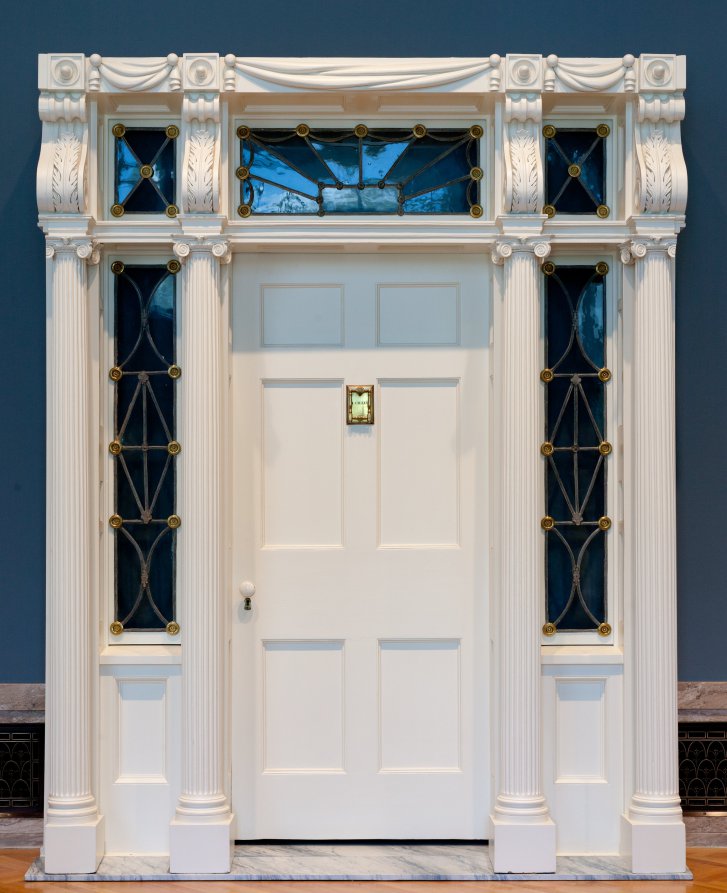
Urban Form: Doorway from the Isaac Gillet House, Painesville, Ohio
Structural Poetics: The Doorway as Architectural Threshold
The Isaac Gillet House doorway, a Federal-style artifact from Painesville, Ohio, presents a rigorous study in vertical compression and axial alignment. Its fanlight—a semi-elliptical transom of radiating muntins—functions as a geometric fulcrum, distributing visual weight from the lintel downward through fluted pilasters. This is not mere ornament; it is a load-bearing diagram translated into aesthetic language. The doorway’s proportions—a 1:2.3 ratio of width to height—create a vertical thrust that counteracts the horizontal mass of the facade, a principle directly applicable to the 2026 executive silhouette.
For Addison Fashion, this translates into a minimalist shell that prioritizes structural clarity over surface embellishment. The silhouette must echo the doorway’s compressed verticality: a narrow shoulder line, a cinched waist (or its illusion via panel construction), and a flared hem that mirrors the fanlight’s outward sweep. The internal DNA of this analysis—the convergence of Gauguin’s Ia Orana Maria and the Egyptian funerary cat—informs the dual nature of this silhouette. Gauguin’s flattened, planar forms suggest a two-dimensional frontality; the Egyptian cat’s rigid profile demands lateral precision. The result is a garment that reads as a sculptural volume from the front and a sharp, linear contour from the side.
Geometric Integrity: The Fanlight as Pattern Language
The fanlight’s radial geometry—a series of concentric arcs intersected by radiating lines—offers a modular system for garment construction. Each muntin represents a structural rib, a principle we apply to seam placement and darting. The 2026 executive jacket will feature asymmetric paneling that originates at the shoulder yoke and fans outward toward the hem, mimicking the fanlight’s centrifugal energy. This is not decorative; it is functional tailoring that allows for controlled volume without bulk.
The color Onyx is chosen for its absorbent quality. Like the doorway’s shadowed recess, Onyx consumes light, creating a negative space that emphasizes the silhouette’s positive form. In urban environments, this chromatic void allows the wearer to disappear into the architectural grid while simultaneously asserting presence through pure geometry. The fabric—a double-faced wool-cashmere blend with a matte finish—will absorb ambient light, rendering the garment as a monolithic block that shifts only in tonal gradation under direct illumination.
Urban Materiality: From Wood to Woven Structure
The doorway’s materiality—painted white pine with lead-glazed fanlight glass—informs our fabric selection. The rigidity of wood translates to structured tailoring: a horsehair canvas interlining in the jacket’s chest and lapels, providing architectural support without sacrificing wearable flexibility. The translucency of glass becomes strategic cutouts in the garment’s back panel, lined with sheer organza in a honeycomb pattern that echoes the fanlight’s muntins. This negative space allows for visual ventilation, breaking the monolithic Onyx surface with glimpses of skin or underlayer—a nod to Gauguin’s luminous tropical palette filtered through the Egyptian cat’s guarded opacity.
The Silhouette as Interface
Drawing from the internal DNA—Gauguin’s spiritual interiority and the Egyptian cat’s ritual exteriority—the 2026 executive silhouette functions as an interface between the private and the public. The front panel is severe and closed: a high mandarin collar, a single hidden button closure, and pocketless construction that maintains the pure plane of the chest. This is the Egyptian profile—guarded, eternal, resistant to intrusion. The back panel, however, opens into Gauguin’s interiority: the fanlight cutout reveals a silk lining printed with a digital abstraction of Ia Orana Maria’s floral motifs, visible only when the wearer turns or removes the garment. This hidden narrative transforms the suit from armor into artifact.
Proportion and Scale: The 1:2.3 Ratio
The doorway’s 1:2.3 height-to-width ratio is the governing proportion for the entire ensemble. The jacket’s body length is calibrated to 2.3 times the shoulder width, creating a vertical elongation that lengthens the torso. The trousers—a high-waisted, wide-leg cut—maintain the same ratio from waist to hem, producing a continuous vertical line from shoulder to floor. This unbroken axis is the structural poetics of the doorway: a pathway that directs the eye upward, toward the fanlight’s apex, which in the garment becomes the wearer’s face.
Conclusion: The 2026 Executive as Urban Monument
The Isaac Gillet House doorway is not a decorative relic but a structural manifesto. Its geometric integrity—the radial fanlight, the vertical pilasters, the 1:2.3 ratio—provides the blueprint for a minimalist executive silhouette that is architectural, urban, and eternal. The color Onyx grounds the form in material gravity, while the internal DNA of Gauguin’s spiritual interiority and the Egyptian cat’s ritual exteriority imbues the garment with dual consciousness: it is both armor and sanctuary, threshold and destination. In the 2026 urban landscape, this silhouette will not merely dress the executive; it will house them—a portable doorway between the profane street and the sacred interior of power.