Urban Form: Seated Male Figure
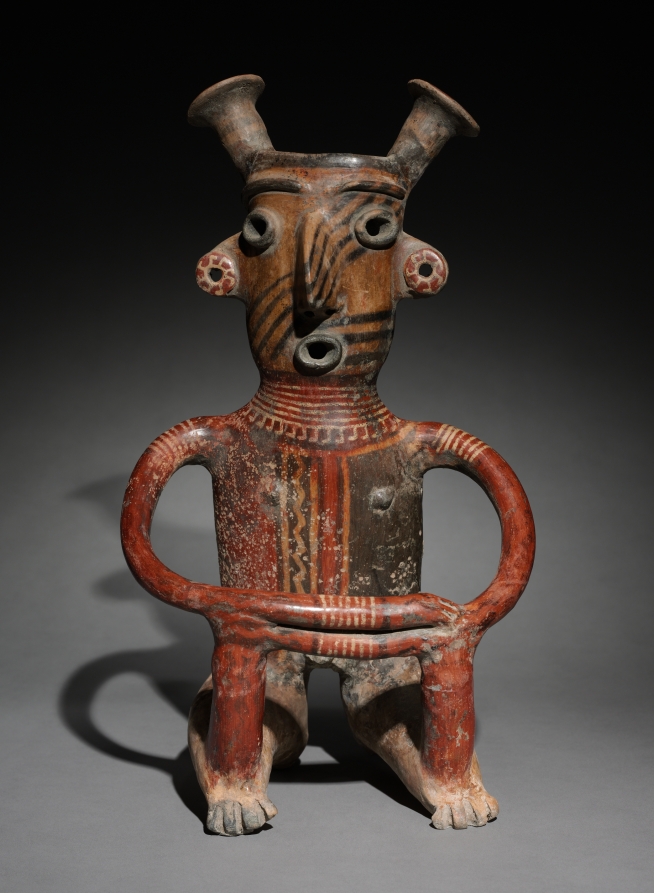
Geometric Integrity of the Seated Male Figure
The seated male figure, as recontextualized within the Addison Fashion Urban Silhouette Research for 2026, presents a radical departure from kinetic or vertical form. Its primary architectural value lies in the compression of mass and the articulation of stillness. Unlike the standing figure, which implies motion and aspiration, the seated form is a study in containment. The geometry is defined by a series of horizontal planes—the seat, the thighs, the shoulders—interrupted by a single, dominant vertical axis: the spine. This creates a cruciform tension that is both meditative and authoritative.
The internal DNA of the Bodhisattva and the Amulet in the Form of a Seated Figure with Bovine Head provides the critical lens. The Bodhisattva’s “寂静威仪” (serene majesty) is achieved through a perfect, almost mathematical equilibrium of volumes. The torso is a truncated cone, the shoulders a broad, stable arch, and the head a sphere of perfect equipoise. This is not a passive geometry; it is a structural poetics of presence. The bovine-headed amulet, conversely, introduces a hybridized tension. The animal head, a symbol of raw force and chthonic power, sits atop a human, meditative torso. The geometric integrity here is one of disruption and synthesis—a sharp, angular mass (the bovine cranium) juxtaposed against the smooth, rounded volume of the seated form. For the 2026 executive silhouette, this duality is paramount: the garment must contain both the serene authority of the Bodhisattva and the primal, protective power of the amulet.
Structural Poetics: From Sacred Geometry to Urban Armor
The Bodhisattva Principle: The Architecture of Stillness
The Bodhisattva’s seated posture dictates a minimalist, monolithic silhouette. The garment must not disrupt the pure, unbroken line from shoulder to seat. We are looking at a single, continuous volume—a coat or a tunic that falls with absolute precision, creating a negative space around the body that is as important as the fabric itself. The “微垂的眼帘” (slightly lowered eyelids) translate into a soft, inward-facing collar that shields the neck and draws the eye to the center of the chest. The “手势(印相)” (mudras) become structural seams—sharp, deliberate lines that bisect the fabric, suggesting a hidden, internal logic. The fabric itself must be a solid, unyielding material—a heavy, matte wool or a dense, non-reflective technical weave—to mimic the stone or bronze of the original sculpture. The color Onyx is chosen for its ability to absorb light, creating a void-like presence that emphasizes the form’s pure geometry.
The Bovine Principle: The Architecture of Protection
The bovine-headed amulet introduces a hard, protective exoskeleton. The “牛首” (bovine head) is not a literal hood but a structural motif: a sharp, angular shoulder yoke or a high, rigid collar that frames the head like a carapace. This element must be sculptural and aggressive, a clear departure from the softness of the Bodhisattva. The “结跏趺坐” (cross-legged seated posture) of the amulet suggests a compressed, grounded base. For the executive silhouette, this translates into a wide, stable hemline—a coat that flares slightly at the bottom, anchoring the figure to the ground. The hybrid nature of the amulet demands a dialectic of materials: the soft, flowing fabric of the Bodhisattva’s robe is now armored with panels of rigid, structured leather or a high-density polymer. The seams become exoskeletal joints, visible and functional, suggesting a garment that is both a second skin and a fortress.
Urban Materiality: The 2026 Executive Silhouette
The final silhouette for the 2026 executive is a synthesis of these two sacred geometries. It is a Minimalist Armor—a garment that is both a meditation on form and a tool for power. The primary silhouette is a long, structured coat that falls to the mid-calf, with a severe, straight shoulder and a high, mandarin-like collar. The fabric is a double-faced Onyx wool, heavy enough to hold its shape without internal stiffening. The structural poetics are embedded in the cut: the back is a single, unbroken panel, evoking the Bodhisattva’s unperturbed spine. The front, however, is bisected by a sharp, diagonal seam that runs from the right shoulder to the left hip, a direct reference to the bovine amulet’s hybridized form. This seam is not merely decorative; it is a functional articulation, allowing the wearer to move with the contained power of the seated figure.
The urban materiality is defined by a cold, tactile precision. The Onyx wool is paired with matte, gunmetal hardware—snap closures that are large, flat, and industrial, like the rivets on a piece of architectural steel. The interior is lined with a raw, unbleached silk, a nod to the “衣饰璎珞” (ornaments and garlands) of the Bodhisattva, but rendered in a minimalist, functional manner. The overall effect is one of severe elegance—a garment that does not flatter the body but houses it, transforming the wearer into a living sculpture. This is not a silhouette for movement; it is a silhouette for presence. It is the uniform for the executive who commands by stillness, whose authority is as solid and unyielding as the stone from which the Bodhisattva was carved. The geometric integrity of the seated male figure, filtered through the dual lenses of sacred serenity and protective hybridity, yields a silhouette that is both a return to pure form and a radical statement of urban power.